



Last updated: November 20, 2026
Quick answer: in most cases, a face mask packaging seal break should be treated as a contamination risk if you cannot explain it, especially when the seal is torn, lifted, punctured, or partially reclosed. A broken face mask packaging seal does not always mean the mask is contaminated, but it does mean the package lost the protection the seal was meant to provide. If the seal is torn, lifted, punctured, or opened in transit, consider it higher risk and, if you are unsure, discard it or consult a pharmacist, manufacturer, or other qualified professional.
Key takeaways
- A seal is a barrier and a warning sign at the same time.
- Not every split in packaging means contamination, but every break weakens confidence in the contents.
- Clean tears are not the same as crushed foil, lifted tape, or missing tamper-evident bands.
- If you cannot explain the break with normal handling, the safer choice is to throw the mask away.
- For the bigger picture on at-home care, this page fits under the hub on face mask safety and maintenance.
- For related storage guidance, see how to store face masks.
What does a face mask packaging seal do?
A face mask packaging seal keeps air, dirt, and handling from reaching the product until you open it. On sealed packaging, the seal is the first clue that the contents stayed closed from the factory to your hands.
That seal can take different forms: a glued flap, a tamper-evident strip, a foil lid, or a plastic cap over a tube or jar. Some masks also have a printed seal line or a shrink band around the cap, and those details matter because each one shows a different kind of protection.
The important point is not “sealed or not” in the abstract. It is whether the package still looks like a closed system. A seal that has been peeled back 2 mm, wrinkled and pressed down again, or cut with a knife is not giving the same protection as a seal that looks untouched.
This is why a seal break matters even when the outer box looks fine. The box can stay neat while the inner foil lid, cap liner, or tamper band has already been opened. A reader checking a skin-care mask, a clay mask, or a sheet mask should inspect both the outer package and the inner closure before trusting the product.
For packaging terms, FDA’s consumer information on tamper-resistant packaging and the general packaging guidance from the International Organization for Standardization are useful reference points. FDA: https://www.fda.gov/consumers/consumer-updates/tamper-resistant-packaging-over-counter-otc-human-drug-products and ISO: https://www.iso.org/home.html. For another consumer-facing example of tamper-evident packaging guidance, see the FTC’s notes on packaging and labeling: https://consumer.ftc.gov/.
How can I tell if a seal break suggests contamination?
A seal break suggests contamination risk when the damage looks like access, not accident. The question is not “is the package open?” but “could something have gotten inside after the seal failed?”
Here is the core check, step by step:
-
Look at the seal edge under bright light. Hold the package near a lamp or window and look at the full seam, tape, foil lip, or shrink band. A clean factory seal is usually even along its whole line, while contamination-risk packaging often shows one lifted corner, a split line, or a gap in the adhesive.
-
Check for tamper evidence. Search for broken bands, missing tabs, stretched film, or a foil lid that no longer sits flat. Tamper-evident seals are meant to change shape when opened, so a torn band or detached strip means the package no longer gives the same assurance.
-
Compare the broken area with the rest of the pack. A random dent from shipping looks different from a deliberate peel. A shipping crush usually affects the box edge or one corner; a human opening often leaves a neat pull line, a pinch point, or a lifted flap.
-
Inspect the inner closure, not only the outside. If the product has a foil lid, inner seal, or protective cap, check that layer too. A box may look intact while the true barrier is already breached.
-
Decide whether the break can be explained. If the package was squashed in a bag, the break may be mechanical damage. If the seal looks peeled, sliced, or partially reclosed, consider it tampered with and, if you are unsure, ask a pharmacist or the manufacturer before using it.
The key judgment is simple: if the seal break gives a plausible path for dust, fingers, liquid, or air to enter, the risk has changed. A face mask with a compromised seal is not automatically unsafe, but it is no longer a product you can assess with confidence.
Which seal damage is minor, and which is a red flag?
Minor damage is a scuff that does not break the barrier; a red flag is damage that opens the barrier. A scratched box corner is different from a torn foil lid, and that difference should guide the decision.
| Sign you see | What it usually means | Contamination risk |
|---|---|---|
| Small crease in outer box | Shipping wear only | Low, if inner seal is intact |
| Dented corner with intact inner seal | Impact during transport | Lower, but still check closely |
| Lifted glue flap | Package has been opened or failed | Higher |
| Torn foil lid | Inner barrier breached | Higher |
| Broken tamper band or ring | Closure may have been opened | Higher |
| Protective cap loose or missing | Contents may have been exposed | Higher |
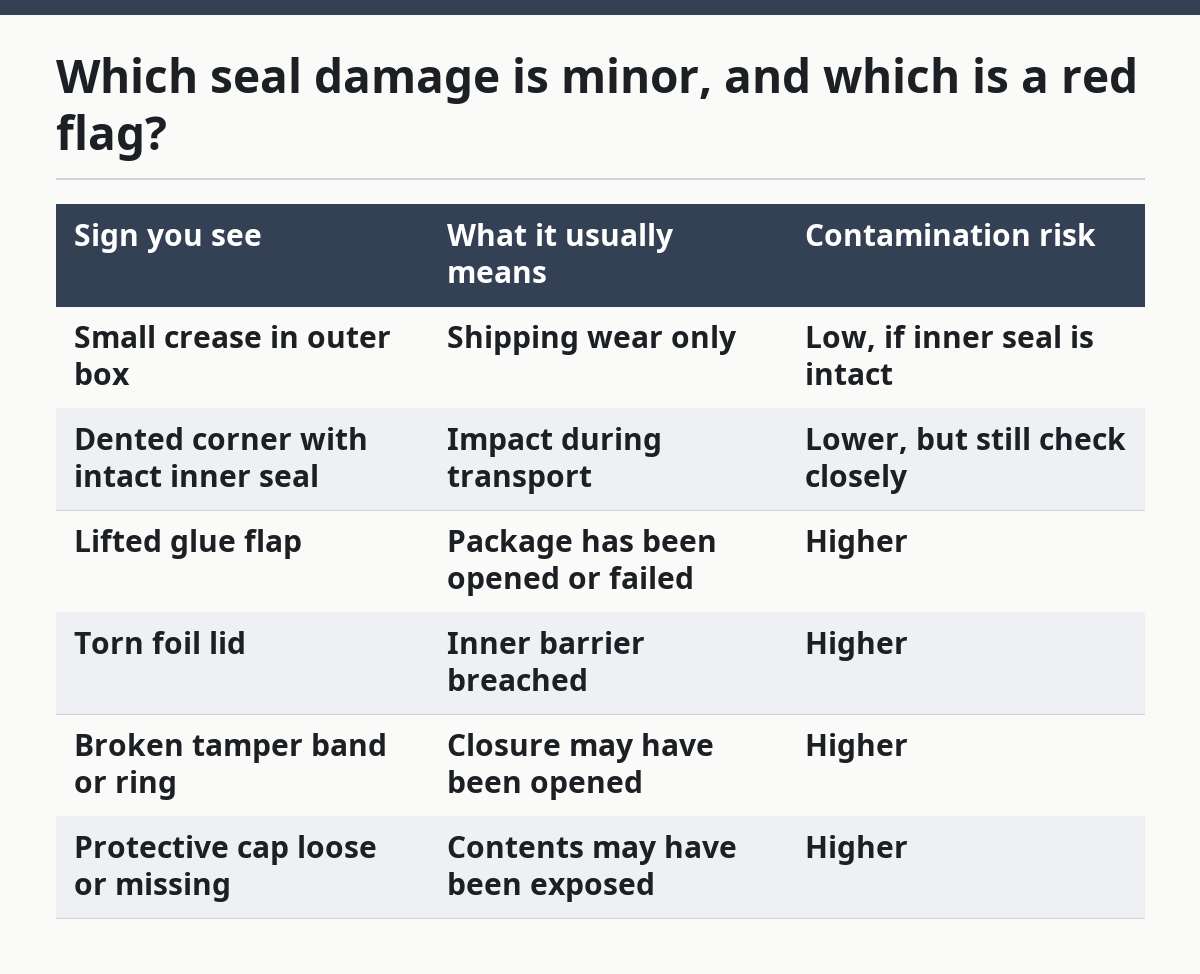
This table matters because the outer package can mislead you. A cosmetic mask in a cardboard carton may still be fine if the tube, pouch, or jar beneath it is untouched. On the other hand, a perfect-looking carton can hide a broken foil lid or a cap that has been removed and put back on.
Protective caps deserve special attention because they are easy to reseat. A cap that turns smoothly but sits slightly crooked, or one with dried residue around the rim, deserves more suspicion than a cap that is firm and even. The same is true of foil lids: once a foil lid is peeled and pressed back down, it may look “closed” while no longer being protective.
If the only issue is a cosmetic dent and the inner barrier is intact, the contamination risk is usually lower, not zero. If there is any sign the product was actually opened, the risk shifts fast. For a broader comparison of storage and handling, see how to store face masks.
What should I do before I use the mask?
Before you use the mask, confirm the seal, inspect the product, and decide whether the packaging history still makes sense. That is the quickest way to separate normal shipping wear from a real exposure risk.
A careful check takes less than 1 minute and should happen before the first use, not after the product is already on your skin.
- Step 1: Check the outer pack. Look for crushed corners, torn film, or a flap that does not lie flat.
- Step 2: Find the main barrier. Identify the foil lid, tamper band, peel strip, or protective cap that actually keeps the mask closed.
- Step 3: Read the damage shape. A straight tear, peeled corner, or missing band suggests opening; a shallow scuff usually does not.
- Step 4: Open the pack only if the seal still makes sense. If you open it, do so in a clean, dry place and expect the contents to look normal.
- Step 5: Stop if anything looks wrong inside. Strange smell, visible debris, leakage, or an odd texture after a seal break means the safer move is to discard the product.
A lot of people make the same mistake here: they trust the outer box and ignore the actual closure. That mistake costs confidence, and sometimes skin irritation, because the product may have been exposed before use.
The same error goes the other way too. Some people throw away a mask after a harmless crease in a carton. That wastes product without improving safety. The fix is to look at the real barrier, not the prettiest part of the package.
When should I throw it away?
Throw it away when the seal looks opened, the barrier is missing, or you cannot explain the damage with normal handling. That is often the safest call when the packaging does not give you a clear yes.
A broken seal is a discard decision when any of these are true:
- the foil lid is torn or partially peeled
- the tamper-evident strip is broken
- the protective cap is missing, loose, or reseated oddly
- the seal line has a gap, slit, or reclosed section
- the contents show residue, leakage, or debris after opening
- you cannot tell whether the product was opened before you got it
This is the part where the honest trade-off matters. If you throw away a mask after a suspicious seal break, you may lose a usable product. If you keep it, you accept uncertainty about contamination risk. That is why “looks probably fine” is not a strong enough standard when the seal is clearly compromised.
This page is not the place to decide whether a mask is expired or whether a label warning matters; those are separate checks. Here, the question is narrower: has the package kept the barrier it was supposed to keep? If the answer is no, or even “I am not sure,” the discard choice is hard to beat.
A reader who wants a simple rule can use this one: if the seal break looks deliberate, unexplained, or impossible to judge at a glance, do not use the mask without checking with the seller, manufacturer, or a qualified professional. That rule is blunt, but it prevents the most common mistake, which is treating a breached barrier like a cosmetic flaw.
What does a false alarm look like?
A false alarm usually looks like shipping damage that never reached the true barrier. A bent box, a rubbed corner, or a scuffed wrapper is annoying, but it does not always mean the face mask packaging seal failed.
Examples of lower-risk damage include a crushed outer carton with an untouched foil lid inside, a scratched plastic sleeve with a fully intact tamper band, or a slightly wrinkled shrink wrap that still covers the closure all the way around. Those are signs to inspect carefully, not automatic reasons to discard.
The trap is assuming all damage means contamination. That costs money and product, and it can make a reader ignore the package next time. The better habit is to ask one plain question: did the damage actually open the barrier, or did it only mark the outside?
That said, false alarms are less dangerous than false reassurance. If a damaged seal makes you hesitate for 10 seconds, that is useful hesitation. If it makes you miss a broken foil lid or a missing protective cap, that is the wrong call.
So the practical rule is this: judge the actual barrier, not the box around it. A face mask can survive a rough trip in a mailer, but it should not survive an open seal.
Should I use a face mask if the seal is broken?
No, not if the break suggests the mask may have been opened, tampered with, or exposed. A broken seal changes the contamination risk because the package no longer gives you the same protection it had at the factory. If the damage is only to the outer box and the inner barrier is untouched, the risk is lower, but the closure still deserves a close check.
How can I tell if packaging is tampered with?
Look for a lifted flap, a torn tamper-evident strip, a broken foil lid, or a cap that seems reseated. Tampering usually leaves a pattern: peeling, slicing, reclosed adhesive, or a closure that no longer sits cleanly. If the break looks deliberate instead of accidental, assume the package may have been accessed.
Does a broken seal always mean a mask is unsafe?
No, a broken seal does not always mean the mask is unsafe, but it does mean the package can no longer be trusted in the same way. A damaged outer carton may be harmless if the inner seal is intact. A torn foil lid or broken tamper band is a much bigger problem, and that is usually the point where discarding the mask is the safer choice.
Drafted with AI; not yet reviewed by a person.



Leave a Reply