




Last updated: November 19, 2026
Quick answer: in most routines, a wash-off face mask makes more sense than a leave-on mask when you want control over residue and cleanup; a leave-on mask makes more sense when you want no rinse step.
This comparison settles application time, residue, layering, finish, and cleanup so you can pick the format that fits your routine. The topic is when a wash-off face mask makes more sense than a leave-on mask, and this article keeps that question front and center.
Key Takeaways
- Wash-off masks suit people who want more control.
- A wash-off face mask can be the cleaner handoff into the rest of skincare.
- A leave-on mask suits routines where cleanup matters less than convenience.
- Wash-off masks favor control; leave-on masks favor convenience.
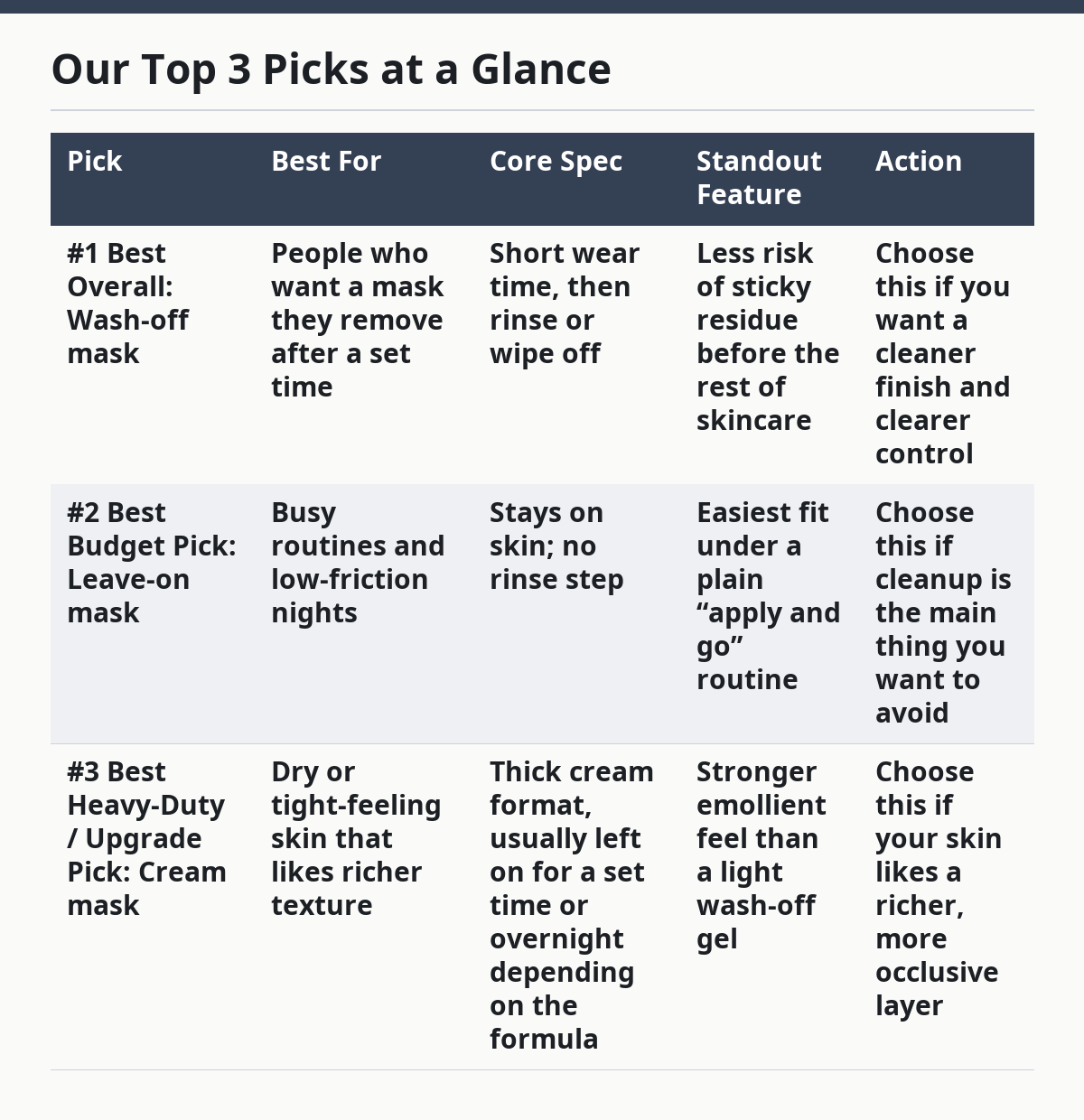
Our Top 3 Picks at a Glance
| Pick | Best For | Core Spec | Standout Feature | Action |
|---|---|---|---|---|
| #1 Best Overall: Wash-off mask | People who want a mask they remove after a set time | Short wear time, then rinse or wipe off | Less risk of sticky residue before the rest of skincare | Choose this if you want a cleaner finish and clearer control |
| #2 Best Budget Pick: Leave-on mask | Busy routines and low-friction nights | Stays on skin; no rinse step | Easiest fit under a plain “apply and go” routine | Choose this if cleanup is the main thing you want to avoid |
| #3 Best Heavy-Duty / Upgrade Pick: Cream mask | Dry or tight-feeling skin that likes richer texture | Thick cream format, usually left on for a set time or overnight depending on the formula | Stronger emollient feel than a light wash-off gel | Choose this if your skin likes a richer, more occlusive layer |
The real difference between wash-off and leave-on masks
Wash-off masks win when you want control. You apply them, wait, and remove the product before the rest of your routine, which means you decide how much stays behind on the skin.
Picture this: you’re getting ready for bed and your face already feels coated from serum, moisturizer, and sunscreen residue. A wash-off mask gives you a clean reset, while a leave-on mask asks you to live with whatever finish it leaves behind. That difference is the whole decision.
A wash-off mask is usually the better call for people who care about residue, finish, and layering with skincare. A leave-on mask makes more sense when you want a product to stay in place and do its job without a rinse step. Some leave-on products are meant for a few minutes; others, like overnight masks, are designed to sit on skin longer. Cream masks can fall into either camp, so the label matters more than the texture.
Key point: the format changes the last step.
- Wash-off: apply, wait, remove.
- Leave-on: apply, then continue with your routine or sleep.
- Overnight masks: a leave-on subtype made to stay on through the night.
- Cream masks: a texture category, not a rule about removal.
For a broader map of formats, the hub on face mask formats and use-cases is the right place to go next.
Who should pick a wash-off face mask?
A wash-off face mask wins for anyone who wants the cleanest handoff into the rest of skincare. Depending on your skin and routine, it can be the better option when you do not want another layer sitting on top of your skin after treatment.
Picture this: you’re using a toner, then a serum, then a moisturizer, and you don’t want a mask to turn that stack into a greasy mess. Wash-off formulas fit that kind of routine because they leave less uncertainty about what remains on the surface.
That matters if you dislike tacky residue, if your skin gets congested easily, or if you want to judge how your moisturizer feels without a mask film changing the result. A wash-off mask also makes more sense before an event, because you can remove it and end up with a more predictable finish. If you are unsure how your skin reacts, consider checking with a dermatologist.
The downside is obvious. You need sink access, a cloth or water, and a few extra minutes. If your routine already feels crowded, the rinse step can become the reason the mask stays in the drawer. The American Academy of Dermatology notes that rinsing off skincare products is often part of reducing irritation risk for sensitive skin, which is one reason the cleanup step can matter.
Pros
- Clear end point
- Less leftover film
- Easier to layer afterward
- Better for people who care about finish
Cons
- Needs cleanup
- Takes more time than a leave-on mask
- Can interrupt a very minimal nighttime routine
Who Should Skip This: someone who wants a mask they can apply and forget, especially if a leave-on mask fits their bedtime routine better.
Buy this if: you want a face mask for a short session and dislike residue.
Skip this if: you need a no-rinse step because you’re already short on time at night.
When does a leave-on mask make more sense?
A leave-on mask wins when convenience matters more than cleanup. Depending on the product and your skin, it is the stronger choice if you want to keep a formula on skin while you move through the rest of your evening.
Picture this: you’re too tired to stand over a sink, and the idea of rinsing off anything feels like one step too many. Leave-on masks solve that problem. They are built for low-friction routines, and that is why people reach for them on rushed nights.
The trade-off is finish. A leave-on formula may feel cushioned, glossy, or slightly tacky depending on the product. That can be fine if you plan to sleep in it or let it sit under a simple routine, but it is less appealing if you want a fresh, bare-skin feel after masking. If you are choosing between formats for a skin concern, a professional can help match the product to your needs.
This format also makes sense when the formula is meant to remain on the skin for longer contact time. Overnight masks live here, and so do some cream masks. The catch is that “leave-on” does not automatically mean “better.” It just means the product is designed around less interruption. The British Skin Foundation also advises patch testing new products if your skin is reactive, which matters with leave-on formulas.
Pros
- No rinse step
- Fast to use
- Fits bedtime routines
- Useful for formulas meant to stay on longer
Cons
- Can feel sticky or heavy
- May not layer well under other products
- Less satisfying if you want a clean finish
Who Should Skip This: someone who hates residue and wants their skincare to end with a rinse, not a film.
Buy this if: you want the easiest possible mask step and don’t mind a finish that stays on skin.
Skip this if: you want to apply makeup or multiple layers right after masking.
The honest side-by-side
Wash-off masks are better for control; leave-on masks are better for convenience. That is the simple split, but the details matter more than the label on the front.
| Criteria | Wash-off mask | Leave-on mask | Winner for this condition |
|---|---|---|---|
| Cleanup | Requires rinsing or wiping | No rinse step | Leave-on mask |
| Residue | Less likely to linger after removal | More likely to leave a film | Wash-off mask |
| Layering with skincare | Easier to add serum and moisturizer after | May change how later products feel | Wash-off mask |
| Routine speed | Slower because of removal | Faster because you skip cleanup | Leave-on mask |
| Finish on skin | More matte or neutral after removal | Often more cushioned or glossy | Wash-off mask |
| Bedtime use | Less useful if you want to sleep right away | Made for longer wear in many formulas | Leave-on mask |
| Event prep | Better if you want a fresh finish before makeup | Riskier if the texture stays tacky | Wash-off mask |
| Busy schedule | Needs a window of time | Fits a rushed evening | Leave-on mask |
Picture this: you’re deciding at 10 p.m. whether to keep your routine short or add one more step. The table makes the rule plain — wash-off wins on finish, leave-on wins on ease.
Wash-off face masks: the cases where they win
Wash-off face masks win when the result you care about is what happens after removal. That includes how your skin feels, how the next product layers, and whether you want a clean end point.
Picture this: you’ve got a 20-minute window before bed and a serum you like to use afterward. A wash-off mask lets you treat that as a separate step, not a sticky layer you have to work around. If you are not sure whether that setup suits your skin, a skincare professional can help you decide.
They also make more sense for people who dislike product buildup. If a leave-on mask tends to sit on top of the skin too long, a wash-off formula gives you more control over the experience. That is especially useful if you are managing a simple routine and want each step to feel distinct.
The limitation is practical. If you never want to rinse, this format will fight you every time. It can also be a poor fit for people who want a very rich, overnight-style finish, because the whole point is that you take it off.
Best-fit profile
- You want a cleaner finish
- You like layering serum and moisturizer afterward
- You have time for a rinse step
- You dislike sticky or glossy residue
Watch out for
- Extra cleanup
- One more step in the evening
- Less convenience than a leave-on formula
Who Should Skip This: a person whose routine already ends in bed and who wants skincare that stays put overnight.
Buy this if: you want to control the last step and keep residue low.
Skip this if: you want a mask that disappears into a bedtime routine without water.
Leave-on masks: the cases where they win
Leave-on masks win when simplicity matters more than a perfect finish. If your main problem is time, this format solves it with the fewest steps.
Picture this: you’ve had a long day, you want some skincare, and you do not want to stand at the sink. Leave-on masks fit that moment well. The product stays where you put it, which makes the routine feel shorter and less fussy.
This format also fits overnight masks and some cream masks, both of which are designed to stay on skin longer. That matters if your skin prefers a richer feel or you want a treatment that works while you sleep; if you are trying to match a product to a skin concern, a professional can help. The downside is the trade-off in texture. A leave-on mask can feel heavy, and not every face likes that before bed.
The other issue is compatibility with the rest of your routine. If you want to add active products, makeup, or even a second layer of moisturizer right away, a leave-on mask can get in the way. It is simple only if you actually want the format it creates.
Best-fit profile
- You want the shortest routine possible
- You hate cleanup
- You like overnight or cream textures
- You do not mind a lingering finish
Watch out for
- Sticky or greasy feel
- Less flexibility with layering
- Not ideal if you want a fresh bare-skin finish
Who Should Skip This: anyone who wants a clean, neutral feel before makeup or after a busy morning.
Buy this if: you want a low-effort mask that stays on while you keep moving.
Skip this if: residue annoys you more than the extra minute of cleanup.
Exceptions: when the usual rule flips
The rule flips when the product texture, not the format label, is the real issue. A cream mask can be wash-off or leave-on depending on the formula, so the package directions matter more than the jar shape.
Picture this: you find a rich cream mask labeled for overnight wear. In that case, the word “cream” does not tell you whether it belongs in the wash-off or leave-on camp. The instructions do.
Three common exception cases change the choice:
- You have very dry skin and a leave-on cream mask feels better than a rinse-off gel. The richer finish can be worth the extra residue.
- You want a quick reset before makeup. Even a leave-on product loses to a wash-off mask if you need a clean surface afterward.
- You only have five minutes. The fastest option can be the most practical one when time is the real bottleneck.
- Your skin reacts to heavy films. In that case, a leave-on mask may create more problems than it solves, even if it sounds easier.
The best way to think about it is: format decides cleanup; formula decides feel.
The verdict: which one to choose and why
Choose a wash-off mask if you want a cleaner finish, easier layering, and a clear end point. Choose a leave-on mask if you want the least cleanup and a format that fits a rushed or overnight routine. Neither if your skin hates residue and you also won’t make time for rinsing or removal.
Picture this: you are standing in your bathroom deciding between a quick step and a cleaner finish. That is the whole trade. If you want your skincare to end without a film, pick wash-off. If you want the easiest routine with the fewest steps, pick leave-on.
For many readers, wash-off makes more sense because it solves the bigger complaint: masks that sit on top of the skin and interfere with the rest of the routine. Leave-on is still the right answer when time is tight or the formula is built to stay on, like many overnight masks.
One practical rule helps: if you care most about residue and layering, go wash-off. If you care most about convenience, go leave-on.
Drafted with AI; not yet reviewed by a person.



Leave a Reply