


Last updated: November 19, 2026
Quick Answer: compare face masks on ingredient list, format, and finish before you buy.
This face mask comparison guide will help you sort out what fits your skin, your routine, and the result you want.
How to compare face masks before you buy: ingredient, format, and finish starts with the label, then the texture, then the after-feel.
The steps below will settle what matters, what to ignore, and when a sheet mask, cream mask, clay mask, or gel mask makes more sense.
Key Takeaways
- The ingredient list is your first screen because it shows the mask’s main purpose.
- The format can make a formula practical or pointless in daily life.
- The finish tells you what remains after rinsing, drying, or removal.
- Usage frequency helps you judge whether the mask fits nightly or weekly use.
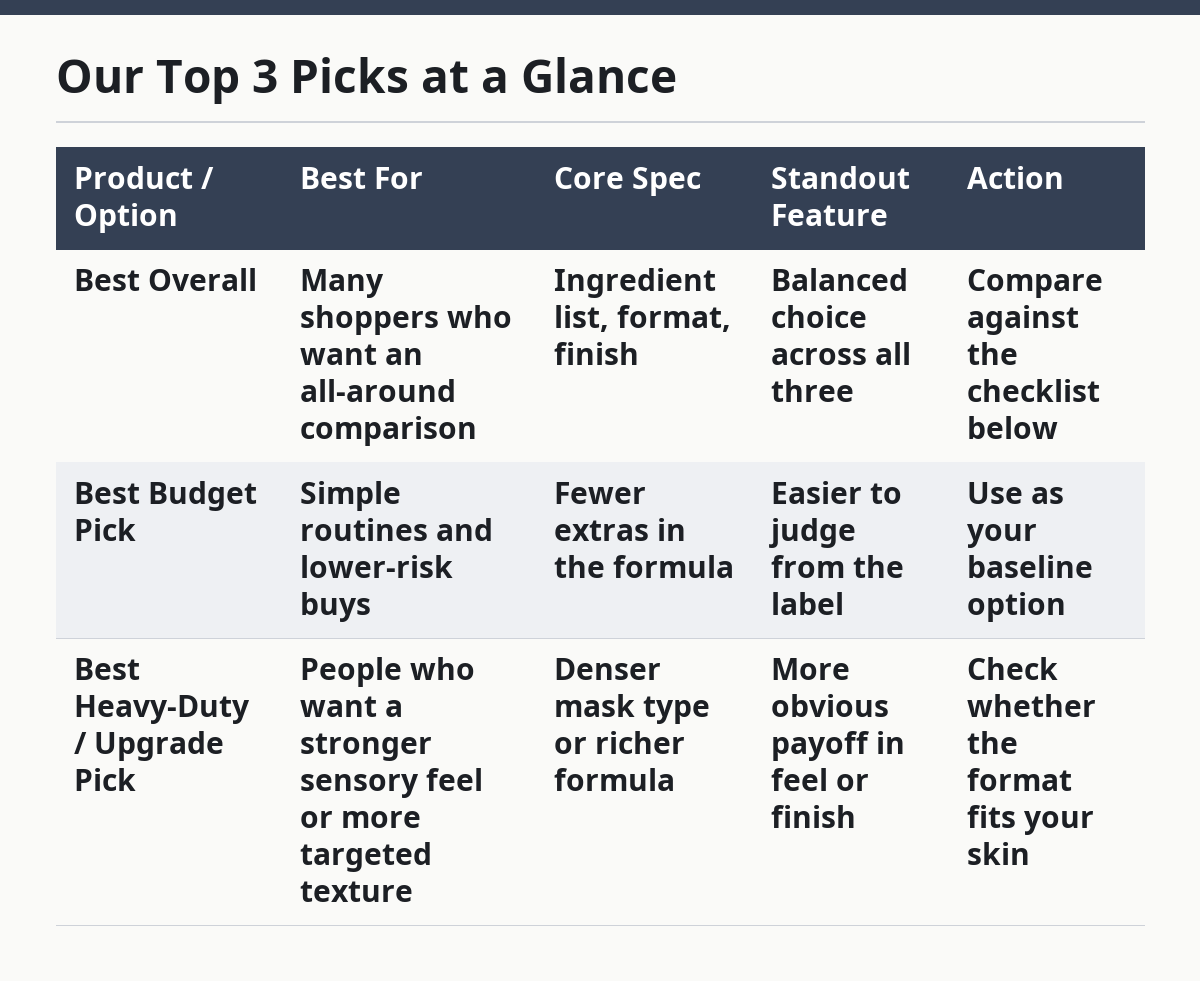
Our Top 3 Picks at a Glance

#1 Best Overall: a mask with a short ingredient list, a format you’ll actually use, and a finish that suits your skin.
#2 Best Budget Pick: a simpler mask that skips extra fragrance and packaging fuss.
#3 Best Heavy-Duty / Upgrade Pick: a more specialized mask with stronger texture payoff and a clearer purpose.
| Product / Option | Best For | Core Spec | Standout Feature | Action |
|---|---|---|---|---|
| Best Overall | Many shoppers who want an all-around comparison | Ingredient list, format, finish | Balanced choice across all three | Compare against the checklist below |
| Best Budget Pick | Simple routines and lower-risk buys | Fewer extras in the formula | Easier to judge from the label | Use as your baseline option |
| Best Heavy-Duty / Upgrade Pick | People who want a stronger sensory feel or more targeted texture | Denser mask type or richer formula | More obvious payoff in feel or finish | Check whether the format fits your skin |
Compare the ingredient list first
The ingredient list is the first filter because it tells you what the mask is trying to do. A face mask that leads with clay, humectants, oils, or calming agents is usually built around a different result, and that matters more than the box art. If you only compare one thing, compare this.
Picture this: you’re standing in the aisle or scrolling a product page, and every option claims to “refresh,” “nourish,” or “clarify.” A practical way to separate them is to read the first few ingredients and note what dominates the formula. That tells you whether you’re looking at a rinse-off clay mask, a moisture-heavy cream mask, a water-rich gel mask, or a sheet mask soaked in serum.
-
Read the first five ingredients and name the base.
The first 5 ingredients usually carry the most weight in the formula, so look for water, clay, emollients, or film-formers. That clue often matters more than the front label. -
Mark the active theme and ignore the marketing words.
If the formula centers on clay, the mask will likely feel drier and more absorbent; if it centers on humectants or oils, it will usually feel softer and richer. That is the real comparison point. -
Check for extras that may not suit your routine.
Fragrance, added color, and crowded ingredient lists can make a mask harder to judge. A cleaner list is often easier to compare and easier to repeat.
You do not need to decode every line. You only need enough to answer one question: does this formula match the kind of mask you actually want to wear for 10 to 20 minutes?
What to compare on the label:
- Water-heavy base vs. clay-heavy base
- Oils and butters vs. lightweight gel ingredients
- Fragrance and dye vs. a simpler formula
- Any standout skin-care ingredient the brand names up front
For ingredient learning beyond this guide, the American Academy of Dermatology Association has general skin-care guidance, and the Cosmetic Ingredient Review panel publishes safety assessments for cosmetic ingredients. Those aren’t shopping pages, but they help you read a label with better judgment. The FDA also explains cosmetic labeling basics, including ingredient order, on its cosmetics pages.
What format fits your routine?

The format matters because a good formula in the wrong format is still a bad buy for your life. Sheet masks, cream masks, clay masks, and gel masks behave differently on the skin and on the clock, so format is part of comparison, not an afterthought.
Picture this: you want a mask that fits a 15-minute wind-down, but the jar you picked needs a thick layer, a rinse, and cleanup in the sink. A small routine mismatch like that is how people end up abandoning perfectly fine products. The right format should fit your sink, your schedule, and your tolerance for mess.
-
Choose sheet masks if you want low mess and fast setup.
A sheet mask is simple to apply and easy to compare if your main question is convenience. It usually works best when you want a one-and-done step without mixing or scooping. -
Choose cream masks if you want a richer, heavier feel.
Cream masks are often better for comfort and slip, especially if you dislike tight-drying textures. They can also be harder to rinse, so factor in cleanup. -
Choose clay masks if you want a firmer dry-down.
Clay masks usually give a more obvious set-and-rinse experience. That makes them easy to compare, but also easier to overdo if your skin dislikes dryness. -
Choose gel masks if you want a cooler, lighter finish.
Gel masks often feel less heavy than cream masks and less drying than clay masks. They can be a good middle ground if you want a mask that feels fresh without feeling stripped.
Here’s the catch: format changes the whole buying experience. A face mask that looks ideal in a photo can become annoying the second it drips, tightens, or refuses to rinse clean. A 20-minute routine only works if the format agrees with your habits.
Format cues to look for:
- Sheet mask: travel-friendly, quick, single-use
- Cream mask: richer texture, more spa-like feel
- Clay mask: firmer set, more drying finish
- Gel mask: lighter feel, often more comfortable for longer wear
How do you judge the finish before buying?
The finish tells you what the mask leaves behind after the rinse, dry-down, or removal. This is where many shoppers get tripped up, because a mask can have a strong ingredient list and still leave skin feeling heavy, tight, sticky, or slick.
Picture this: you’re comparing two masks with similar claims, but one leaves a powdery feel and the other leaves a glossy film. That difference matters more than the promise on the box, because the finish is what you’ll feel after the product is off your face. It affects whether you reach for it again.
-
Look for finish words like dewy, matte, soft, cushioned, or clean.
Those words are not perfect science, but they do tell you what the brand is trying to deliver. A “matte” finish points in a different direction than a “dewy” one. -
Match the finish to your skin’s comfort zone.
If you dislike residue, avoid masks that sound glossy or cushiony. If your skin tends to feel tight, a finish described as soft or replenishing may suit you better. -
Compare finish against the format.
A clay mask often trends matte or dry-touch, while a cream or gel mask often trends more cushioned or smooth. That combination is a stronger clue than either detail alone.
The truth is, finish is where many first-time buyers get burned. A mask can be well made and still feel wrong on your skin because the post-mask sensation is the whole point for many people. If you know the finish you want, you can rule out half the shelf.
Common finish clues:
- Matte or dry-touch: usually a firmer, less shiny end feel
- Dewy or luminous: often leaves more glow or slip
- Soft or cushioned: tends to feel more comfort-focused
- Clean or fresh: usually means less residue
Compare usage frequency before you commit
Usage frequency matters because a mask that sounds great once a week may be wrong every night. The label may suggest “as needed” or “1 to 3 times weekly,” and that spacing tells you how intense the formula is meant to be.
Picture this: you buy a clay mask because the finish sounds perfect, then discover it feels like too much after two uses in a week. Or you buy a gentle cream mask and realize it’s too mild for the routine you had in mind. Comparing usage frequency helps you avoid both mistakes.
-
Check the suggested cadence on the package.
Many masks are built for weekly use, while some feel comfortable more often. If the label suggests 1 to 2 uses a week, that usually signals a stronger or more treatment-like product; if you have sensitive skin, a dermatologist or other qualified professional can help you judge whether that frequency fits. -
Ask whether the routine is realistic.
A mask that needs a careful rinse, a 15-minute wait, and post-care is harder to keep using than one that lifts off cleanly. A realistic cadence is often the better buy. -
Match frequency to sensitivity.
If your skin gets cranky with too much product, a less frequent mask may be the safer comparison. If you want something simple and gentle, a lower-intensity formula can fit better; a professional can help if you are unsure.
On the flip side, more frequent use is not automatically better. A product you can use often is only useful if it still gives you the finish and feel you want. Frequency should be a fit check, not a bragging point.
What packaging clues actually matter?
Packaging clues matter because they hint at freshness, convenience, and waste. A jar, tube, sachet, or single-use pouch changes how the mask is stored, dispensed, and used, so packaging belongs in the comparison process too.
Picture this: you’re holding two masks with similar ingredient lists, but one comes in a jar and the other in a single-use sachet. One may be easier to keep in your bathroom and use a little at a time; the other may be better for travel or trying a product once before committing.
-
Look at the container size and shape.
Jars make it easier to scoop cream or clay masks, but they also invite repeated air exposure and messy fingers. Tubes are often cleaner to use. Sachets are easy to test but less economical for repeat use. -
Check whether the package supports the formula.
A wet gel or serum-heavy formula usually needs packaging that keeps the contents stable and easy to dispense. A dense clay mask often makes more sense in a tube or jar. -
Notice if the pack tells you shelf life or opening behavior.
Some products are designed for one-time use, while others are meant to stay on a bathroom shelf. If the package gives clear directions, that usually signals a more thoughtful product.
Packaging gives you a quick read on how the brand expects you to use the mask. A single-use sheet mask, a squeeze tube, and a wide-mouth jar solve different problems. Don’t compare them as if they’re the same thing.
The comparison checklist that keeps you from overbuying
A good mask comparison is a 3-part check: ingredient, format, finish. If those three line up, the product is at least worth a closer look. If one of them clashes with your routine, skip it.
Picture this: you have three masks in front of you, and all of them sound tempting. One has the ingredient profile you want, one has the right texture, and one promises the finish you like. The point of a comparison framework is not to find a perfect product; it’s to make a defensible choice.
- Ingredient: Does the base match the job?
- Format: Will you actually use it?
- Finish: Will you like what it leaves behind?
- Frequency: Can you keep up with it?
- Packaging: Does the container make sense for the formula?
A simple rule helps here. If two of the three core checks pass and the third is only a mild compromise, the mask may be worth trying. If the ingredient list, format, and finish all pull in different directions, that is a bad fit.
This is also where generic articles go wrong. They treat all face masks like one category, then hand-wave the details that make a buyer regret the purchase. A clay mask and a sheet mask do not ask the same questions of your skin or your schedule. The AAD and NHS both emphasize matching skin-care products to skin needs, which is the same logic here.
What should I compare when buying a face mask?
Compare the ingredient list, the format, and the finish first. Those three tell you what the mask does, how it behaves, and how it feels after use. After that, check usage frequency and packaging so you know whether the product fits your routine in real life.
Picture this: you’re standing at a shelf with too many options, and every box sounds helpful. The fastest way to sort them is to strip away the claims and compare the parts that affect use. If the formula, texture, and after-feel line up, the product has a chance.
Do not start with the prettiest box or the loudest claim. Start with the facts you can compare in under a minute.
How do I tell if a mask is worth trying?
A mask is worth trying if its ingredients, format, and finish all match what you want more than they conflict with it. That does not mean it has to be perfect. It means the trade-offs are small enough that the mask has a fair shot at fitting your routine.
Picture this: you’ve narrowed the list to two products. One has a cleaner ingredient story but a finish you’re unsure about. The other has the right finish but a format that sounds annoying. The better choice is the one with the fewest real-life friction points.
Look for a package that clearly states how often to use it and what the texture will feel like. If the label is vague on both, the product is harder to trust.
What is the best way to narrow down mask choices?
The best way to narrow down mask choices is to pick one format, one finish, and one ingredient theme before you compare brands. That keeps the search focused and prevents you from chasing every claim on the shelf. It also makes it easier to spot the masks that truly fit your routine.
Picture this: you want a mask that feels light, rinses clean, and doesn’t look overly fussy in the ingredient list. Once you set those three limits, the field gets smaller fast. That’s the point.
If you need a broader shopping path, the hub on face mask shopping and selection can help you compare options by skin goal, texture, and use case.
Drafted with AI; not yet reviewed by a person.

Leave a Reply