



Last updated: November 19, 2026
Quick answer: use 1 jar per person when you can, or at least 1 dedicated tool per jar. To keep a face mask sanitary in a shared household, separate jars, spatulas, and applicators, then put the mask back with clean hands right away. In a shared household, the real risk is cross-use: one person dips a finger in, another uses the same spatula, and the jar becomes a shared surface instead of a personal product. That is the part to fix first in a face mask hygiene in shared households routine.
Key takeaways
- Give each person their own face mask jar or, at minimum, their own labeled applicator.
- Keep shared shelves from turning into shared contact points by using lids, bins, and labels.
- Never double-dip a spatula into a jar after it has touched skin, fingers, or sink edges.
- If a bathroom is shared, store the mask somewhere dry and closed, not in a damp splash zone.
- The cleanest setup is the one that removes guesswork: one product, one person, one tool.
What makes a shared household risky?
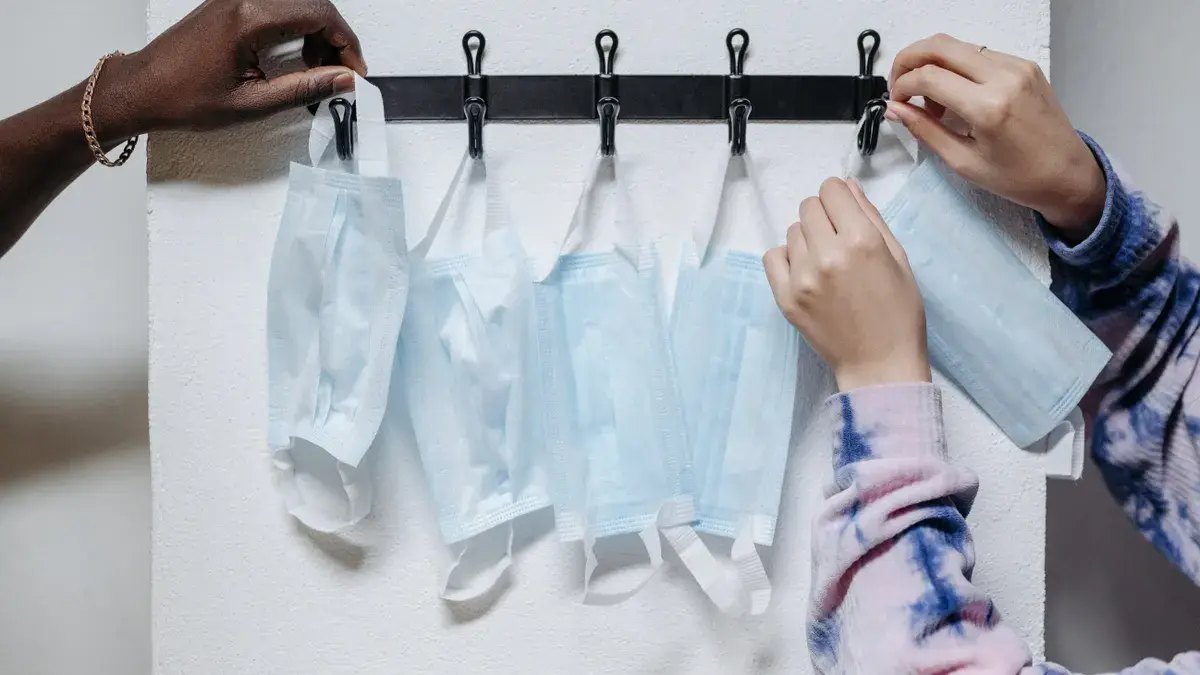
A shared household is risky because face mask jars invite repeat contact from hands, lids, and tools. The product itself may be fine; the problem starts when people reach in from the same shelf, leave the lid loose, or reuse a spatula after it has touched skin.
The most common trouble spots are the places people rush through in 10 seconds: shared bathrooms, crowded shelves, and a face mask jar left open near the sink. A damp bathroom is not ideal for any product that depends on a clean lid and a clean tool. If the mask is kept with toothpastes, razors, and rinsed brushes, the chance of mix-ups goes up fast.
Therefore, the simple fix is to separate the product from the traffic. Put each face mask in a labeled storage bin or keep it on a higher shelf that only one person uses. If more than one person likes the same type of mask, the cleanest option is for each person to have a separate jar, even if the formula is identical.
For at-home face mask safety and maintenance, the same logic applies: less sharing means less confusion. For broader product-handling guidance, the FDA and the American Academy of Dermatology both recommend avoiding contamination and keeping personal-care products clean and closed.
How do I keep a face mask sanitary in a shared household?
You keep a face mask sanitary in a shared household by making it personal, labeling it clearly, and cutting out any shared dipping. That means one jar per person when possible, or one jar with one dedicated spatula and one dedicated applicator that never leaves that person’s space. The FDA’s cosmetics guidance and the American Academy of Dermatology’s skin-care advice both support the basic idea of keeping personal products clean and uncontaminated.
Here is the core routine:
- Assign the product to one person. Put the name on the jar or on the storage bin with a label. If the label is visible, other people are less likely to treat it like community property. When in doubt, consult a dermatologist or other skincare professional about product sharing.
- Store it in a closed bin or separate shelf space. A lidded storage bin does more than look tidy; it keeps the jar from being bumped, opened, or used by mistake.
- Use a clean spatula, not fingers. A spatula keeps oils and germs out of the jar better than direct finger contact. If the product came with a spatula, keep that one with that one jar.
- Take out only what you need. Put the lid back on as soon as you have the amount you need. The less time the jar sits open, the fewer chances there are for dust, splash, or mix-ups.
- Keep the applicator personal. If the mask is meant to be scooped, brushed, or spread on the face, the tool should stay with the person, not in a shared cup.
- Return it to its own spot immediately. The right place should be obvious: same shelf, same bin, same label, every time.
A shared home does not need a complicated system. It needs a boring one. A labeled jar in a storage bin beats a fancy organization setup that nobody follows after a week.
Which storage setup works best?

The best storage setup is the one that reduces contact between people, tools, and wet hands; the less convenient option is the one that leaves all three in the same place. In a shared household, a face mask jar on an open shelf is the least protected option, while a labeled bin with a closed lid is the safest of the simple choices.
Here is the trade-off in plain terms:
| Storage setup | Best for | Weak point | My take |
|---|---|---|---|
| Open shared shelf | Very limited space | Easy to grab by mistake | Not ideal for shared homes |
| Labeled storage bin | One person per product | Needs a little discipline | Good default choice |
| Closed cabinet shelf | Dry storage and privacy | People can still confuse jars | Better than open shelving |
| Shared bathroom counter | Fast access | Splash risk and cross-use | Poor choice for sanitary storage |
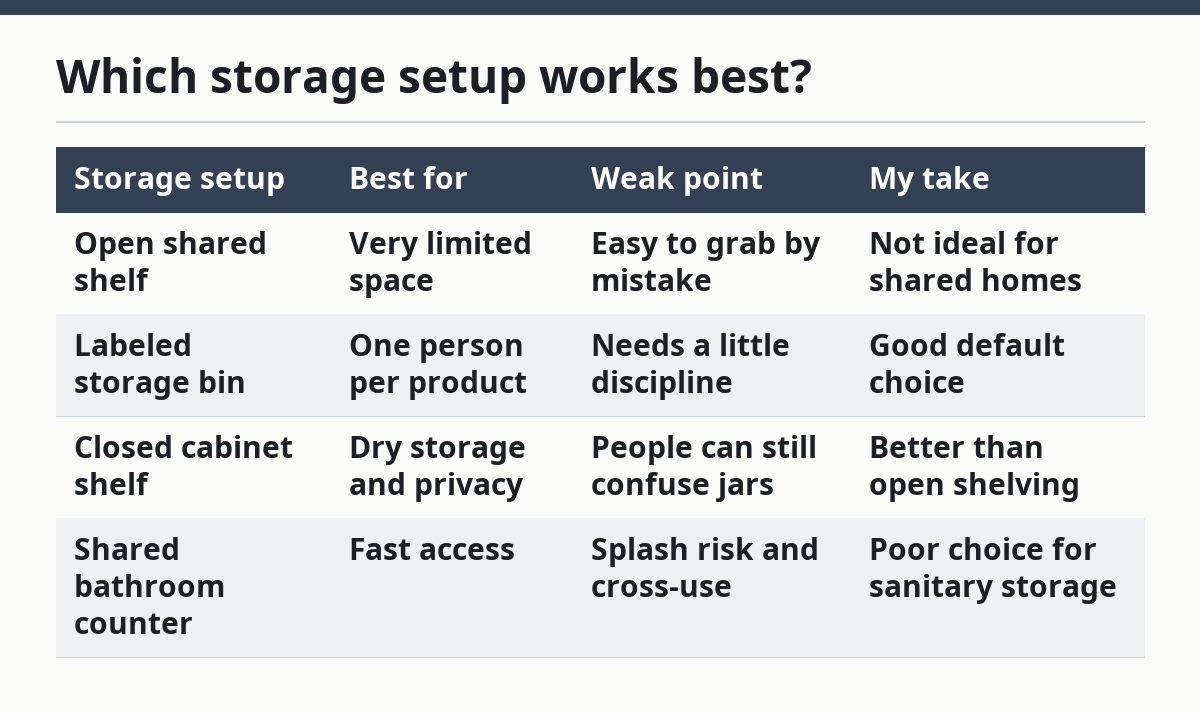
If the home has only one shared bathroom, keep the mask away from the sink edge and out of splash range. A cabinet or bin on a drier wall is better than a counter spot next to hand soap and rinsed tools. If there is room, place the product in a separate bedroom drawer or shelf instead of the bathroom at all. For bathroom storage basics, the same rule holds: dry, closed, and clearly labeled.
This is also where labels matter most. A label is not decoration; it helps prevent the classic mistake where two people reach for the same white jar and assume it is theirs. A single word name on the lid can do more than an elaborate organizer with no labels, according to standard cosmetic-safety guidance from the FDA and the AAD.
What should each person use?
Each person should use their own applicator, and in most homes each person should have their own face mask jar too. That is the cleanest setup because it removes the need to guess whether a tool has touched another person’s hands, face, or sink area.
If the household is large, the shared item to avoid is not just the product but the tool. A shared spatula is a weak point because it moves from jar to skin and back again. Once that happens, the jar is no longer a private product; it is a shared surface with extra steps.
A useful rule is simple: one person, one label, one tool. If you can only separate one thing, separate the applicator first. A personal applicator is cheaper in effort than policing every jar opening, and it reduces the chance of cross-use in a bathroom that already has too many moving parts.
Here is a quick comparison:
| Option | Sanitary level | Convenience | Best use |
|---|---|---|---|
| Shared jar, shared spatula | Low | High at first, low over time | Not recommended |
| Shared jar, personal spatulas | Better | Moderate | Better than nothing |
| Separate jars, separate spatulas | Highest | Most organized | Best for shared households |
A common mistake is assuming that careful people do not need a system. They do. Shared homes run on memory until somebody is tired, rushing, or distracted. A separate applicator removes that weak point without adding much work.
What mistakes cause contamination?
The biggest mistakes are double-dipping, leaving lids off, and storing the jar where everyone reaches. Those habits cost cleanliness fast because they put a private product in contact with hands, damp air, and shared surfaces.
The first mistake is double-dipping a spatula or finger after it has touched skin. That moves oil and residue back into the jar. The fix is plain: take a fresh amount each time, and never return a used tool to the product.
The second mistake is leaving the lid loose while you answer a text, grab a towel, or step away from the sink. Even a short open period invites dust and accidental contact. Put the lid back on before you do anything else.
The third mistake is storing the jar in a crowded bathroom shelf next to items that get used by everyone. A shelf near razors, toothbrush cups, and shared storage bins makes mix-ups more likely. A labeled bin or separate shelf keeps the product from becoming part of the household traffic pattern.
The fourth mistake is using the same towel to wipe the jar, the spatula, and the counter. That spreads residue around instead of cleaning it up. If a product or tool gets messy, clean the area with a separate cloth and keep that cloth away from the jar itself.
When is shared use not a good idea?
Shared use is not a good idea when the setup cannot keep the product clearly tied to one person. If the home does not have enough space for labels, separate bins, or personal applicators, the risk of cross-use goes up enough that a shared face mask is a poor choice.
It is also a bad fit for a bathroom that stays damp or crowded all the time. A shared bathroom with no dry shelf and no clear storage zone makes it too easy for the jar to sit open or get touched by the wrong hands. In that case, a different storage location is better than trying to force a bathroom routine that keeps failing.
Because of that, a simple product is safer than a clever system. If the household cannot keep separate tools straight, then one product per person is the honest answer. The extra jar is less of a problem than a contaminated one.
The FDA’s cosmetics safety pages and the American Academy of Dermatology’s skin-care advice are useful starting points for this kind of handling. They are not a substitute for common sense, and they do not replace the label on the product itself. If you are unsure whether a product should be shared, ask a dermatologist or pharmacist.
How do I set up the bathroom so people stop mixing things up?
You set up the bathroom so people stop mixing things up by making the face mask harder to grab by accident than to grab on purpose. That means a labeled storage bin, a consistent shelf, and no loose jars among shared items.
Start with one shelf or drawer section for personal skin-care items. Put each jar in a bin or tray with the owner’s name. If the household shares a bathroom, do not leave the mask beside the sink where everyone passes through with wet hands. A higher shelf or a closed cabinet is better, even if it is less convenient.
Next, make the tools obvious. Keep each spatula with its own product, or keep a personal applicator in a small labeled cup. If the product is used with a finger, the rule should be stricter, not looser: that person should be the only one opening that jar.
A simple 3-part setup works well:
- Label
- Separate storage bin
- Personal applicator
That combination is basic, but it cuts down on the two things that spread mess in shared homes: habit and haste. If the setup is clear, people do not have to ask every time who owns what. For shared bathroom organization, consistency matters more than appearance.
How often should you review the setup?
You should review the setup any time the household changes, because shared routines drift after about a week or two. A new roommate, a guest staying for several nights, or a bathroom shelf rearrangement is enough to cause mix-ups.
Check three things: whether the label is still readable, whether the jar is still in the right bin, and whether the applicator is still personal. If any one of those has slipped, the system is already less sanitary. The fix is usually small: relabel, move the bin, or replace the tool arrangement with something easier to follow.
If the household keeps using the same face mask type, a monthly reset is enough for most people. Put the jars back in order, clear out anything unlabeled, and move any shared items away from the mask area. A 5-minute reset can help prevent the kind of confusion that makes people dip into the wrong product without thinking.
Can multiple people use the same face mask?
No, not if the goal is to keep it sanitary in a shared household. A shared jar turns into a shared contact point very quickly, especially if more than one person uses fingers or the same spatula. The safer choice is one jar per person, or at minimum one jar with one dedicated tool and no cross-use.
How do I prevent cross-contamination?
Prevent cross-contamination by keeping the mask in a labeled container, using a personal applicator, and closing the lid right after use. Store it away from shared bathroom clutter and do not let tools move from one person to another. If a spatula or finger touches skin, it should not go back into the jar.
Should each person have their own applicator?
Yes, each person should have their own applicator if the household shares face masks or shares a bathroom. A personal applicator is the easiest way to stop transfer from hands and faces back into the product. It also makes the routine simpler, because nobody has to wonder whose tool was used last.
Drafted with AI; not yet reviewed by a person.



Leave a Reply