




Last updated: November 20, 2026
Quick Answer: choose the lowest-scent face mask you can wear for the full labeled time, and if it still smells strong after 10 to 15 minutes, skip it. This topic is about how to choose a face mask by scent strength and fragrance load. A face mask with a low fragrance load may smell faintly floral, herbal, or soapy; a stronger one will announce itself as soon as you open the pouch. If your skin is touchy after shaving, lightly scented or unscented formulas are usually the safer bet. For broader ingredient shopping, see face mask ingredients and sensitive skin care.
Key takeaways
- Scent strength is a shopping clue, not just a personal preference.
- A strong smell often means a higher fragrance load, more essential oils, or both.
- Lightly scented masks can be easier to use, but “light” is not the same as “gentle.”
- Unscented formulas are the cleanest choice when you want less smell at the sink.
- The safest practical pick is the one you can leave on for the full time without burning, stinging, or wanting to peel it off early.
What is fragrance level in a face mask?

Fragrance level is how much a mask smells when you open it and while it sits on your skin. In plain terms, it is the difference between a mask that has a soft cosmetic scent and one that fills the room. That matters because scent strength often tracks with fragrance load, which is the amount of fragrant material in the formula.
A strong smell can come from added fragrance, essential oils, or botanical extracts that carry a natural odor. A faint smell can still come from any of those, so the nose is a clue, not a full ingredient check. The American Academy of Dermatology notes that fragrance is a common skin irritant and allergen, which is why scent matters even when the product looks gentle.
For a reader shopping after shaving, fragrance level is one of the fastest ways to sort options. Freshly shaved skin can feel more reactive for a few hours, so a mask that smells heavy may be a poor match even if it is marketed as calming. If a product has a scent strong enough that you notice it before you apply it, treat that as a warning sign rather than a bonus. If you are unsure, check with a dermatologist or pharmacist, especially if you have had fragrance reactions before; the American Academy of Dermatology advises caution with fragranced products.
How do I choose a face mask by fragrance level?
You choose by matching the smell to your skin’s tolerance, then by checking whether the scent fades or hangs around. A simple rule helps: the more obvious the scent at arm’s length, the more caution it deserves. If you are scent-sensitive, aim for unscented first, lightly scented second, and skip anything that smells rich, perfumed, or lingering.
Use this order when you shop:
- Open the package and smell it once, before the mask touches your face. If the scent is mild and disappears in a few seconds, it is closer to a light scent than a heavy one.
- Look for words that suggest perfume-like scent or added aroma, then compare them with unscented formulas. A mask sold as “fresh,” “spa,” or “aromatic” often has more scent than one sold as plain or fragrance-free.
- Check whether the smell seems layered. A one-note scent is often easier to live with than a mask that smells floral plus sweet plus herbal all at once.
- If your skin stings easily after shaving, start with the least scented option available and leave it on for the shortest labeled time first. That gives you a lower-risk read on the formula.
- After removal, notice how long the smell stays on your skin. If it lingers for more than a short rinse cycle, the fragrance load is probably not low enough for daily use.
The point is not to find a mask with no smell at all. The point is to choose a scent level that does not become the main event on your face. A mask that smells pleasant in the pouch can still be the wrong mask if the scent keeps you from wearing it comfortably for the full session.
Which scent types are easier to live with?
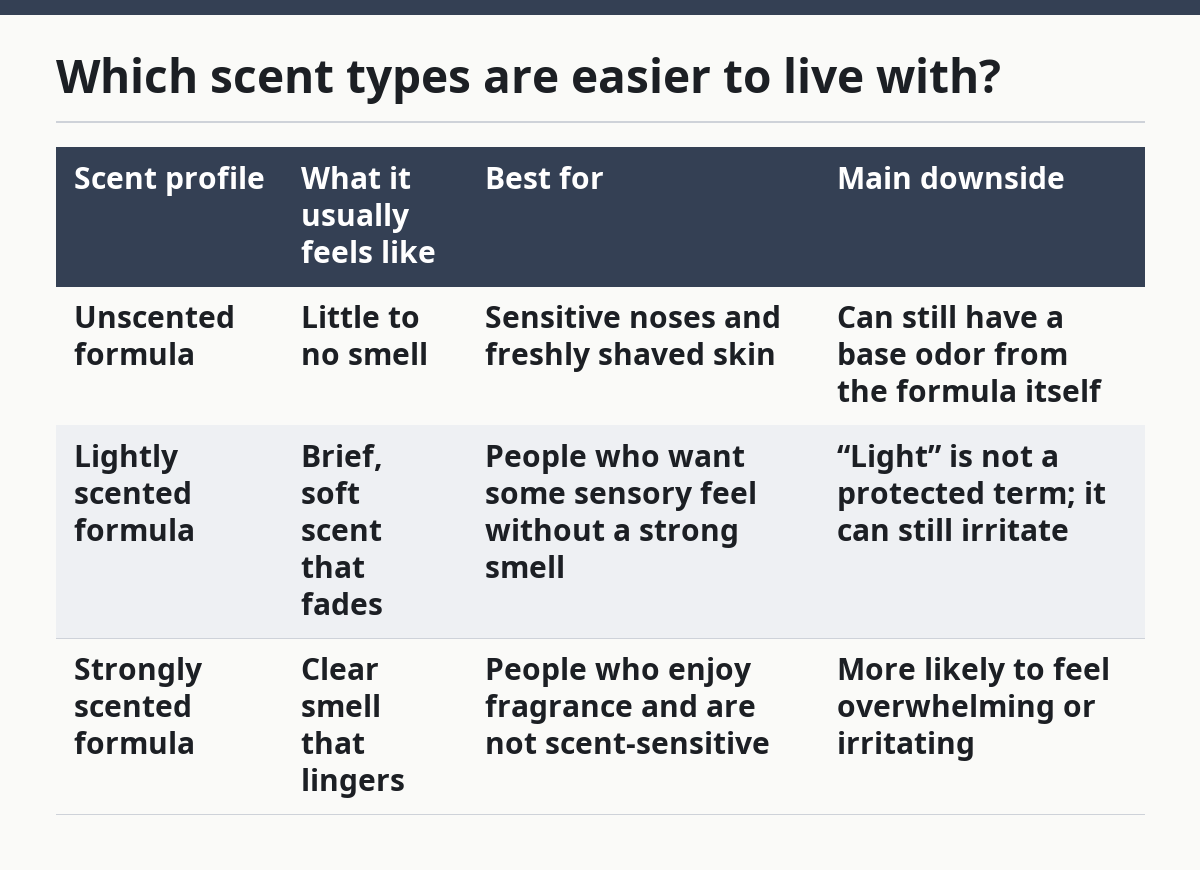
The easiest scent profiles are plain, faint, and short-lived. A soft clean smell is usually less distracting than a sweet perfume note or a dense herbal oil blend. If two masks claim to be “calming,” the one that smells less intense is usually the easier pick for regular use.
Here is the basic trade-off:
| Scent profile | What it usually feels like | Best for | Main downside |
|---|---|---|---|
| Unscented formula | Little to no smell | Sensitive noses and freshly shaved skin | Can still have a base odor from the formula itself |
| Lightly scented formula | Brief, soft scent that fades | People who want some sensory feel without a strong smell | “Light” is not a protected term; it can still irritate |
| Strongly scented formula | Clear smell that lingers | People who enjoy fragrance and are not scent-sensitive | More likely to feel overwhelming or irritating |
Essential oils and botanical extracts sit in a tricky middle. They can make a mask smell natural, but “natural” does not mean mild. Tea tree, lavender, citrus, mint, and similar notes can read as pleasant at first and still be too much on skin that is already warm, dry, or post-shave. If you know you react to perfume in soap, the safer move is still to keep the scent low, not to chase a more “natural” fragrance. The National Center for Complementary and Integrative Health notes that essential oils can cause irritation or allergic reactions in some people.
What should I avoid if scents bother my skin?
You should avoid masks with a heavy, persistent smell, especially if your skin already reacts after shaving. A strong scent is not proof of a bad formula, but it is a practical reason to pass if your goal is comfort. The American Academy of Dermatology also advises that fragrance can trigger irritation or allergy in some people.
Watch for these common mistakes:
- Buying by a nice smell alone. A scent that feels relaxing in the jar can still sting on damp skin.
- Thinking “botanical” means gentle. Botanical extracts can add smell without removing the irritation risk.
- Treating essential oils as automatically better than fragrance. They are different ingredients, not a free pass, and if you are unsure it is reasonable to consult a professional.
- Choosing a mask with a strong scent for a first use after shaving. Freshly shaved skin can feel more reactive, so this is often the least forgiving time to test a heavy fragrance.
The cost of the wrong choice is usually wasted product, a mask you dread using, or skin that feels hot and annoyed after a few minutes. The fix is plain: move one step down the scent scale. If you were tempted by a strong floral mask, try a lightly scented version instead. If even that feels like too much, go straight to unscented.
For readers building a bigger routine, the hub page on face mask shopping and selection covers the broader buy-or-skip questions. This page stays on fragrance level so the scent choice does not get buried under ingredient shopping.
How can I compare fragrance load before I buy?
You can compare fragrance load by using the nose, the product name, and the scent’s staying power together. None of those tells the whole story, but all three point in the same direction. If a mask smells strong before you open it fully, has a perfume-style name, and keeps smelling after 10 to 15 minutes, it is probably not a low-load choice.
A practical way to compare options is to sort them this way:
- Unscented formulas first. These are the cleanest option when scent is the concern, even if the base formula still has a slight raw smell.
- Lightly scented formulas second. These work when you want a little sensory feel but not a perfume cloud.
- Essential-oil-heavy masks third. These often smell natural and fresh, but they can still carry a strong odor and a higher chance of irritation.
- Strong fragrance last. If the scent is the first thing you notice and the last thing you lose, it is usually the least suitable choice for scent-sensitive skin.
If you are shopping online, product photos do not help much here. A scent-led decision needs words, not color. Look for terms such as unscented, fragrance, essential oils, and botanical extracts, then use the smell description as one clue rather than the final verdict. A mask that is described as “refreshing” can still be stronger than one described as “gentle” if the fragrance load is higher. If the label is confusing, consult a dermatologist or pharmacist before buying.
Are lightly scented masks better than unscented ones?
Lightly scented masks are better only if you want a little smell and your skin does not mind it. For scent-sensitive skin, unscented formulas are usually the better choice because they remove one more variable. That said, a mild scent can be fine for someone who dislikes completely neutral products.
The real difference is control. Unscented gives you the lowest scent burden from the start. Lightly scented still asks your skin and nose to accept some fragrance, even if the amount is modest. If you are choosing a face mask after shaving, that small difference can matter more than the marketing on the front of the package.
Think of it this way: if you have ever wished your face mask smelled less like a spa and more like nothing at all, go unscented. If you want a little sensory cue and you know fragrance does not bother you, a lightly scented option can be acceptable. The wrong pick is the one that smells “pleasant” in the box but leaves your face wanting a rinse after 5 minutes.
When is a stronger scent not a good fit?
A stronger scent is not a good fit when your skin is already reactive, your nose dislikes lingering fragrance, or you use face masks to calm redness after shaving. In those cases, the smell becomes part of the problem instead of part of the experience. A product can be a fine match for someone else and still be a poor pick for you.
Stronger scent is also a bad match when you want a simple routine. A mask with a heavy fragrance load leaves less room for error, because any tingling, heat, or redness is harder to separate from the scent itself. If you are trying to figure out whether a mask is helping your skin, a strong fragrance makes that harder, not easier.
The cleanest rule is short: if the scent is noticeable before the mask touches your face, do not assume it will feel lighter on skin. Choose the lowest scent level you can tolerate, then move up only if you have a real reason to do so. That keeps the decision tied to comfort, not to the marketing copy.
How can I tell if a face mask is strongly scented?
If the scent is obvious as soon as you open the package, it is probably strongly scented. A smell that lingers for several minutes or fills a small room is another clue.
Strong scent often means a higher fragrance load, more essential oils, or both. If your goal is comfort after shaving, that is usually the wrong direction.
What does fragrance load mean?
Fragrance load means how much scented material is in the mask. It does not tell you the exact formula, but it does tell you whether fragrance is a minor part of the product or a major one.
A higher fragrance load usually means a stronger smell and a greater chance of irritation for scent-sensitive skin. It is a useful shopping clue when you are choosing between lightly scented and unscented formulas.
Are lightly scented masks better for sensitive skin?
Not always. Lightly scented masks are only better if your skin handles fragrance well and you want some scent without a heavy smell.
If you have scent sensitivity, especially after shaving, unscented formulas are usually the safer choice. A light scent is still a scent, and that can be enough to cause stinging or redness for some people.
Drafted with AI; not yet reviewed by a person.


Leave a Reply