




Last updated: November 20, 2026
Choose the mask whose first few ingredients match the job you want done, then check where the actives and fragrance sit on the list. Start with the ingredient list, look for water or glycerin near the top, and skip formulas that hide the main benefit in the last few lines. The next step is simple: compare two masks side by side and pick the one with the base you want, not the one with the fanciest front label.
Key takeaways
- The first ingredients set the base of the mask, so they matter more than the claim on the front.
- Water first usually means a water-based formula; glycerin high on the list often points to a more humectant-heavy mask.
- Actives placed very low may be present, but usually in a smaller amount than the top-listed ingredients.
- Fragrance near the end is common, yet it can still matter if you prefer a plain formula.
- The fastest way to choose is to compare the first 3 to 5 ingredients, not the whole panel.
What does ingredient order tell me?
Ingredient order tells you which materials make up most of the mask, and that is the fastest way to judge the formula before you pay. In most cosmetic ingredient lists, ingredients are listed in descending order of predominance until the point where the amounts get small enough that the rest may appear in any order.
That means the top of the list is not decoration. If water is first, the mask is mostly a water base. If glycerin is high on the list, the mask likely leans more toward moisture retention than toward a dry clay feel or a heavy oil feel.
This is useful because the front of the package can be vague. Words like “hydrating,” “soothing,” or “brightening” do not tell you where the useful ingredient sits. The ingredient list does. If you want the guide to face mask shopping and selection, this is the part that keeps you from buying by slogan alone.
A plain reading also helps with trade-offs. A mask with water and glycerin near the top may feel more comfortable for short wear, but it may not feel as rich as a cream-heavy formula. A mask with fragrance high on the list may smell nicer to some buyers and be a poor pick for anyone who wants a plain label.
For the label rules behind cosmetic ingredient lists, the FDA’s cosmetics labeling guidance is a useful reference, and the European Commission’s cosmetic ingredient labeling rules follow the same general idea of ordered ingredients. Those rules are the backbone of label reading, even when a brand’s marketing copy is noisy.
How do I read the first 5 ingredients?
Read the first 5 ingredients as the part of the formula that usually does the most work, because that is where the base tends to live. That short run tells you more than the rest of the panel for most shopping decisions.
Use this quick process on the shelf or on a product page:
- Find the ingredient list, not the marketing panel. The list is usually on the back, box, or product page. If you cannot find it in 10 seconds, pause before buying.
- Check the first ingredient. If it is water, expect a water-based mask. If it is a butter, oil, or another base material, expect a richer texture.
- Read the next 2 to 4 ingredients. These usually show the main support ingredients, such as glycerin, thickeners, or slip agents.
- Look for the active ingredient. If the ingredient you care about is buried after a long run of base ingredients, it may be present in a smaller role.
- Scan for fragrance and the rest of the list. If fragrance appears near the end, it is there in a smaller amount; if it appears early, the formula may be more scent-forward than you want.
This method is fast, but it is not a full safety screen. It is a shopping screen. That matters because the page’s job is to help you choose by ingredient order, not to replace a separate safety check.
One common mistake is stopping after the first named ingredient. That can cost you the real shape of the formula. Water first and water plus glycerin are not the same thing. A second mistake is reading only the active and ignoring the base. A high-profile active in a weak support base may not give the finish you want.
Does water first always mean the best mask?
Water first does not mean the best mask, but it does mean the formula is built around a water base. That is the most common starting point for a lot of face masks, so seeing water first is normal, not a warning by itself.
The real question is what comes next. Water followed by glycerin points to a formula that is likely trying to hold moisture. Water followed by a long run of texture agents may point to a mask that relies on feel and spread more than on a strong active story. Water first with fragrance early in the list may suit someone who likes a scented product and not someone who wants a plainer formula.
Here is a simple comparison of common label patterns:
| Label pattern near the top | What it usually suggests | Who it may suit | Main drawback |
|---|---|---|---|
| Water, then glycerin | Water-based, moisture-focused formula | Buyers who want a familiar, light mask | May feel less rich than a creamier base |
| Water, then several texture ingredients | Formula built for feel and spread | People who care about application | The main benefit may be less obvious from the label |
| Water, then active, then fragrance | Active is present early, scent is also a feature | Buyers who want both a named benefit and scent | Fragrance can be a poor fit for plain-formula shoppers |
| Water far down the list | Not a typical water-led formula | Buyers who want a different base style | Harder to predict without closer reading |
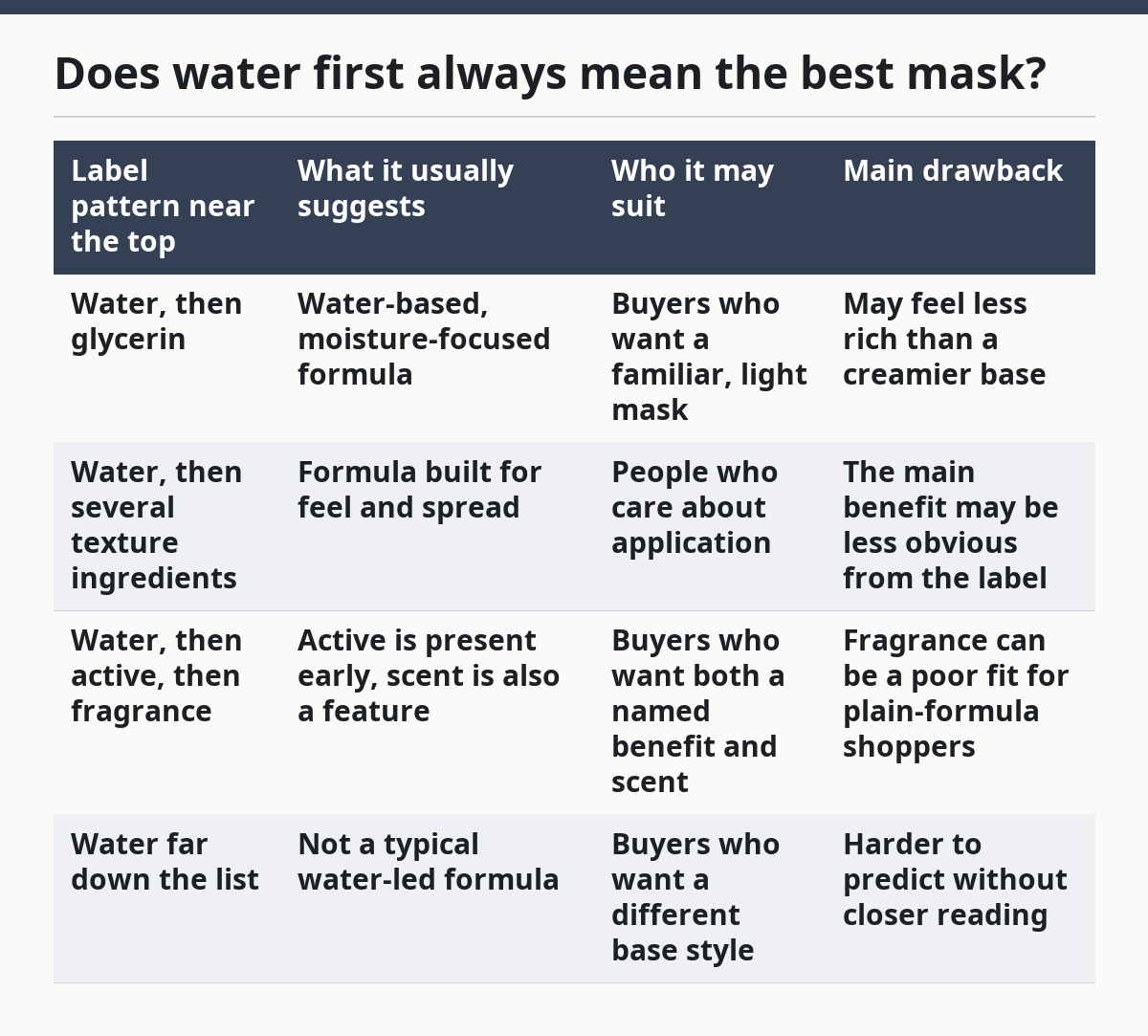
This is where many shoppers get tripped up: they think the first ingredient is the whole story. It is not. The first ingredient is the biggest piece, but the next few items show whether the formula is really built around hydration, texture, scent, or a named active.
If your goal is a simple, low-drama pick, a water-led formula with a short top section is easier to judge than a long, crowded list. If your goal is a richer or more specialized mask, the top of the list matters even more, because that is where the trade-off usually shows up.
Where should actives sit on the label?
Actives should sit high enough to signal that they are part of the formula, but not every low-placed active is useless. The honest answer is that ingredient order tells you relative presence, not exact strength.
A face mask with an active near the top usually gives that ingredient a bigger role in the formula than one that appears near the bottom. That makes the label easier to trust when you want a mask built around a specific effect. If the active appears after a long list of water, glycerin, and texture ingredients, it may still be included, but it is likely there in a smaller amount.
That is why shoppers often ask how to tell if an active is high enough on the list. The practical answer is to compare it with the first few ingredients, not with the entire panel. If the active is in the first third of the list, it is easier to treat it as a meaningful part of the formula than if it is buried near the end.
One honest limit: ingredient order does not tell you exact percentages for most cosmetic items. It tells you relative position. A mask with a lower-listed active is not automatically weak, and a mask with a high-listed active is not automatically better. The rest of the base still matters.
This is also where a generic article often goes wrong. It treats actives as the only thing worth reading. That is backwards for shopping. The base ingredients shape the mask you live with; the active shapes the story you are buying. Both matter, but the base comes first.
What should I do about fragrance?
Fragrance should be one of the last things you check because it can change the experience of the mask even when the rest of the formula looks good. A fragrance line near the end often means the amount is small, but it still may matter to someone who wants a plain product.
If you like scented masks, fragrance near the bottom is usually less of a concern than fragrance up near the top. If you want the most stripped-back label you can find, choose a formula without a prominent fragrance entry or with a short list that does not center scent.
The mistake here is easy to make: buyers see glycerin or an active they like and ignore fragrance until after the purchase. That can cost you comfort. A mask can look perfect on paper and still be the wrong choice if the scent is stronger than you prefer.
There is a second cost too, and it is subtle. A scent-heavy formula can crowd out simpler ones when you are comparing products quickly. If you are choosing between two masks in under a minute, fragrance is the detail that often separates a practical pick from a regret.
For shoppers who care most about a plain formula, the cleaner route is simple: compare the first 5 ingredients, then check whether fragrance appears at all. That is faster than trying to decode the whole list.
Which label pattern is right for me?
The right label pattern is the one that matches the kind of mask you want, not the one with the most familiar name on the front. Ingredient order is useful because it helps you sort water-led formulas, glycerin-led formulas, active-led formulas, and scent-heavy formulas before you spend.
A practical way to choose:
- Pick your main goal first. Hydration, scent, or a named active.
- Read the first ingredient. Water usually means a water-based base.
- Read the next 3 ingredients. Look for glycerin if moisture matters, or for the active if the formula claims a specific benefit.
- Check where fragrance sits. Decide whether it is acceptable for you.
- Choose the shorter, clearer label if two masks seem similar. A simpler top section is usually easier to predict.
This method works because it mirrors how formulas are built. The first ingredients make the biggest impression on feel and function. The later ingredients fine-tune the formula. That is why ingredient order matters in a face mask: it gives you a map of the formula before you open the box.
It also tells you who a mask is not for. A scented mask is not the best pick for someone who wants a plain label. A formula with the active buried low is not the best pick for someone shopping mainly by that active. A rich, non-water-led formula is not the best pick for someone who wants a lighter base.
If you want a fast rule that fits most buying decisions, use this one: buy from the top of the ingredient list down, not from the front label up. That keeps the choice grounded in the formula itself, which is the part that matters once the package is open.
Drafted with AI; not yet reviewed by a person.



Leave a Reply