



Last updated: November 19, 2026
Key Takeaways
- Common additives can shape mask texture in different ways, including xanthan gum, carbomer, and cellulose gum.
- A quick read starts with the thickener, emulsifier, and suspension support in the formula.
- Ingredient function matters more than whether a name sounds familiar.
Common face mask additives explained: thickeners, stabilizers, and fillers are the non-active ingredients that change how a face mask feels, spreads, and stays mixed. They are the texture, stability, and suspension tools in the formula—not the main treatment ingredient. If you are unsure what a product is doing for your skin, consult a professional and check a source such as the U.S. Food and Drug Administration’s cosmetics overview. This guide breaks down what thickeners, stabilizers, emulsifiers, and fillers do, and what they’re often confused with.
In short: if a mask is too runny, separates in the jar, or feels gritty, these additives are usually why it works the way it does.
What face mask additives do in a formula
Picture this: you open a clay mask, and it holds a smooth peak instead of pouring like lotion. That behavior often comes from thickeners, stabilizers, fillers, and emulsifiers working together in the jar, often at just 0.1% to a few percent of the formula.
The job is practical, not flashy. A thickener gives body. A stabilizer keeps the formula from separating. An emulsifier helps oil and water stay mixed. A filler can bulk up the product or improve slip without acting like the main treatment ingredient. If you’re reading an ingredient list, these names usually explain texture more than skin claims. If you are unsure how an ingredient will affect a specific mask, consult a professional and refer to an authoritative source such as the Cosmetic Ingredient Review.
Common examples include xanthan gum, carbomer, cellulose gum, and polysorbates. Those names show up in wash-off clay masks, cream masks, gel masks, and peel-off masks.
- Xanthan gum: a plant-derived thickener and stabilizer
- Carbomer: a polymer that builds gel texture
- Cellulose gum: a thickener from cellulose
- Polysorbates: emulsifiers that help oil and water stay blended
- Fillers: low-cost or texture-building ingredients, depending on the formula
The catch: the same ingredient can play more than one role. A gum can thicken and stabilize. A polysorbate can also help disperse fragrance or oils. That’s why ingredient labels are better read as a system, not as a list of solo players.
If you want the bigger picture, this page sits inside the larger guide to face mask ingredients and formulation science.
Which additive does what in a face mask?
Picture this: you scoop a mask and it clings to the spatula instead of dripping into the sink. That result usually comes from a thickener, while a stabilizer keeps the same texture from changing after a few weeks on the shelf.
A thickener changes viscosity. It makes a gel feel like a gel, a cream feel richer, and a clay mask less watery. Xanthan gum, carbomer, and cellulose gum are common examples. They do not usually act as the main “active” skin ingredient; they help the formula behave.
A stabilizer keeps the formula from splitting, settling, or thinning out too fast. In mask formulas, that often means helping suspended clays, powders, oils, or pigments stay evenly distributed. Some ingredients do both jobs at once.
A filler is different. It can mean a powder or base ingredient that adds body, cost control, or glide, but doesn’t drive the mask’s main benefit. In cosmetics, “filler” is not always a bad word, but the label can be used loosely, so consult a professional or a formulation source before judging a formula by that term alone.
- Texture agent: a broad term for ingredients that change feel
- Thickener: raises viscosity
- Stabilizer: reduces separation or settling
- Filler: adds bulk, structure, or slip
- Emulsifier: helps mix oil and water
The best part? These jobs overlap in real formulas, so a single ingredient may have two or three functions. A label won’t always spell that out.
What makes xanthan gum, carbomer, and cellulose gum different?
Picture this: you’re comparing two masks that look similar on the shelf, but one feels bouncy and the other feels slick. The difference may come from xanthan gum, carbomer, or cellulose gum, which build texture in very different ways.
Xanthan gum is a common thickener in gel and cream masks. It works well at low use levels and helps suspend particles. It can feel slightly stringy if the formula is pushed too far, which is one reason formulators often pair it with another texturizer.
Carbomer is a synthetic polymer used to make clear gels and stable mask bases. It can create a clean, glassy look and a strong gel structure, but it usually needs neutralization to thicken properly. Without the right pH, it won’t build the texture the formulator wants.
Cellulose gum is another thickener used to improve body and reduce separation. It often gives a softer, less glossy feel than carbomer. It can also help with slip, which matters in masks that need to spread in a thin layer over 5 to 15 minutes.
Here’s a quick way to think about them:
| Ingredient | Typical role | Common feel |
|---|---|---|
| Xanthan gum | Thickener, stabilizer | Slightly elastic |
| Carbomer | Gelling agent | Smooth, clear, firm |
| Cellulose gum | Thickener, stabilizer | Soft, cushioned |
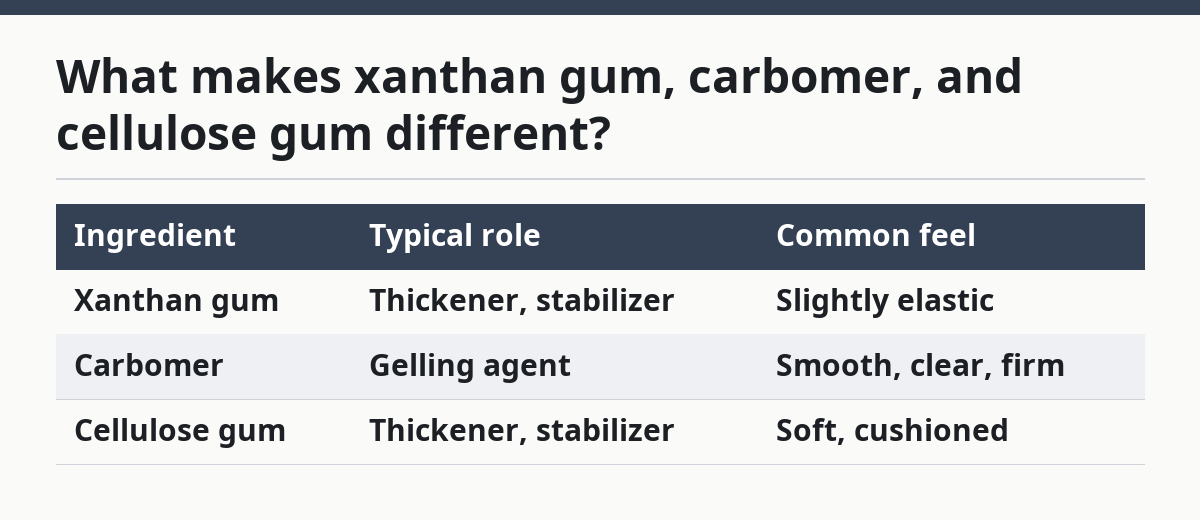
The truth is, none of these ingredients is “better” in the abstract. Carbomer suits clear gels. Xanthan gum suits suspension. Cellulose gum can be a middle ground. The right choice depends on the mask’s water phase, oil phase, and how the final product should spread.
Why do face masks contain emulsifiers and polysorbates?
Picture this: you open a mask that contains oils and water, and it still looks uniform after a month on the shelf. That consistency usually depends on an emulsifier, and polysorbates are one of the best-known examples.
An emulsifier helps oil and water stay blended. Without it, a mask with both phases can separate into layers or look blotchy. In a cream mask, that means the water phase and the oil phase stay together long enough for you to use the product evenly from the first scoop to the last.
Polysorbates are often used when the formula contains fragrance, oils, or other ingredients that don’t naturally mix with water. They act like translators between phases. In wash-off masks, they can also help spread ingredients more evenly through the jar.
This matters because a face mask doesn’t need to separate to fail. It can also be unstable in a subtler way: oil beads on top, pigments sink, or texture shifts from batch to batch. An emulsifier helps prevent that.
- Oil-in-water mask: usually lighter and easier to rinse
- Water-in-oil mask: richer, less common in simple wash-off masks
- Polysorbates: support dispersion and blending
- Emulsifying system: the full set of ingredients that holds the texture together
On the flip side, an emulsifier is not the same thing as a preservative. It keeps phases mixed; it does not stop microbial growth. That confusion shows up often in casual ingredient advice, and it leads readers to expect the wrong job from the wrong ingredient.
Common mistakes people make when reading these ingredients
Picture this: you scan an ingredient list, see a long chemical name, and assume it must be harsh or unnecessary. That’s a bad read on face mask additives, because many of the “extra” ingredients are the reason the mask is usable at all.
The biggest mistake is treating every additive like a filler in the insulting sense of the word. In formulation science, a filler can be a texture aid, a carrier, or a bulk ingredient that keeps the product stable. Without those pieces, the mask may separate, dry out oddly, or spread unevenly.
Another mistake is assuming a thickener is the same as an active ingredient. Xanthan gum or carbomer changes feel, not the main skin promise. If a label leans on a thickener, that tells you about the formula’s structure, not its treatment power.
A third mistake is reading “natural” as automatically simpler. A plant-derived gum can still be more technically important than a synthetic polymer, and a synthetic emulsifier can be the ingredient that prevents the product from failing in the jar.
Use this checklist instead:
- Identify the role, not just the name.
- Look for patterns: gums, polymers, polysorbates, clays, starches.
- Separate texture from treatment.
- Expect overlap: one ingredient can thicken and stabilize.
- Read the formula as a whole, not as a single scary word.
That’s the cleanest way to avoid overreacting to ingredients that are doing ordinary, useful work.
How to read a mask formula for thickeners, stabilizers, and fillers
Picture this: you have the ingredient list in front of you and want to know why the mask feels the way it does before you buy it. The fastest answer often comes from spotting where the thickener sits, what kind of emulsifier appears, and whether the formula needs suspension support.
Start at the middle of the ingredient list. Ingredients are usually listed in descending order by weight until they reach very small amounts. If you see water first, then a humectant, then xanthan gum or carbomer, that gum is likely there to shape texture rather than dominate the formula.
Then look for the supporting cast:
- Thickeners: xanthan gum, carbomer, cellulose gum
- Stabilizers: gums, polymers, clay dispersants
- Emulsifiers: polysorbates and related systems
- Fillers: powders or base materials that improve body or spread
If the mask is a clay mask, a stabilizer may keep the clay particles from settling too fast. If it’s a cream mask, an emulsifier matters more because the formula has oil and water in the same jar. If it’s a gel mask, carbomer or cellulose gum may be doing most of the visible work.
One honest limitation: ingredient lists rarely tell you the full formulation story. A mask can use a small amount of a strong polymer and still feel thick because of pH, salt balance, or the rest of the formula. So the label gives clues, not the full recipe.
That’s why a generic ingredient page often misses the real point. It names the ingredient but not the job.
Which additives are not the same thing as preservatives or actives?
Picture this: you see a mask with a long list of extra ingredients and assume they are all there for shelf life or skin treatment. That’s wrong. Thickeners, stabilizers, emulsifiers, and fillers are not the same as preservatives or active ingredients.
A preservative keeps a formula from spoiling. That is a different job from keeping it thick or mixed. A thickener changes viscosity. A stabilizer controls separation. An emulsifier holds oil and water together. None of those automatically stops microbial growth.
An active ingredient is also different. That is the ingredient the brand is usually using for a skin result, such as a clay, acid, botanical extract, or soothing agent. The supporting ingredients make the active easier to apply, easier to store, and more even in the jar.
This distinction matters because readers often judge a formula by the longest or hardest-to-pronounce ingredient name. That misses the structure of the product. A well-built mask may rely on a plain-looking gum or polymer to do the hard work.
- Preservative: protects the formula from spoilage
- Active: delivers the main skin claim
- Additive: supports texture, stability, or mixing
- Filler: may build body, but not the main claim
The clean takeaway is simple: don’t lump every extra ingredient into one bucket. The bucket label tells you almost nothing.
Why ingredient names matter less than ingredient jobs
Picture this: you want to know whether a face mask will spread cleanly, stay blended, and feel right on skin for the full use time. The answer comes from the job each ingredient performs, not from whether the name sounds familiar.
A mask built with xanthan gum may feel elastic and hold particles well. A mask built with carbomer may feel sleek and clear. A formula using polysorbates may stay uniform even with oil-based parts. A formula using cellulose gum may land somewhere softer and less glossy. Those are practical clues, not moral judgments about “good” or “bad” ingredients.
This is where filler language gets sloppy. Some fillers are true bulk agents. Others are structure helpers. Some are there to improve spread so the user gets a thinner, even coat instead of clumps. In a wash-off mask, that can be the difference between a formula that rinses evenly and one that drags across the skin.
So the useful question is not “Is this additive natural?” It’s “What does this additive do in this mask?” That question gets you closer to the truth, and it cuts through label noise fast.
FAQ
Why do face masks contain thickeners?
Face masks contain thickeners so the formula stays in place, spreads evenly, and feels the way the brand intended. A thickener like xanthan gum or carbomer can stop a mask from running off the spatula or separating in the jar.
Are fillers bad in skincare?
Fillers are not automatically bad in skincare. In a mask, a filler may help with texture, spread, or product stability, and some are part of a normal formula structure. The problem is not the word itself; the problem is using it as a label for ingredients without knowing what job they do.
What does a stabilizer do in a mask?
A stabilizer helps a mask keep the same texture over time. It can reduce separation, settling, or thinning, especially in formulas with clays, powders, or mixed oil-and-water phases. That keeps the product more uniform from the first use to the last.
Drafted with AI; not yet reviewed by a person.



Leave a Reply