




Last updated: November 19, 2026
Quick answer: 5 ingredients are the main ones to skip in a homemade face mask if you want to lower the risk of sting, dryness, and irritation. Homemade face masks can turn irritating fast when you mix in the wrong kitchen items. Skip lemon juice, baking soda, essential oils, scrubs, and apple cider vinegar if you want to avoid sting, dryness, and skin damage. This guide on what not to mix into a homemade face mask shows what to leave out, why it causes trouble, and what to do instead.
Key Takeaways
- The main issue is usually one harsh add-in in an otherwise simple mask.
- Some mixes are a poor fit for facial skin, especially when acid, friction, and fragrance stack together.
- On facial skin, scrubs can hurt because they add abrasion where the skin is thin and easy to irritate.
- Essential oils may seem harmless, but they are a frequent source of irritation and allergy.
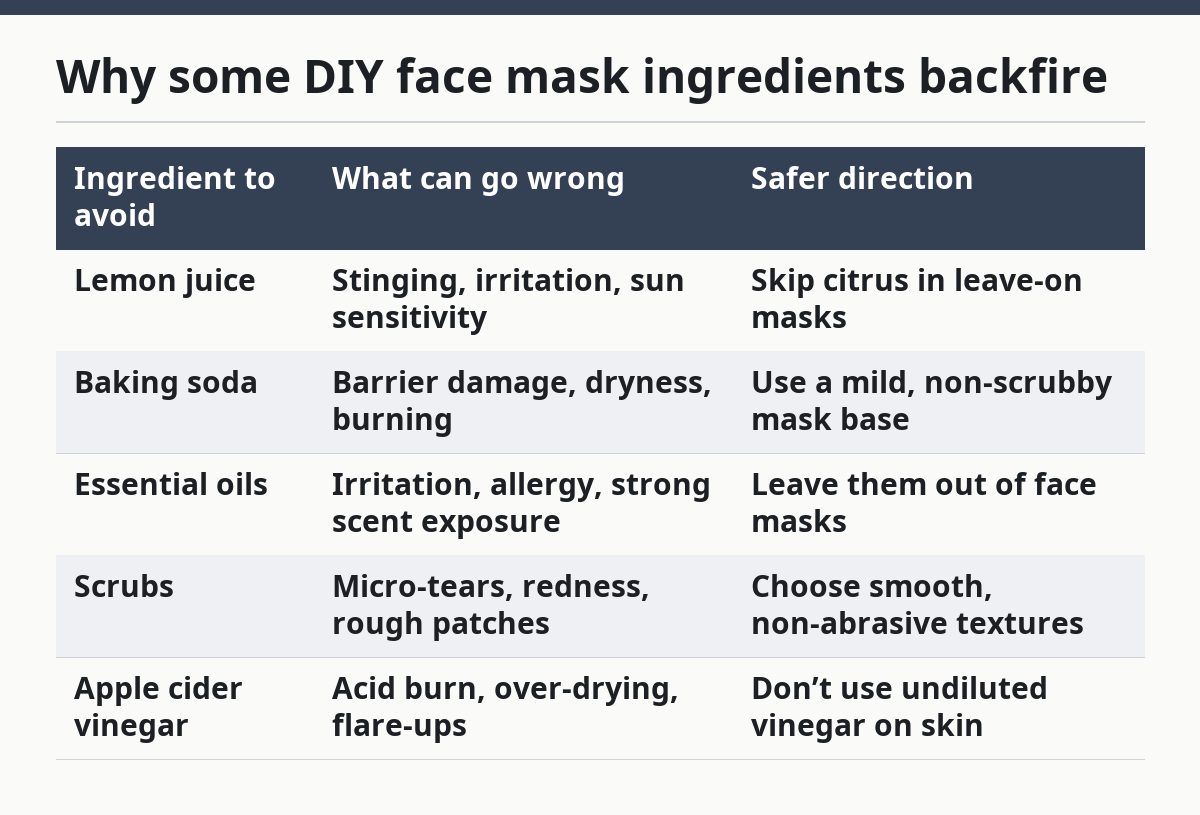
Why some DIY face mask ingredients backfire
Picture this: you’ve got a bowl on the counter, a spoon in hand, and a skin flare-up you did not plan for. The problem is usually one harsh ingredient added to an otherwise simple mask, not the recipe as a whole.
Some DIY face mask ingredients act like a chemical peel, a scouring pad, or a perfume overload. That can leave skin red, tight, or more sun-sensitive than before. If you already use a retinoid, a prescription acne product, or any strong exfoliant, the risk goes up. For ingredient and skin-safety guidance, see the American Academy of Dermatology and the NIH Office of Dietary Supplements on essential oils.
Here’s the catch: “natural” does not mean gentle. Lemon juice is still acidic. Baking soda is still highly alkaline. Essential oils are still concentrated plant compounds, and concentration is often the issue. In practical terms, that means a recipe with 3 risky ingredients is usually a worse bet than one with 1.
| Ingredient to avoid | What can go wrong | Safer direction |
|---|---|---|
| Lemon juice | Stinging, irritation, sun sensitivity | Skip citrus in leave-on masks |
| Baking soda | Barrier damage, dryness, burning | Use a mild, non-scrubby mask base |
| Essential oils | Irritation, allergy, strong scent exposure | Leave them out of face masks |
| Scrubs | Micro-tears, redness, rough patches | Choose smooth, non-abrasive textures |
| Apple cider vinegar | Acid burn, over-drying, flare-ups | Don’t use undiluted vinegar on skin |
The best part? The fix is simple: fewer ingredients, not more. A shorter ingredient list also makes it easier to spot the one thing that goes wrong.
What not to mix into a homemade face mask
Picture this: you are mixing a quick mask from pantry items, and every ingredient seems harmless on its own. The truth is, some combinations are a bad fit for facial skin, especially when they stack acid, friction, and fragrance in the same bowl.
The biggest troublemakers are lemon juice, baking soda, essential oils, physical scrubs, and apple cider vinegar. These are the items that most often turn a DIY mask into a burn, rash, or dry patch problem. In studies and dermatology guidance, irritation from acids and abrasives is a recurring theme, not a one-off concern.
- Lemon juice: Its acidity can sting, especially on skin that is already dry, broken out, or freshly shaved. It can also make skin more reactive to daylight, which is why citrus belongs in the “don’t improvise” bucket.
- Baking soda: This is a common mistake. Baking soda has a very different pH from skin, so it can strip away the surface barrier and leave skin feeling tight or raw.
- Essential oils: Tea tree, lavender, peppermint, and similar oils are concentrated. A few drops in a small bowl can still be too much for facial skin, especially around the eyes, cheeks, and upper lip.
- Scrubs: Sugar, salt, coffee grounds, crushed seeds, and walnut-style powders can scratch instead of smooth. On the face, that roughness can mean more redness, not less.
- Apple cider vinegar: Undiluted vinegar is too sharp for a leave-on mask. Even when diluted, it can still irritate sensitive or compromised skin.
If a mask already has one of these in it, do not “balance it out” with more ingredients. A second harsh ingredient does not cancel the first one. It often makes the problem worse.
Why lemon juice and apple cider vinegar are bad DIY actives
Picture this: you want a brightening mask, so you reach for something acidic because it sounds effective. That’s where DIY actives get people in trouble, because strong kitchen acids are not the same thing as a carefully formulated skincare acid.
Lemon juice and apple cider vinegar are the two most common offenders. Both can sting on contact, and both can cause trouble when left on the skin for even a short time. The face is not a cutting board. It does not need a marinade.
A lot of beginner recipes treat these as quick fixes for dullness, spots, or texture. Dermatology sources caution that acidic DIY ingredients can irritate skin, especially when used repeatedly or alongside other actives. If you’re already using exfoliating acids, retinoids, or acne treatments, adding a kitchen acid can be too much, so it is worth checking with a dermatologist or another qualified professional first.
- Do not combine lemon juice with baking soda and call it a “balanced” mask. The fizz is a reaction, not a safety check.
- Do not mix apple cider vinegar with scrubs. Acid plus abrasion is a rough deal for facial skin.
- Do not use citrus before sun exposure. The concern is not just immediate sting; it’s the way some citrus oils and juices can make skin more reactive.
A less risky move is to skip the acid entirely and choose a bland, smooth base. That way the mask does one job: sit on the skin without turning into a chemistry lesson.
For a broader look at the full kitchen-ingredient picture, this page sits under the hub on DIY face masks and kitchen-ingredient care.
Why baking soda is a bad idea on facial skin
Picture this: you have a breakout, and baking soda looks like a cheap way to “dry it out.” That is exactly the trap. Baking soda is one of the worst DIY face mask add-ins for facial skin because it can disrupt the skin barrier and leave skin more reactive, not less.
The problem is not just that it can feel harsh in the moment. It can also leave skin too stripped to handle the rest of your routine. If your face feels squeaky clean after a mask, that usually means it has gone too far.
Here’s what that can look like:
- tightness that starts within minutes
- burning when you apply moisturizer
- flaky patches the next day
- a flushed look that does not settle quickly
If you were hoping baking soda would act like a gentle exfoliant, it does not fit that job. Physical scrubs already create friction; baking soda adds another layer of irritation. That combination can be especially rough on sensitive cheeks and around the nose, where the skin is already vulnerable.
The better move is to keep the mask smooth and low-drama. If you want exfoliation, use a product made for facial skin rather than a kitchen powder that was never meant to sit on your face for 10 to 20 minutes.
Not even close.
Why scrubs and gritty textures cause more harm than help
Picture this: you open the pantry and think, “A little texture can’t hurt.” On facial skin, scrubs often do hurt, because they add abrasion where the skin is thin and easy to irritate.
Sugar, salt, coffee grounds, crushed nut shells, and other gritty bits are not kind to the face. They can drag across the skin instead of polishing it. That can leave tiny raw spots, especially if you rub hard or use the mask on an area that is already inflamed. Even one rough ingredient can be enough to turn a simple mask into a problem.
The roughest mistake is pairing a scrub with an acid. That is the skin-care version of sanding wet paint. One ingredient scratches, the other stings, and the face ends up paying for both.
- Avoid scrubby add-ins if you have acne, eczema, rosacea, or a recent shave.
- Skip coarse particles if the mask is meant for the under-eye area or around the nose.
- Use a smooth base if you want a leave-on mask that rinses off cleanly.
A plain texture matters more than people think. A silky mask can still be useful without having anything “active” in it. On the flip side, a gritty one can turn a calm routine into a red one.
Can essential oils go in a face mask?
Picture this: you want your mask to smell fresh, so you add lavender, tea tree, or peppermint oil and assume a few drops can’t matter. Essential oils can go in a face mask only in theory; in practice, they are a common cause of irritation and allergy.
Essential oils are concentrated, which is the whole point of the bottle and the problem in a face mask. Even a small amount can be too strong for cheeks, jawline, or the skin near the eyes. Some oils also have a strong scent that lingers, which is a bad fit if your skin is already reactive. The American Academy of Dermatology and NIH guidance both treat fragrance exposure as a common source of trouble.
People often make two mistakes here. First, they add an oil because they like the smell. Second, they assume “natural” means safe in any amount. Neither is a good rule for facial skin.
- Do not add essential oils to a mask if you have sensitive skin.
- Do not use them near the eyes, nostrils, or lips.
- Do not stack them with acids or scrubs.
If a recipe calls for an essential oil and you are not sure how your skin will react, the safest substitution is no scent at all. A face mask does not need to smell like a spa to be useful.
A simple way to check a DIY mask before it touches your face
Picture this: you have a bowl ready, but one ingredient looks borderline and you are tempted to “see what happens.” That is the moment to stop and run a quick safety check. The safer choice is to remove anything acidic, gritty, or strongly scented before the mask goes on skin.
Use this short procedure before you apply any homemade face mask:
- Read every ingredient out loud and circle the risky ones: lemon juice, apple cider vinegar, baking soda, scrubs, and essential oils.
- Check the texture in the bowl. If it feels sharp, grainy, or oily, do not apply it to your face.
- Remove any ingredient that can sting, scratch, or perfume the mask heavily. One bad add-in is enough to make the whole batch a poor choice.
- Apply a small amount to the jawline or inner forearm first, then wait 10 to 15 minutes. Mild warmth is one thing; burning, itching, or redness is a stop sign.
- Rinse with lukewarm water, not hot water, and pat dry. If the skin looks angry, skip the rest of the mask entirely.
This is not about being cautious for the sake of caution. It is about avoiding the easy mistakes that turn a kitchen idea into a skin problem. If you are trying a new recipe and it includes one of the ingredients above, leave it out first and see what’s left. In other words, test the simplest version before you add more.
What makes a DIY mask unsafe?
Picture this: you are staring at a list of “clean” ingredients and trying to tell which one turns a nice idea into a bad one. A DIY mask becomes unsafe when it combines irritation, friction, and unpredictability on facial skin.
The warning signs are usually simple. The recipe uses strong acids like lemon juice or vinegar. It includes abrasives like sugar or coffee grounds. It uses concentrated essential oils. It adds baking soda in the hope of “detoxing” or “balancing” skin. Any one of those can be a problem; two or three together are worse. Dermatology groups repeatedly warn against mixing strong actives without knowing how skin will respond.
A mask can also be a bad fit if it is meant to sit on skin for a long time, because the longer contact time gives irritants more room to work. If a recipe sounds more intense than your regular cleanser, it is probably too much for a face mask.
You do not need a long ingredient list to make a mask unsafe. A short one can do it. The rule is simple: if the recipe asks skin to endure acid, scratch, or strong fragrance at the same time, pass.
FAQ
Why is baking soda bad for your face?
Baking soda is bad for your face because it can disrupt the skin barrier and leave skin dry, tight, or burned-looking. It is not a gentle exfoliant, and it can be rough on already sensitive skin. If a recipe uses it with acids or scrubs, the irritation risk goes up.
Can essential oils go in a face mask?
Essential oils can go in a face mask only with serious caution, and most DIY recipes are better without them. They are concentrated and can trigger irritation or allergy, especially around the eyes and mouth. If a mask already smells strongly, that is usually enough of a warning.
What makes a DIY mask unsafe?
A DIY mask is unsafe when it uses ingredients that sting, scratch, or overwhelm facial skin. Lemon juice, apple cider vinegar, baking soda, scrubs, and essential oils are common troublemakers. A mask that feels harsh in the bowl usually feels harsh on the face, too.
Drafted with AI; not yet reviewed by a person.



Leave a Reply