



Last updated: November 19, 2026
Quick Answer: A homemade face mask for sensitive skin usually works best with 3 ingredients or fewer, no fragrance, and a smooth texture. The steps below show how to adjust a homemade face mask for sensitive skin without adding more irritation.
Key Takeaways
- A homemade face mask is gentler on sensitive skin with 3 or fewer ingredients, no fragrance, and a soft spread.
- To adjust a homemade face mask for sensitive skin, remove irritants first, then test texture, then add one calming ingredient at a time.
- Cut fragrance first, then harsh acids, then anything gritty.
- Yes, but only as simple, fragrance-free ingredients and only if your skin already tolerates them.
Your homemade face mask stings, reddens, or leaves your skin tight. The fix is to strip it down, keep it fragrance-free, and swap in bland ingredients like oats, aloe vera, or plain yogurt only if they already suit your skin.
In short: a thinner, simpler mask with fewer ingredients is often the safer place to start. The steps below settle what to keep, what to drop, and what to do if your skin starts to complain.
What makes a homemade face mask easier on sensitive skin?
A homemade face mask is easier on sensitive skin when it uses 3 or fewer ingredients, skips fragrance, and stays soft enough to spread without scrubbing. That means less rubbing, less residue, and fewer chances for a reaction.
Picture this: you’re standing at the sink with a bowl, a spoon, and a patch of red skin that flared up after your last mask. The goal is not a spa moment; it is a gentler mix that does less. A plain oat base, a spoon of aloe vera gel, or a little plain yogurt can be calmer choices than a bright, scented, scrubby mash.
The first move is usually to remove the “extra” things that make a DIY mask feel fancy. Fragrance, lemon juice, cinnamon, and rough bits can turn a simple recipe into a skin irritant fast. Honey can be soothing for some people, but it still belongs in a careful, small-batch formula, not a heavy one.
- Use a fragrance-free base.
- Keep the mask smooth, not gritty.
- Choose one soothing add-in at a time.
- Skip anything that burns on contact.
A plain formula also helps you spot the troublemaker. If a mask has oats, honey, aloe, and yogurt all at once, you cannot tell which part bothered your skin. That matters when the skin is reactive and you need to cut the recipe back.
How do you adjust a homemade face mask for sensitive skin?
You adjust a homemade face mask for sensitive skin by removing irritants first, then testing a simpler texture, then adding only one calming ingredient back at a time. That is the cleanest way to make the mask gentler without guessing.
Picture this: you’re halfway through mixing and the bowl already smells like breakfast. Good. Now keep going in the direction of plain. A sensitive-skin version usually needs less acid, less scent, and less friction than the recipe online promised.
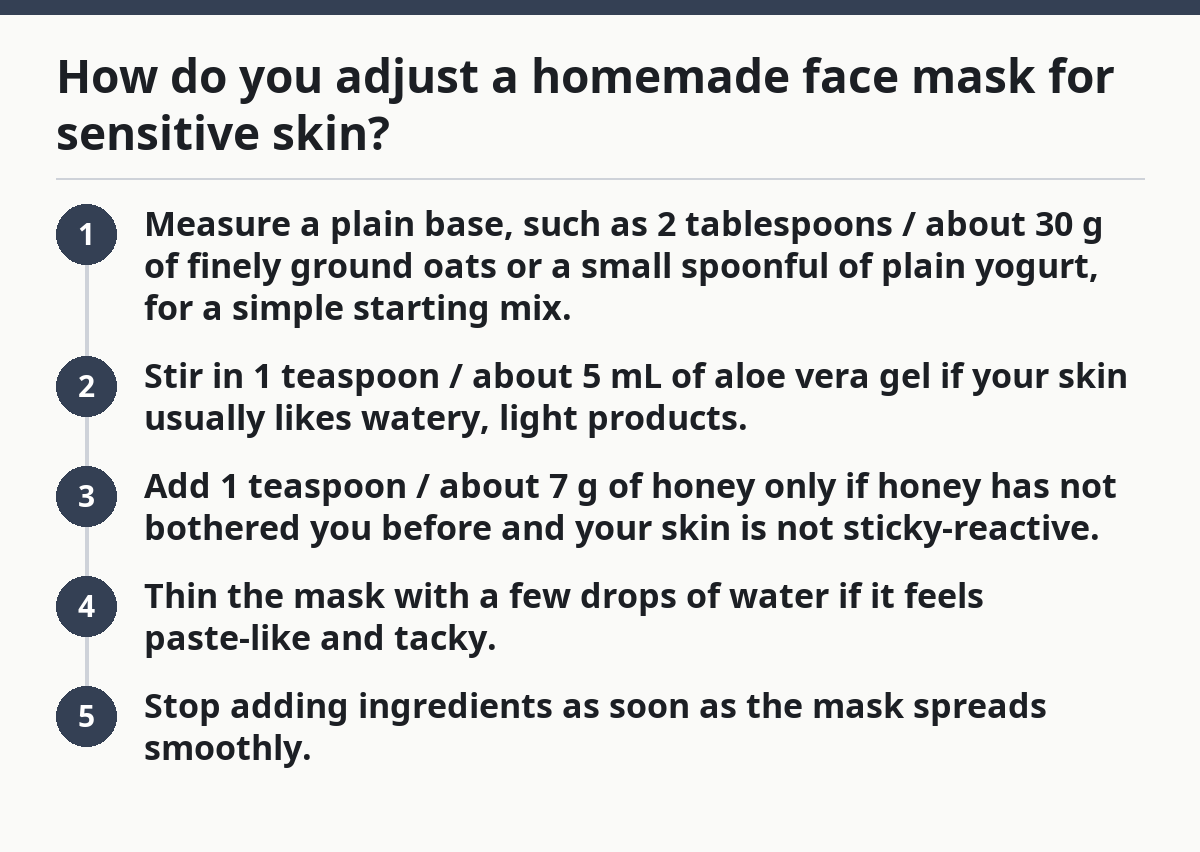
- Measure a plain base, such as 2 tablespoons / about 30 g of finely ground oats or a small spoonful of plain yogurt, for a simple starting mix.
- Stir in 1 teaspoon / about 5 mL of aloe vera gel if your skin usually likes watery, light products.
- Add 1 teaspoon / about 7 g of honey only if honey has not bothered you before and your skin is not sticky-reactive.
- Thin the mask with a few drops of water if it feels paste-like and tacky.
- Stop adding ingredients as soon as the mask spreads smoothly.
The texture should feel soft, not grainy and not glue-thick. If you need to press hard to spread it, the mask is too rough for sensitive skin. If it runs off your face, it is too thin to stay put and will invite rubbing during cleanup.
A plain oat mask often works as the easiest base because oats can be ground into a very fine powder. If the oats are coarse, they can scratch. That is a common mistake, and it costs you comfort right away. Use a finer grind or another base.
Which ingredients should I cut first?
Cut fragrance first, then harsh acids, then anything gritty. Those are the ingredients most likely to make a homemade face mask feel hot, itchy, or tight on sensitive skin.
Picture this: you’re reading a recipe that calls for cinnamon, citrus juice, sugar, and a few drops of essential oil. That is not a sensitive-skin mask. It is a pile of possible irritants with a face-shaped plan.
The easiest way to simplify is to separate soothing from risky. Oats are bland and useful. Aloe vera is light and often chosen for a calming feel. Plain yogurt adds a creamy texture, but it also brings dairy, which some people prefer to avoid. Honey can add slip, yet it can leave skin sticky and is not the right call for everyone.
- Fragrance: remove it completely, even if the scent is “natural.”
- Citrus juice: skip it; acid plus sensitive skin is a bad pair.
- Scrubs and sugar: they add friction, not calm.
- Spices: leave them for the kitchen.
Here’s the catch: “natural” does not mean gentle. A homemade mask can contain ingredients from the pantry and still feel sharp on the skin. The word “kitchen” is not a safety label.
If you want a lower-irritation version, keep the recipe close to a single base. Oatmeal and water is one simple path. Oatmeal plus aloe vera is another. Yogurt can be the creamy option, but if your skin stings around dairy, leave it out and stay with oats or aloe.
Can oats, aloe vera, honey, or yogurt help?
Yes, but only as simple, fragrance-free ingredients and only if your skin already tolerates them. Each one plays a different role, and none of them is a cure-all. If you have persistent irritation, consult a dermatologist or other qualified professional.
Picture this: you’re choosing between a bowl of oats, a bottle of aloe vera gel, a jar of honey, and a spoon of plain yogurt. The best choice is often the one that keeps the mask simpler, not more elaborate.
Oats are usually the easiest starting point because they can be made very fine and blended with water into a soft paste. That gives you texture without perfume. Aloe vera brings moisture and a slippery feel, which can reduce the drag of spread-on-and-wash-off masks. Honey gives a thicker, tackier finish that some people like, but it can feel heavy on very reactive skin. Plain yogurt gives a creamy mask and may feel cooling, yet dairy is a common enough concern that it should stay optional.
- Oats: best when finely ground; skip if coarse.
- Aloe vera: best as a small add-in, not the whole mask.
- Honey: best in a light formula, not a thick one.
- Plain yogurt: best when your skin tolerates dairy.
The trade-off is simple. The more ingredients you stack, the harder it is to predict how your skin will react. A mask with oats and water is easier to read than a five-ingredient bowl that mixes scent, acid, and texture at once. That is why restrained formulas are the smarter bet for sensitive skin.
How should I patch test a homemade face mask?
You should patch test a homemade face mask on a small area before putting it near your whole face. That is the safer way to catch burning, itching, or redness before you commit to the full mask.
Picture this: you’re tempted to smear the mix across your cheeks because it “seems gentle enough.” Don’t. A small test spot saves you from a full-face mess if your skin objects.
Use a pea-sized amount on the inner arm or behind the ear, then leave it alone long enough to see whether the skin gets angry. If it tingles briefly and then settles, that is still not a green light for everyone; sensitive skin can react later. If you already know a specific ingredient causes trouble, leave it out entirely instead of testing your luck.
- Apply a pea-sized amount.
- Keep it on a small patch of skin.
- Watch for redness, itching, burning, or swelling.
- Wash it off if the skin starts to complain.
The key is restraint. A patch test is not a challenge. It is a filter. If a formula causes warmth, stinging, or a rash-like look, the mask is not a fit for sensitive skin, even if the ingredient list sounds gentle on paper.
What should I do if the mask still irritates my skin?
Stop using it, wash it off with cool water, and simplify the recipe before trying again. If your skin reacts, the mask is too strong, too gritty, or too fragranced for that day.
Picture this: you’re ten minutes into a mask and your face starts to sting. That is your cue to get it off, not to wait and see if it “works through.” Sensitive skin often gives a fast answer.
The next adjustment should be a subtraction, not a substitution spree. Remove honey if the mask feels sticky or hot. Remove yogurt if dairy seems suspect. Remove any scent, spice, citrus, or coarse particles. Then rebuild with one plain base, such as finely ground oats mixed with water or aloe vera.
- Rinse with cool water, not hot water.
- Use a soft cloth only if needed.
- Dry by patting, not rubbing.
- Restart with one ingredient if you try again.
The real mistake is trying to rescue an irritating mask by making it richer or more “active.” More ingredients usually means more trouble. Sensitive skin does better with a quiet formula and a short ingredient list.
For broader DIY ideas beyond sensitive skin, the hub on DIY face masks and kitchen-ingredient care covers the wider kitchen side of this topic without repeating the same recipe logic here.
What ingredients should sensitive skin avoid in DIY masks?
Sensitive skin should avoid fragrance, citrus juice, rough scrubs, and strong spice ingredients in DIY masks. Those are the most common sources of stinging and redness. If a recipe smells strong, feels scratchy, or tingles right away, it is not a good fit for reactive skin.
Can you use honey on sensitive skin?
You can use honey on sensitive skin if it already suits your skin and the mask stays simple. Honey is not a guaranteed irritant, but it can feel sticky and heavy, so it works best in a small amount with a bland base like oats or aloe vera.
Are homemade masks safe for sensitive skin?
Homemade masks can be safer for sensitive skin when they are very simple, fragrance-free, and used carefully. They are not automatically safe just because they are homemade. A short ingredient list, a smooth texture, and a patch test on a small area are the best safeguards.
Drafted with AI; not yet reviewed by a person.



Leave a Reply