


Last updated: November 20, 2026
Quick answer: clay mask minerals usually change texture in 3 main ways—slip, grip, and dry-down. This article on How clay mask minerals change texture, grip, and dry-down explains why kaolin usually feels smoother and lighter, while bentonite usually feels denser, tackier, and more dramatic as it dries.
Key takeaways
- Clay masks do not all feel the same because the mineral particles differ in size, charge, and water-holding behavior.
- Kaolin tends to make a creamier paste with a softer drag and a gentler dry-down.
- Bentonite usually makes a thicker, more gripping mask that sets faster and can feel tighter as it dries.
- Dry-down is not only about water loss; it also comes from the mineral structure as the paste firms up.
- If a clay mask feels chalky, stringy, or hard to spread, the mineral mix is often the reason.
What makes clay mask minerals feel different?
Clay mask minerals feel different because the particle shape, surface charge, and water-binding ability change how the mask moves on skin and how it dries. The same word “clay” can cover kaolin, bentonite, and other clays, and those do not behave the same way in a tube or jar.
Therefore, kaolin usually gives a smoother, more slip-heavy paste. It spreads with less pull and often leaves a finer, creamier film. Bentonite, which is known for very strong swelling in water, often makes a thicker paste that grips the skin more and can feel more “set” once it starts drying. Mineral powders can also change the feel when they are added to a clay base, since they can make the paste feel drier, grainier, or more matte right away.
Because of that, the ingredient list matters as much as the marketing on the front of the pack. A mask described as “gentle clay” may still feel firm if bentonite sits near the top of the formula. A mask can also contain more than one clay, and that blend can make the paste easier to spread than a single mineral alone.
For a quick reference on the clay minerals themselves, the Britannica entry on kaolin and the Britannica entry on bentonite are useful starting points. The USGS mineral information pages also provide background on common industrial clays used in cosmetics and other products.
Why does one clay spread silkier than another?
One clay spreads silkier than another because the mineral platelets and water retention change the paste’s slip. Kaolin usually makes a softer, more even spread, while bentonite often creates more drag unless the formula includes enough water and humectants to loosen it.
Specifically, the difference shows up fast in the first few strokes. A kaolin-rich mask often feels like a thin cream at first, then settles into a light film. A bentonite-rich mask can feel paste-like from the start, with more resistance under the fingers. That resistance is the “grip” many people notice when they say a clay mask feels stronger or more serious.
Particle size matters too. Finer mineral powders usually feel smoother and more uniform, while coarser mineral loads can feel sandy or chalky. The result is not always poor quality; it can simply mean the formula uses more mineral content or less slip support from oils, humectants, or emulsifiers.
A simple way to think about it is this: the more a mineral holds shape in water, the more the mask can feel structured on the face. That structure can be useful if the goal is a firmer set. It is less useful if the reader wants a cushiony, glide-on texture.
What causes the grip and pull on skin?
The grip and pull come from adsorption and from the way clay particles form a tight film as water leaves the paste. Clay minerals have surfaces that attract and hold certain substances, which is why they are used in masks that aim to bind oil and surface debris. As the water phase thins out, the remaining mineral network tightens and feels more gripping.
That grip is not the same as stickiness from syrup or glue. It is a mineral feel. Bentonite often creates the strongest version because it swells in water and forms a more structured paste. Kaolin usually gives less pull, so it can feel more forgiving when the mask is spread thin.
However, many generic articles flatten “tightness” into a simple drying issue. In practice, the tighter feel is partly the mineral structure itself. A mask with more bentonite can feel like it is “holding” the skin earlier, even before it looks fully dry. A mask with more kaolin may stay movable longer and then dry more quietly.
If a formula includes mineral powders along with clay, the grip can become more immediate because the powders interrupt the creamier flow. That can be a plus in a mask meant to feel mattifying. It can also make the spread rougher and the dry-down less even.
How do clay minerals change dry-down?
Clay minerals change dry-down by controlling how fast water leaves the paste and how rigid the film becomes as it sets. Bentonite tends to dry into a more noticeable, firmer layer; kaolin often dries into a softer, thinner veil. The result is not just “dry” versus “not dry,” but different kinds of dry-down.
For example, a clay mask with more bentonite can look like it moves from wet paste to tight film with little in-between. That can be useful when a formula is meant to feel efficient and matte. It can also feel more aggressive on the face if the user expects a softer finish. Kaolin usually leaves more room for a gentle set, with less visible cracking and less hard pull when movement stops.
The dry-down curve also depends on how much water the formula starts with. A thick paste with a lot of water can still dry slowly even if it contains a strong clay. A thinner paste with less water can dry faster even if the mineral load is mild. That is why “clay” alone does not predict the finish.
Overall, the safest rule is simple: more structured clay minerals usually mean more pronounced dry-down. Less structured, finer clays usually mean a softer one. Neither is automatically better. A person with a very dry skin feel may dislike a hard set. A person who wants a matte, fast-setting mask may find the softer finish too mild.
Which mineral blend gives which texture?
Different mineral blends give different textures because each clay shifts the paste toward either slip, structure, or powdery drag. The common pattern looks like this:
| Mineral or blend | Texture on application | Grip on skin | Dry-down feel |
|---|---|---|---|
| Kaolin-heavy clay | Smooth, creamy, light | Lower grip | Softer, less dramatic |
| Bentonite-heavy clay | Thick, paste-like, dense | Higher grip | Faster, tighter set |
| Clay plus mineral powders | More matte, sometimes chalkier | Medium to high | Can feel drier earlier |
| Mixed clays | Balanced, less one-note | Middle range | More even, less extreme |
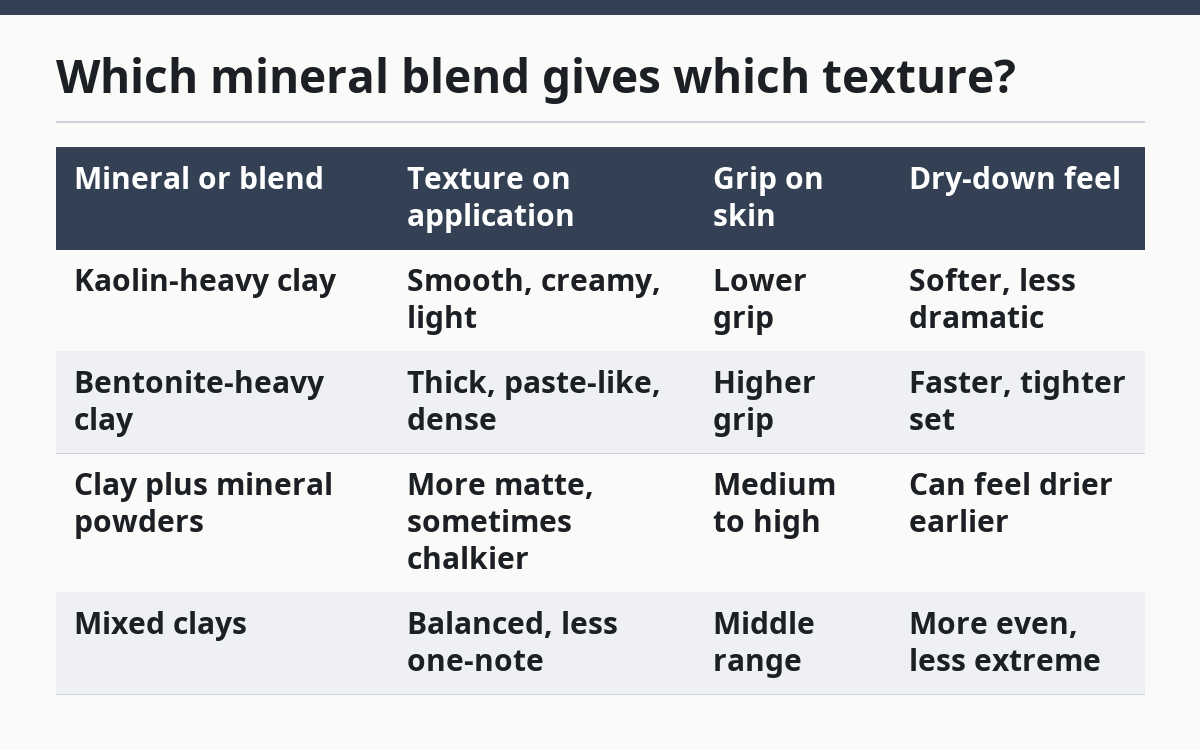
In particular, the practical value of this table is simple: it helps predict feel before the jar is opened. If a reader wants a mask that glides on with less tug, kaolin-heavy formulas usually make more sense. If the goal is a firmer mask that sets quickly, bentonite-heavy formulas tend to match that brief.
Mixed-clay formulas are common because they can soften the weak points of each mineral. A kaolin-bentonite blend may spread better than bentonite alone and feel more structured than kaolin alone. That middle ground is often the easiest place for a face mask formula to land.
This is also where people can be misled by color. A pale clay is not automatically gentler, and a darker one is not automatically stronger. Texture comes from mineral behavior, not shade.
How should a reader read the ingredient list?
A reader should read the ingredient list by looking at which clay appears first and whether the formula adds mineral powders or texturizing fillers. Ingredients are listed in descending order, so the position of kaolin or bentonite gives a clue about the dominant feel, even if the exact percentage is not shown.
If kaolin is first, expect a lighter paste and a softer finish. If bentonite is first, expect more body, more grip, and more noticeable dry-down. If both appear, the one listed first usually has the stronger influence on feel. Mineral powders near the top can make the mask more matte and less silky.
For example, here is a simple 4-step way to predict texture before buying or mixing a clay mask:
-
Find the first clay on the ingredient list.
If it is kaolin, expect a smoother, lighter paste; if it is bentonite, expect a thicker one. -
Look for a second clay or mineral powder.
A second mineral usually changes the finish from simple and flat to more structured or drier. -
Check for ingredients that suggest slip support, such as oils, humectants, or emulsions.
Those formulas usually spread better and feel less chalky. -
Scan the list for signs of a very lean formula.
If the formula is mostly clay and powder with little else, the dry-down is likely to feel more obvious.
Because of that, texture is part of the experience, not a side note. A mask can be effective in a broad sense and still be the wrong choice if the grip feels too heavy or the dry-down feels too harsh for the skin type using it.
What clay masks are not a good fit?
Clay masks are not a good fit for someone who wants a creamy, cushioned face feel or very little tightening. A bentonite-heavy mask in particular can feel too firm, too matte, or too draggy for a reader who dislikes noticeable dry-down.
Even so, they may also be a weak match if the only goal is a plush, emollient mask finish. Clay minerals are built to structure and absorb, not to stay soft and oily. That means the finish often trends toward matte, firm, or powdery rather than rich and dewy. A formula can soften that edge, but it cannot erase the mineral behavior completely.
The other trade-off is predictability. Clay masks are easy to describe in broad terms, but the exact feel depends on the blend, water level, and supporting ingredients. Two clay masks can both say “kaolin” on the label and still spread very differently. One may feel silky; the other may feel thin and dusty.
So the best use case for clay is often texture control, not softness for its own sake. If a reader is choosing between mask formats, the broader face mask materials guide on this site can help place clay next to sheet, cream, gel, and overnight options without turning this page into a buying guide.
What do clay minerals in masks actually do?
Clay minerals in masks actually do three things at once: they shape the paste, they grab onto surface oils and water, and they set the dry-down feel. Kaolin usually makes the formula smoother and lighter, while bentonite usually makes it denser and more gripping.
That is the short answer, but the useful part is the pattern behind it. Texture comes from particle shape and blend. Grip comes from adsorption and film structure. Dry-down comes from how that structure tightens as water leaves. Once those three pieces are separated, the label on the jar becomes easier to read.
What minerals are in clay masks?
Clay masks most often use kaolin and bentonite, and some formulas include other clays or mineral powders. Kaolin tends to create a smoother, lighter paste, while bentonite tends to swell more and feel denser on the skin. The exact feel depends on which mineral leads the formula and how the rest of the ingredients support it.
Why do clay masks dry differently?
Clay masks dry differently because each clay mineral holds water and forms a film in its own way. Bentonite usually sets into a firmer layer, while kaolin often dries more softly and evenly. The amount of water in the formula and any extra mineral powders also affect how fast and how hard the mask sets.
How do clay minerals affect feel?
Clay minerals affect feel by changing slip, grip, and the amount of pull during dry-down. Kaolin usually feels smoother and less forceful, while bentonite usually feels more structured and more matte. Mixed formulas can land between those two extremes, which is why two clay masks can feel very different even when both look plain at first glance. If a reader wants to compare clay with other formats, the sheet mask vs cream mask guide can help separate texture goals from coverage goals.
Drafted with AI; not yet reviewed by a person.
Leave a Reply