



Last updated: November 19, 2026
Quick Answer: 5 core formulation jobs decide whether a face mask works. Face mask ingredients are only useful when they fit the formula, because the same clay, oil, or humectant can work well in one mask and fail in another. The right face mask is a balanced system, not a pile of trendy ingredients.
In the topic of face mask ingredients and formulation science — The Complete Guide, this guide shows what each ingredient does, what breaks a formula, and how to read a mask label without guessing.
Key Takeaways
- A mask’s performance comes from the whole formula: base, active, texture builder, preservative, and pH all have jobs.
- Clay masks, cream masks, gel masks, peel-off masks, and sheet masks behave differently because water, oil, polymers, and particles are arranged differently.
- “Natural” does not mean safer, and “active” does not mean stronger if the formula cannot hold it together.
- The best masks match ingredient choice to skin need, then keep irritants, fragrance, and harsh solvents low enough to avoid a backlash.
- A short ingredient list is not automatically better; a stable formula with the right pH and preservative system usually matters more.
I write on cosmetic formulation, ingredient labeling, and skin-care chemistry, so I read masks the way a formulator does: by structure, not by slogans.
What a face mask formula has to do
Picture this: you open a jar that looks simple, but the cream inside has to spread evenly, stay stable on the shelf, feel good on skin, and rinse or peel off cleanly. If any one part fails, the whole mask fails.
A good mask formula usually has five jobs: deliver water or oils, hold that system together, carry the active ingredients, feel pleasant on skin, and survive storage. A 2023 review in the International Journal of Cosmetic Science describes these as core formulation functions. A formula that feels rich can still separate, sting, or dry down in patches.
The base decides the mask type. Water-heavy gels need thickeners and humectants. Oil-heavy balm masks need emulsifiers or waxes. Clay masks need suspension so the clay does not sink to the bottom. Peel-off masks need film formers so they dry into one sheet instead of cracking.
The base also sets the contact time, and contact time matters. A sheet mask usually sits on skin for about 10 to 20 minutes. A clay mask may dry in under 15 minutes, depending on film thickness and room humidity.
The main parts you keep seeing on labels
- Water or solvent base: the main carrier. In many masks this is water, aloe juice, or a mix of water and glycols.
- Humectants: glycerin, propanediol, butylene glycol, hyaluronic acid, beta-glucan. These hold water in the formula and on the skin surface.
- Emollients: squalane, caprylic/capric triglyceride, plant oils, esters. These soften and reduce the tight feel.
- Texture builders: clays, gums, starches, cellulose, carbomer, acrylates, xanthan gum.
- Actives: salicylic acid, sulfur, niacinamide, charcoal, enzymes, acids, vitamin C derivatives, calming extracts.
- Preservatives: phenoxyethanol, sodium benzoate, potassium sorbate, organic acid systems, or other systems approved for cosmetic use.
- pH adjusters: citric acid, sodium hydroxide, arginine, lactic acid. These keep the formula in a workable range.
A formula that lacks one of these can still look fancy on the front of the jar. It usually performs badly.
Which ingredients actually do the work?
Picture this: you scan an ingredient list and want to know which names matter and which are just there to support the structure. The answer is not “the first three ingredients only.” A tiny amount of the right active can matter more than a big amount of filler.
Many mask ingredients fall into a few broad groups. Some remove oil. Some add water. Some soothe. Some exfoliate. Some only exist to make the product physically possible. That last group is not cosmetic fluff. It is the scaffolding.
1) Oil-absorbing and mattifying ingredients
Clay is the classic. Kaolin, bentonite, and sometimes illite are used to soak up oil and create the dry-down feel people expect from detox masks. They work by adsorption and by giving the formula a dense, spreadable body.
Charcoal appears in many masks, but its real role is often visual and sensory rather than magical. It can help with oil feel, yet it does not make a weak formula stronger. If the mask is overloaded with charcoal and underbuilt with binder, it can crumble or streak.
Common trade-offs
- Can leave skin tight if the formula has too little humectant
- Can be messy to remove if the particle load is high
- Can feel over-drying on dry or barrier-impaired skin
Substitution note: If clay stings or dries you out, look for a cream or gel mask with kaolin lower in the list and more glycerin, panthenol, or aloe.
2) Hydrators and humectants
Glycerin is still the workhorse. It is cheap, effective, and hard to beat for water binding. Propanediol and butylene glycol help with slip and can improve the feel of actives. Hyaluronic acid, sodium hyaluronate, and beta-glucan are common in hydration masks, though their job is usually support rather than magic.
Humectants matter because masks sit on skin for a short time. A mask that holds water at the surface can leave skin looking smoother right away. If the formula dries down too fast, that benefit shrinks. In practical terms, a sheet mask can deliver a wet serum for 10 to 20 minutes, while a thin gel can lose surface moisture much faster.
Common trade-offs
- High humectant load can feel sticky
- Some formulas use too many humectants and not enough emollients, so the skin feels damp but not comfortable
- Humectants do not replace lipids in a damaged barrier
Substitution note: If you react to propylene glycol, many formulas use propanediol or glycerin instead.
3) Soothing and barrier-support ingredients
Panthenol, allantoin, beta-glucan, colloidal oatmeal, and centella extracts show up in calming masks. These ingredients are meant to reduce the “I stripped my face” problem that some clay or acid masks create.
Ceramides and cholesterol are less common in masks than in leave-on creams, but when present they signal a barrier-support angle. They work best when the formula also has lipids and a sensible texture, not just a token sprinkle. A 2022 review in the Journal of Cosmetic Dermatology notes that barrier-support formulas tend to perform best when humectants and lipids appear together.
Common trade-offs
- Botanicals vary more than simple humectants
- Sensitive skin can still react to fragrant plant extracts
- Barrier-support claims can be hollow if the mask also contains lots of drying alcohol or fragrance
Substitution note: If you know you react to oat, avoid colloidal oatmeal and use panthenol or beta-glucan instead.
4) Exfoliating and resurfacing ingredients
AHAs such as glycolic acid and lactic acid, BHA such as salicylic acid, PHA such as gluconolactone, and enzyme blends can all appear in masks. These are not interchangeable.
- Salicylic acid is oil-soluble enough to make more sense in acne-leaning or oily-skin masks.
- Lactic acid is often gentler-feeling than glycolic acid and adds humectant behavior.
- Glycolic acid can be effective but more likely to sting if the formula is aggressive or poorly buffered.
- Enzymes such as papain or bromelain depend heavily on pH and formula care.
These ingredients need the right pH. A mask with acid actives that sits at the wrong pH can be weak, unstable, or irritating. That is one reason the ingredient list alone is never enough. The U.S. FDA also notes that acid products can sting more when overused or layered with other exfoliants.
Common trade-offs
- Higher sting risk
- More sensitivity to sunlight after use, depending on formula and skin response
- Poor fit for compromised skin barriers
Substitution note: If acids are too much, a clay-and-humectant mask or an enzyme-free gel mask is the cleaner choice.
5) Film formers, thickeners, and binders
A peel-off mask only peels because of polymers such as polyvinyl alcohol or related film formers. Gels depend on carbomer, acrylates, cellulose gums, or xanthan gum. Clay masks need binders so the pigment-like particles do not separate.
These ingredients are not glamorous, but they make the product usable. Without them, the mask can leak, separate, dry unevenly, or tug too hard on removal.
Common trade-offs
- Too much film former can make peel-off masks harsh
- Too much gum can feel slimy
- Poorly chosen binders can cause pilling or uneven spread
Here’s the catch: the “active” ingredient is not always the ingredient doing the most visible work. In a peel-off mask, the film former may control the whole user experience. In a clay mask, the binder may decide whether the product works at all.
Why mask texture matters as much as the ingredient list
Picture this: you put on two masks with nearly the same actives, but one spreads thinly and dries in 8 minutes while the other stays creamy and comfortable. The ingredient list may look similar. The feel is not.
Texture tells you a lot about formulation science. A thick cream mask can carry oils and emollients without drying too fast. A gel mask can feel cool because it is mostly water and humectants. A clay mask can be built to dry down fast, which makes it useful for oily skin but rough on dry skin. A peel-off mask has to form a coherent film, or it will flake instead of lifting.
Texture also changes how ingredients behave on skin:
- Thin, runny masks often need more stabilizers
- Rich masks need emulsifiers and anti-separation support
- Clay masks need suspension
- Sheet masks depend on the serum that saturates the fabric, not the sheet itself
Common mask formats and what they imply
| Mask format | What it usually contains | Formulation pressure point | Best use case | Common problem |
|---|---|---|---|---|
| Clay mask | kaolin, bentonite, water, humectants | drying rate | oily skin, visible shine | tightness, over-drying |
| Cream mask | oils, emulsifiers, humectants, soothing agents | emulsion stability | dry or mature skin | heaviness, residue |
| Gel mask | water, glycerin, polymers, aloe | thickening and feel | heat, dehydration, redness-prone skin | tacky finish |
| Peel-off mask | film formers, plasticizers, water | film integrity | superficial smoothing, novelty feel | tugging, patchy peel |
| Sheet mask | serum base, humectants, actives | serum formula and fabric | quick hydration | short contact time, waste |
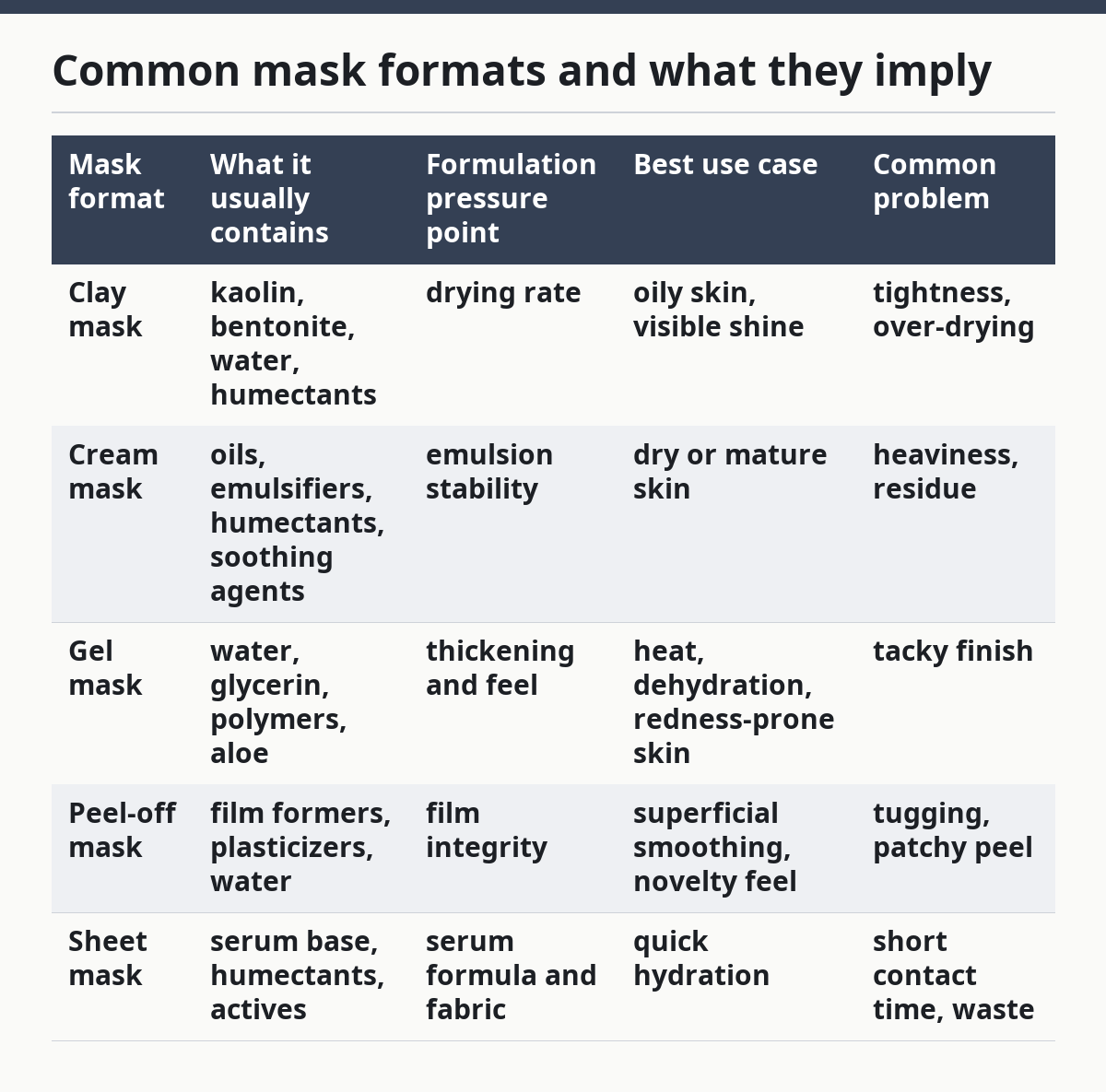
Texture is not cosmetic theater. It is a clue to how the formula was built.
What makes a mask irritate skin
Picture this: the ingredient list looks gentle, but your face still burns. That usually means the formula is fighting your skin barrier, not supporting it.
The biggest irritation triggers are usually fragrance, high acid load, drying alcohols, strong surfactants, and too much clay or film tension. Essential oils are a frequent problem too. Tea tree oil, citrus oils, peppermint oil, and scented blends can sound natural and still be irritating.
A mask can also sting for structural reasons. A formula with the wrong pH can make acids harsher. A peel-off mask that dries too tightly can pull on the skin surface. A clay mask with little glycerin can leave the face tight for hours.
Watch for these label signals
- Fragrance / parfum: not automatically bad, but a frequent irritant for sensitive skin
- Limonene, linalool, citronellol, geraniol: fragrance allergens often listed separately in some markets
- Alcohol denat. high on the list: can make some formulas feel quick-drying, but also more stripping
- Peppermint, eucalyptus, citrus oil: can sting, especially on reactive skin
- Lots of acids plus clay: can feel like too much at once
Who this is not for: if your skin stings easily, flakes, or is recovering from over-exfoliation, a fragrance-free gel or cream mask is a safer starting point than a strong clay-acid hybrid.
Substitution note: sensitive skin often does better with glycerin, panthenol, beta-glucan, colloidal oatmeal, and simple emollients than with botanical blends.
How to read a face mask label like a formulator
Picture this: you are holding two jars. One says “detox,” the other says “hydrating,” and both look convincing. The ingredient list tells you which one is built for real work and which one is mostly marketing.
Start with the first five to seven ingredients. That part gives the strongest signal about the formula’s backbone. Then look for the active class and the support ingredients around it. If a mask claims to hydrate but the list is mostly clay, alcohol, and fragrance, the claim is doing more work than the formula.
A simple reading order
- Base ingredients: water, aloe, oils, solvents
- Texture system: clay, gums, polymers, emulsifiers
- Main active: acid, sulfur, niacinamide, enzyme, charcoal
- Support agents: glycerin, panthenol, allantoin, squalane
- Preservative and pH adjusters: safety and stability clues
- Fragrance and botanical extras: often there for sensory appeal
This order matters because a beautiful active can be held back by a bad base. A salicylic acid mask with the wrong solvent system may underperform. A hydrating mask with no preservative system is not a bargain; it is a storage problem.
Questions that separate good formulas from bad ones
- Does the mask type match the ingredient load?
- Is the main claim supported by the backbone?
- Is fragrance doing unnecessary work?
- Is there enough humectant to offset clay or acid?
- Does the formula include a preservation system?
- Is the pH likely to fit the active?
For evidence-based reading, I like to cross-check with standards and reference bodies such as the Cosmetic Ingredient Review and the European Commission’s SCCS opinions on cosmetic ingredients and safety assessments. These are not shopping guides, but they help separate sound formulation from hype. The FDA also publishes consumer guidance on cosmetic label reading and ingredient caution points.
Which formula works best for your skin type?
Picture this: you do not need the “most powerful” mask. You need the one that gives you the result you want without causing the next problem. That changes the formula you should seek.
Oily or acne-prone skin
A clay mask with kaolin or bentonite, a modest humectant load, and a well-chosen acne-active like salicylic acid is the most direct fit. It helps control shine and can make pores look less obvious for a while.
The weak point is obvious: too much drying can backfire. If your face feels squeaky or taut after use, the formula is too aggressive for regular use.
Better fit ingredients: kaolin, bentonite, salicylic acid, niacinamide, glycerin
Watch out for: heavy fragrance, strong alcohol, dense essential oils
Dry or dehydrated skin
Cream or gel masks win here. Look for glycerin, panthenol, hyaluronic acid, squalane, ceramides, and low fragrance. These formulas support the water-and-lipid balance that dry skin wants.
The drawback is that some “hydrating” masks are just sticky serums in disguise. If the formula has humectants but no emollient support, skin may feel damp, then tight again.
Better fit ingredients: glycerin, panthenol, beta-glucan, squalane, ceramides
Watch out for: clay-heavy formulas, peel-off masks, high acid load
Sensitive or redness-prone skin
A fragrance-free cream or gel mask is the safest category. Simple formulas with panthenol, colloidal oatmeal, allantoin, or beta-glucan are usually easier to live with than masks loaded with fragrance or acids.
The trade-off is potency. Gentle formulas usually work slower and may not give the dramatic “detox” look some shoppers expect.
Better fit ingredients: panthenol, allantoin, colloidal oatmeal, beta-glucan
Watch out for: parfum, essential oils, acid stacks, hot-feel ingredients like menthol
Mature skin
A richer cream mask with emollients, humectants, and mild exfoliating support can be a better fit than a hard-drying clay mask. Mature skin often benefits from comfort first, then resurfacing second.
The downside is residue. Rich formulas can feel heavy if the emollient phase is too large or the emulsion is poorly balanced.
Better fit ingredients: glycerin, squalane, ceramides, lactic acid, peptides if included
Watch out for: stripping clay, harsh peel-off films, highly fragranced botanicals
The formulation mistakes that ruin good ingredients
Picture this: you see a great ingredient on the label, but the product still underperforms. That is usually a formulation failure, not a raw material failure.
The most common mistake is stuffing a mask with too many jobs at once. A formula that tries to be clay, acid, fragrance bomb, and brightening treatment can end up irritating skin and destabilizing itself. If that sounds like the kind of product you want to use anyway, consult a dermatologist or other qualified professional before you stack it with other exfoliating products, and check safety guidance from the FDA and SCCS. Another mistake is ignoring pH. Acids and enzymes are sensitive to it, and so is preservative performance.
Common formulation errors
- Too much active, not enough support: the product becomes harsh instead of useful
- Wrong pH for the active: acids or enzymes lose performance
- Poor preservation: water-based masks need a proper preservative system
- Unstable suspension: clays or pigments settle, leaving the last uses weaker than the first
- Too much fragrance: sensory appeal rises while tolerability drops
- Overuse of film formers: peel-off masks tug and crack
A formulator has to balance comfort, shelf life, and performance. A shopper sees only the finished jar. That is why two masks can look nearly identical and behave very differently.
The verdict: how to choose without getting fooled
Choose a clay mask if your main problem is oil and shine and your skin can tolerate some dry-down. Choose a cream or gel mask if your skin is dry, reactive, or barrier-impaired. Neither type wins if the formula is loaded with fragrance, harsh alcohol, or a pile of actives that fight each other.
The simplest rule is this: match the formula to the job, then check the support ingredients. If the mask’s claim is hydration, look for humectants and emollients. If the claim is pore care or oil control, look for clay or salicylic acid. If the claim is soothing, look for low fragrance and barrier-friendly ingredients.
Exception scenarios where the usual advice flips
-
Very oily but easily irritated skin
A mild gel mask can beat a clay mask if clay leaves you tight or inflamed. -
Dry skin with clogged pores
A gentle cream mask with low-dose salicylic acid or lactic acid can be better than a pure hydrating mask. -
Sensitive skin that still needs exfoliation
A low-fragrance enzyme mask may work better than a classic acid mask, as long as the formula is simple and the pH is appropriate. -
Dehydrated skin under a humid climate
A lighter gel mask with glycerin and beta-glucan may feel better than a heavy cream that sits on top and never settles.
What should I avoid if I have sensitive skin?
Avoid masks with strong fragrance, essential oils, high alcohol, and stacked acids. Those are common reasons a product feels “active” in the bad sense. A simple gel or cream mask with glycerin, panthenol, or colloidal oatmeal is usually the safer place to start.
Is a clay mask always drying?
Not always. A clay mask is drying only when the rest of the formula does not support it. Kaolin or bentonite can be paired with glycerin, aloe, and emollients to reduce tightness, but a bare-bones clay formula will usually feel harsher.
Do expensive masks have better ingredients?
Not automatically. A higher price can reflect packaging, fragrance, brand positioning, or a more complex formula, but it does not guarantee better structure or better skin feel. Read the ingredient list first; the formula tells you more than the price tag.
Are sheet masks better than jar masks?
Not by default. Sheet masks are good at delivering a wet serum for a short time, but the effect depends on the serum, not the sheet itself. Jar masks can be more flexible in texture and actives, but they need a good preservative system and stable structure.
Can I use an acid mask and a clay mask together?
Sometimes, but that is a higher-risk combo for irritation. If you do this, keep both formulas mild, avoid fragrance-heavy products, and watch for stinging or lasting tightness. If your skin barrier is already stressed, separate them or skip one.
Drafted with AI; not yet reviewed by a person.



Leave a Reply