



Last updated: November 19, 2026
Quick answer: 4 kitchen ingredients are the safest starting points for most DIY face masks—plain honey, finely ground oats, plain yogurt, and plain aloe vera.
Kitchen ingredients can soothe skin, but honey, plain oats, plain yogurt, and aloe vera are the safer bets, while lemon juice and baking soda are the ones I’d treat with caution.
This guide on which kitchen ingredients are safe to put on your face sorts the gentler options from the risky ones so you can skip the sting, dryness, and surprise irritation.
The sections below show what belongs on skin, what to leave in the kitchen, and how to use the safer choices without making a mess of your face.
For the broader skincare context, see the DIY face masks guide and the skin barrier basics page.
Key takeaways
- The safest kitchen ingredients for face masks are usually plain, low-acid, and not gritty.
- Honey, plain oats, plain yogurt, and aloe vera are the names most people ask about first.
- Lemon juice and baking soda are the big caution flags.
- Fragrant add-ins, coarse scrubs, and strong acids can turn a simple mask into an irritant.
- A face mask that feels “natural” is not the same thing as one that’s skin-friendly.
Which kitchen ingredients are safe to put on your face?
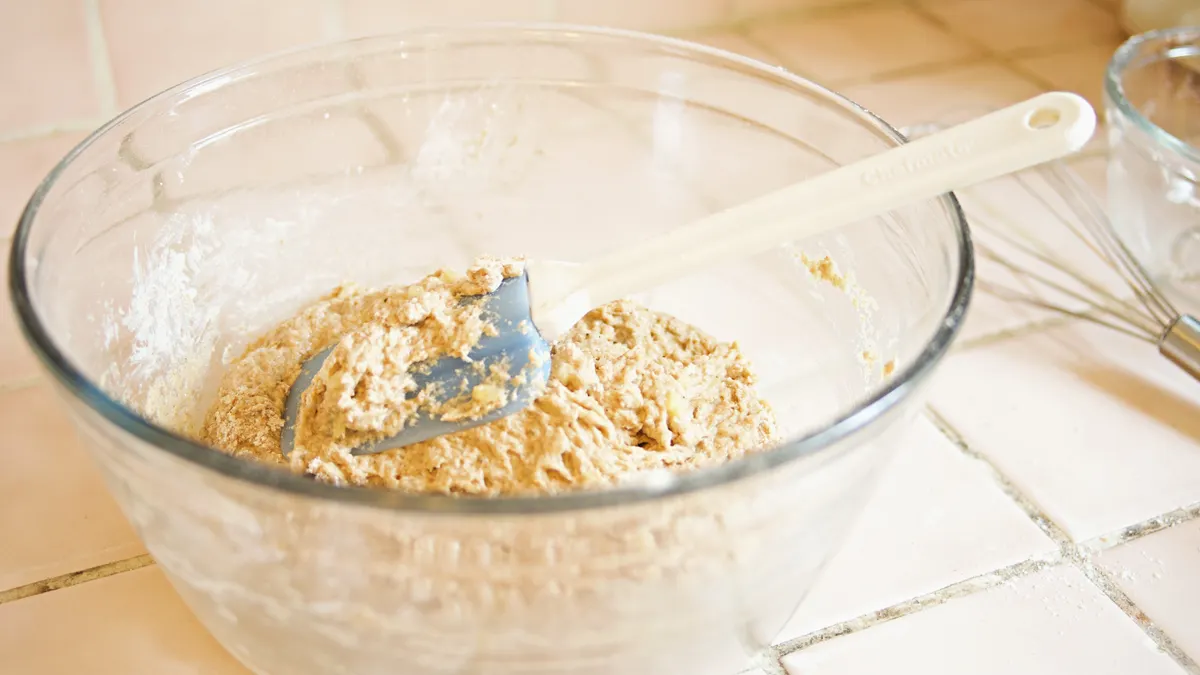
Honey, plain oats, plain yogurt, and aloe vera are the kitchen ingredients most likely to be safe on facial skin for many people. They are simple, low-drama ingredients, and they’re the ones I’d put in the “reasonable to try” column before I’d touch anything acidic, gritty, or heavily scented.
Picture this: you want a mask for a dry patch, not a chemistry experiment. You open the pantry and need a quick yes-or-no list, not a beauty myth. That’s where the safe ingredients matter most, because the wrong one can leave skin red for hours.
A 2023 American Academy of Dermatology review also advises caution with DIY products on sensitive skin, so it is smart to patch-test and to ask a dermatologist if your skin reacts easily.
For a practical example, plain honey is one ingredient. Finely ground oats are another. That small list is easier to use safely than a long recipe.
Here’s the practical split:
- Honey: often used because it’s smooth, sticky, and not abrasive. Use plain, unscented honey rather than blends with spice, citrus, or added flavorings.
- Plain oats: oatmeal needs to be finely ground or already very soft if it’s going on skin. Whole, dry oats can scratch.
- Plain yogurt: plain yogurt is the version to consider, not flavored cups with fruit, sugar, or fragrance. The milk proteins and gentle acidity make it a common DIY base.
- Aloe vera: pure aloe vera gel can feel light and calming, but it should be plain and free of alcohol or perfume.
What they have in common is simple. They’re not sharp, highly acidic, or coarse. They also don’t need heat, and that matters because warm mixtures can feel soothing right up until they’re too hot and irritate skin.
If you’re comparing options in the pantry, start with the least complicated ingredient you already own. A plain ingredient gives you fewer unknowns and a better read on how your skin reacts. For another cautious option, the face mask safety checklist explains how to spot irritants before you mix anything.
Which kitchen ingredients should stay off your face?
Lemon juice and baking soda are the biggest kitchen-ingredient red flags for facial skin. They’re the ones most likely to cause stinging, dryness, or a blotchy patch that lasts longer than the mask itself.
Picture this: you’re standing at the sink with a lemon half in one hand and a bowl in the other, trying to fix dull skin fast. That sounds tidy. It isn’t. Skin on the face is not kitchen tile, and it doesn’t like being scrubbed or shocked into looking “fresh.”
Here’s the catch:
- Lemon juice is highly acidic and can sting, especially on skin that’s already dry, sensitized, or freshly shaved. Sun exposure after lemon on skin can also be a bad idea.
- Baking soda is alkaline and abrasive enough to throw skin off balance fast. People often use it because it feels “cleaning,” but your face is not a sink.
- Coarse sugar, salt, coffee grounds, and nut meal can scrape the skin barrier. They may feel exfoliating, but they’re often too rough for the face.
- Spicy ingredients like cinnamon and hot pepper are common DIY mistakes. They can burn, not brighten.
- Strong-smelling add-ins can irritate even if they look harmless in a bowl.
The mistake I see most is treating “edible” as the same thing as “safe for skin.” Those are different categories. Vinegar, citrus juice, garlic, and similar pantry items may belong in food, not on cheeks. If you are unsure, check with a dermatologist or other qualified professional before trying a new ingredient on your face. For a wider overview of common irritants, the American Academy of Dermatology has clear guidance on sensitive skin and contact irritation.
If a kitchen ingredient leaves a strong smell on your hands, a fizz, a burn, or a sharp tingle in the bowl, that’s a warning sign, not a glow-up. The face mask should feel boring, not dramatic.
Why some ingredients are gentle and others are not

The gentlest DIY face-mask ingredients are usually bland, smooth, and low in acid or grit. That sounds plain because skin likes plain better than most people do.
Picture this: you want one simple rule to use at the counter. You don’t want to memorize every pantry item. The rule is this—if the ingredient can scratch, sting, or strip oil, it’s a poor face-mask choice.
The Maillard reaction has nothing to do with it; this is about skin, not browning food.
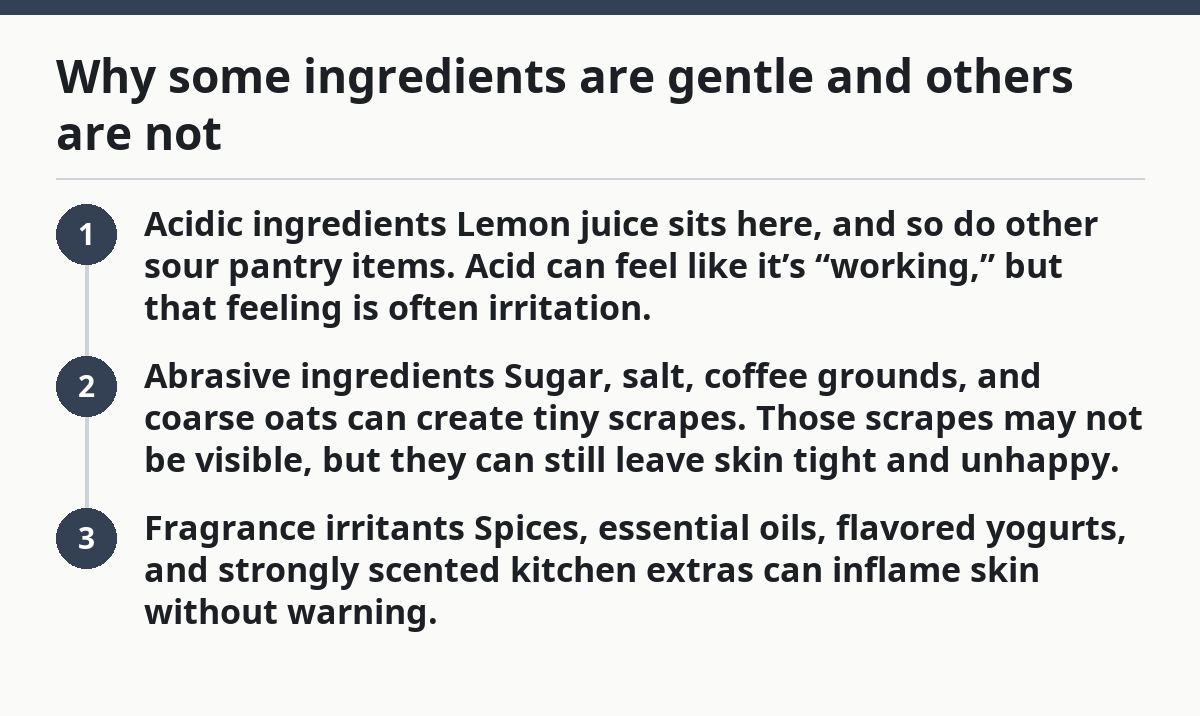
The trouble usually comes from three buckets:
-
Acidic ingredients
Lemon juice sits here, and so do other sour pantry items. Acid can feel like it’s “working,” but that feeling is often irritation. -
Abrasive ingredients
Sugar, salt, coffee grounds, and coarse oats can create tiny scrapes. Those scrapes may not be visible, but they can still leave skin tight and unhappy. -
Fragrance irritants
Spices, essential oils, flavored yogurts, and strongly scented kitchen extras can inflame skin without warning.
A gentle ingredient does not need to tingle to count. In fact, tingling is usually the wrong sign. The calmest masks are the ones that let skin stay calm while the ingredient does its mild, simple job.
The same rule applies to leftovers and “almost spoiled” food. If it’s past its best in the fridge, don’t smear it on your face. A face mask isn’t a rescue mission for old yogurt or oxidized fruit. If you want a simpler place to start, the ingredient guide compares common pantry items with skin-friendly use cases.
How to use safer kitchen ingredients without irritating skin
Use plain ingredients, keep the mix simple, and stop if the skin starts to sting, burn, or turn red. A calm application beats a complicated recipe every time.
Picture this: you’ve got a bowl of plain yogurt or a spoonful of honey and want a face mask that doesn’t backfire. The goal is a thin, even layer, not a thick crust that cracks, drips, or traps heat.
Because the ingredients are simple, the steps should be simple too.
- Choose one base ingredient. Start with plain honey, finely ground oats, plain yogurt, or plain aloe vera gel. Skip add-ins at first so you can tell what your skin likes.
- Use a small amount. A teaspoon or two is enough to start. More product does not mean better skin.
- Apply to clean, dry skin. Use clean fingers or a soft spatula. Avoid rubbing hard; press the mixture on gently.
- Leave it on briefly. If the mask feels comfortable, keep the first try short. Do not sit with a mask that starts to tingle, sting, or heat up.
- Rinse with lukewarm water, 22–38°C / 72–100°F. That range keeps the water comfortable and avoids a hot rinse that can leave skin flushed.
- Pat dry with a clean towel. Don’t scrub. Then follow with a plain moisturizer if your skin feels tight.
A few practical notes help here:
- If you’re using oats, grind them finely first so they behave more like a soft paste than sand.
- If you’re using honey, thin it slightly with water if needed so it spreads in a light layer.
- If you’re using plain yogurt, skip fruit flavors and sugar-heavy cups.
- If you’re using aloe vera, check that it’s plain and not loaded with fragrance or drying alcohols.
The move is simple: patch the idea on your face only after the ingredient itself looks calm, smells mild, and feels smooth in your hand. Anything sharp, gritty, or perfumed belongs back in the kitchen. For the next step, see the patch test guide, which shows how to check a new ingredient with less risk.
Common mistakes that turn a safe ingredient into a bad mask
The most common mistake is mixing a gentle ingredient with a harsh one and then blaming the gentle part. Honey can be fine, but honey plus lemon juice is a different story. Oats can be soft, but oats mixed with sugar become a scrub.
Picture this: you read a DIY tip online and toss in three pantry items because they all sound natural. That’s how a simple mask becomes hard to predict. One ingredient may be fine on its own, then the mix becomes too acidic, too gritty, or too scented.
Adding more does not make the mask better.
Watch for these traps:
- Using flavored yogurt instead of plain yogurt. Fruit, sugar, and flavorings can irritate skin and make the mask sticky in a bad way.
- Using whole oats and rubbing them hard. Coarse bits can scratch, especially around the nose and chin.
- Adding lemon juice “for brightness.” That usually adds sting, not glow.
- Adding baking soda “to balance things.” It can swing the skin’s surface in the wrong direction.
- Adding cinnamon or essential oils. These are common irritants, even in small amounts.
There’s also the time factor. A mask that sits too long can dry out, tighten, or start to sting. That matters with yogurt and honey, which can feel fine at first and then get tacky, dry, or uncomfortable.
What to do instead is plain and unglamorous: use one ingredient, keep the layer thin, and stop at the first sign of discomfort. Skin does not reward bravery here. It rewards restraint.
For broader DIY context, the hub on DIY face masks and kitchen-ingredient care covers the bigger picture. This page stays with the safety question: what belongs near your face and what doesn’t.
When should you avoid a kitchen-ingredient face mask?
You should skip a kitchen-ingredient face mask when your skin is already irritated, broken, or reacting to something. If your face is raw, sunburned, or stinging from another product, a DIY mask can add fuel to the fire.
Picture this: you’re tempted to cover a flare-up with something “natural” because the sink is right there. That’s the wrong moment to experiment. The skin barrier is already busy, and the extra ingredient can make the problem harder to calm down.
On the other hand, doing nothing is sometimes the better move.
Skip DIY masks if:
- your skin is cracked, oozing, or bleeding
- you have a fresh shave, wax, or peel
- you’re already irritated by skincare, makeup, or sun
- you know you react to milk, oats, or fragrance
- the ingredient smells off, looks spoiled, or feels sharp on a fingertip
A kitchen mask is also a poor fit if you want fast, dramatic change. It is not a treatment for acne, eczema, rosacea, or a rash. Those need a different kind of attention, and a pantry bowl is not the place to guess.
The honest trade-off is this: the gentlest kitchen ingredients can still bother some skin. “Safe” here means “reasonable to try with caution,” not “guaranteed fine.” That’s why plain ingredients beat fancy mixtures every time.
If you do decide to try one, keep the first use short and simple. One calm ingredient. One small amount. One clear result. That’s the whole game.
How do I choose the safest ingredient for my skin?
Choose the plainest ingredient first, then skip anything acidic, gritty, or scented. For most people, that means honey, oats, plain yogurt, or aloe vera before anything else.
Picture this: you’re staring at four pantry items and want a fast rule. Start with the ingredient that has the fewest moving parts. No fruit chunks, no spice, no fizz, no scrub.
That rule saves a lot of trouble.
Use this quick filter:
- Honey if you want a smooth, simple ingredient that spreads well.
- Oats if you want a soft, bland base, but only if they’re finely ground.
- Plain yogurt if you want a cool, plain dairy base and you tolerate dairy on skin.
- Aloe vera if you want a light gel and you have plain, fragrance-free product.
- Neither lemon juice nor baking soda if your goal is a safe first try.
One more thing matters: your skin type. Very dry, sensitive, or reactive skin is less forgiving of anything acidic or abrasive. Normal skin can still react, so “normal” is not a free pass.
The safest choice is the one that asks the least of your skin. That usually means one ingredient, one test, and one quiet result.
Is lemon safe for face masks?
No, lemon juice is not a safe first-choice ingredient for face masks. It’s acidic and can sting or irritate facial skin, especially if your skin is dry, freshly shaved, or already sensitive. If you want a gentler pantry option, plain honey or plain oats is a better place to start.
Can you put baking soda on your face?
I would not recommend baking soda on the face. It’s alkaline and abrasive enough to disrupt the skin barrier and leave skin feeling tight or irritated. A better kitchen ingredient for a simple DIY mask is plain yogurt or finely ground oats, which are much less aggressive.
Which kitchen ingredients are best for skin?
The best kitchen ingredients for most DIY face masks are plain honey, finely ground oats, plain yogurt, and plain aloe vera. They’re simple, low-fragrance, and less likely to scratch or sting than citrus, baking soda, or gritty scrubs. The best choice still depends on how your skin reacts, so plain is better than mixed.
Drafted with AI; not yet reviewed by a person.



Leave a Reply