


Last updated: November 19, 2026
Quick answer: the first active a face mask should deliver is the one that matches the main skin problem, and for redness after shaving that is often niacinamide or ceramides first. This article on what active ingredients should a face mask deliver first uses that rule throughout. For redness after shaving, that usually means a calming or barrier-supporting ingredient first, then an exfoliant only if clogged pores or rough texture are also part of the problem. A mask that leads with the wrong active can sting, dry out skin, or do little at all.
Key takeaways
- Start with the skin concern, not the ingredient name.
- For post-shave redness, barrier support usually beats strong exfoliation.
- Salicylic acid, vitamin C, niacinamide, ceramides, and hyaluronic acid each pull in different directions.
- Two actives can work together, but they should not compete for the same job.
- A mask with the “right” active at the wrong strength can still miss the mark.
What should a face mask deliver first?

A face mask should deliver the main active that solves the problem you actually have first. If the goal is less redness after shaving, that often means calm and barrier repair before brightening or pore clearing. If the goal is oil control and breakouts, salicylic acid usually has a higher priority than hyaluronic acid.
The mistake many buyers make is reading the front label as if every active does the same thing. It does not. Vitamin C is usually chosen for dullness or uneven tone, salicylic acid for clogged pores and breakouts, niacinamide for oil balance and visible redness, ceramides for barrier support, and hyaluronic acid for hydration. Those are different jobs, and a mask has limited room to do them all well.
Therefore, think of the “first” active as the one that should get the strongest formulation support. That can mean the main active is present at the right level, in a formula that stays comfortable on skin for the full mask time, often around 10 to 20 minutes depending on the product. If the ingredient is too aggressive for the skin concern, the mask may feel busy but still miss the point.
A simple ranking helps:
- For redness after shaving: niacinamide or ceramides first, then hyaluronic acid.
- For clogged pores: salicylic acid first.
- For dullness or dark marks: vitamin C first.
- For dry, tight skin: hyaluronic acid first, with ceramides close behind.
That ranking is not a law. It is a practical order of operations. A mask for shaving irritation is not the same as a mask for acne, and it should not be judged by the same first ingredient.
Which active fits each skin concern?
The right active comes first when it matches the skin concern the mask is meant to fix. The table below shows the main actives named in this guide and the job each one is best at.
| Active ingredient | Best first priority for | Why it gets picked first | Main trade-off |
|---|---|---|---|
| Salicylic acid | Clogged pores, blackheads, oily breakouts | It works on oil and dead skin in pores | Can feel drying or stingy on freshly shaved skin |
| Vitamin C | Dull tone, uneven look, post-blemish marks | It is tied to brightening and tone support | Can be too sharp for sensitive or post-shave skin |
| Niacinamide | Redness, oil balance, skin that gets reactive | It supports the barrier and is usually easier to fit into a calm routine | It may not be enough alone for heavy clogging |
| Ceramides | Dryness, barrier damage, tight or flaky skin | They support the skin’s outer layer | They do not exfoliate or clear pores |
| Hyaluronic acid | Dehydration, tightness, plump look | It helps skin hold water | Hydration alone does not treat redness or acne |
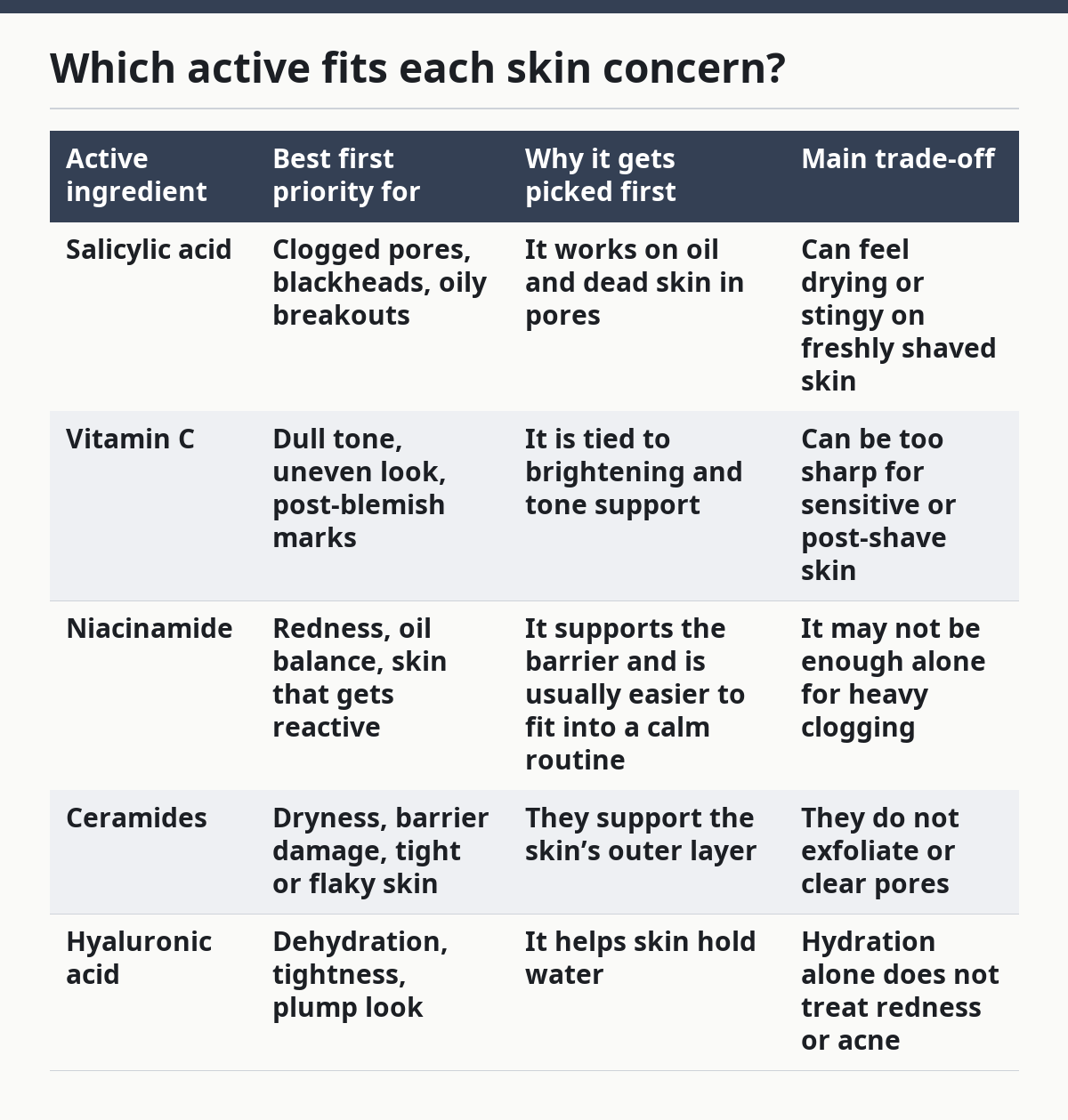
For someone shaving often, niacinamide and ceramides usually deserve a higher slot than salicylic acid unless bumps and clogged pores are the bigger issue. That is because fresh shave skin can already be stressed. A mask that pushes exfoliation first may do more harm than good, especially if used right after shaving.
Vitamin C belongs higher only when tone change is the main goal. It is not the first pick for active razor irritation. Hyaluronic acid is useful when skin feels thirsty, but it is a support act, not a fix for pore congestion. That is why the “first ingredient” question matters: it keeps the formula honest about its job.
How do you rank actives before you buy?
Rank actives by skin need, then by tolerance, then by formula type. That order keeps the mask useful instead of fashionable. A face mask can look impressive on a package and still be the wrong choice for skin that is already irritated.
Use this simple procedure:
- Name the main problem in one sentence. If it is “redness after shaving,” that points toward barrier support rather than strong acid treatment. If it is “my pores clog easily,” salicylic acid moves higher.
- Pick one lead active. Choose the ingredient that should do the main job, such as niacinamide for redness or salicylic acid for breakouts. The lead active should be the one you would miss most if it were removed.
- Check the support actives. Look for ceramides or hyaluronic acid if the skin needs comfort, or a gentler brightener if tone is the goal. Support actives should help the lead ingredient, not fight it.
- Match the mask type to the active. A rinse-off mask used for 10 to 20 minutes should not act like a harsh scrub. A leave-on sheet or cream mask can suit calming ingredients better than a strong acid blend.
- Look for a formula that stays in one lane. If the skin is sensitive, one clear job is usually better than three competing jobs. The result should be less irritation, not a long ingredient list for its own sake.
This method works because it keeps you from choosing by label size or ingredient fame. A mask with vitamin C, salicylic acid, niacinamide, ceramides, and hyaluronic acid all at once is not automatically better. It may be broader, but it can also be less focused.
If the concern changes by day, the first active can change too. After shaving, calming ingredients rise. On a week when clogged pores are the problem, salicylic acid can move to the front. Because of that, treating every mask as a one-size answer is usually less useful than matching the active to the skin that day.
Which ingredients should not fight each other?
A face mask should not put actives together when they pull skin in opposite directions. The biggest problem is not that the ingredients are “bad.” It is that one can make the other less suitable for the skin at that moment.
Here is the practical version:
| Combination | Usually makes sense when | Watch out for |
|---|---|---|
| Niacinamide + ceramides | Redness, dryness, barrier support | May be too plain if acne is the real issue |
| Hyaluronic acid + ceramides | Dry or tight skin | Does not clear clogged pores by itself |
| Vitamin C + niacinamide | Tone plus redness support | Can be more than sensitive skin wants at once |
| Salicylic acid + vitamin C | Oily skin with dull tone | Can feel too active for freshly shaved skin |
| Salicylic acid + hyaluronic acid | Oily skin that also feels dry | Hydration does not cancel out irritation |
The cleanest pairing for a post-shave mask is often niacinamide with ceramides, sometimes with hyaluronic acid alongside them. That combination keeps the focus on comfort and barrier support. It is less exciting than a strong acid blend, but it is often more useful.
Salicylic acid needs the most caution in this context. It is valuable when clogged pores are the main concern, yet it can be the wrong first pick for skin that already feels raw. A mask that treats shaving redness like acne can leave the face tighter, not better. If the skin is persistently irritated, consult a dermatologist or pharmacist before using a stronger acid mask.
Vitamin C is also easy to overestimate. It is a strong name and a familiar one, but brightening is not the same as calming. If the skin is irritated right now, vitamin C should usually not be the first active you chase. For ingredient basics, the American Academy of Dermatology and the U.S. Food and Drug Administration both explain how cosmetic ingredients are used and labeled. American Academy of Dermatology / FDA cosmetics guidance.
What concentration focus matters most?
Concentration focus matters more than ingredient popularity because a mask can include the right active at the wrong level and still disappoint. The exact number is not the only thing that matters, but the number can be one of the first signs that the formula knows its job.
Use concentration as a signal, not a trophy. If the label suggests a high-activity formula but the skin goal is mild redness after shaving, that can be a mismatch. A gentler level with a better support system may be the smarter choice. The same is true in reverse: a very mild mask may feel pleasant but may not help a clogged-pore problem enough.
Therefore, look for a clear relationship between strength and purpose. Salicylic acid should be there for pore clearing, not as a decorative extra. Niacinamide and ceramides should make sense in a calming formula, not be packed in as filler. Hyaluronic acid should support water retention, not pretend to solve every issue by itself.
The real question is whether the formula feels matched. A mask used for 10 to 20 minutes should not leave skin stripped. If it does, the active load is too aggressive for the use case, even if the ingredient list looks impressive. If the mask feels like it did nothing, the active may be too low, too broad, or aimed at the wrong concern.
This is why the “first active” question matters more than chasing a long list. A shorter formula with the right lead ingredient often beats a crowded one. A better mask is not necessarily the one with the most actives; it is the one with the right first active for the skin in front of you.
What active ingredient should a mask deliver first for redness after shaving?
A mask for redness after shaving should usually deliver a calming, barrier-supporting active first, not an exfoliating one. For that specific problem, niacinamide and ceramides are often better first choices than salicylic acid or vitamin C.
That does not mean exfoliants never belong in a shaving routine. It means timing matters. If the skin is already fresh-shaved, a strong acid can be the wrong first move. If bumps and clogged pores are the bigger issue, salicylic acid may move back into the lead later, when the skin is less reactive. If you are unsure, ask a skin professional which active should come first for your routine.
The safest practical rule is simple: calm first, correct later. A mask that respects that order is more likely to help than one that tries to do everything in one pass.
What is the safest way to choose the first active?
The safest way is to choose the first active by skin condition, not by what sounds advanced. If the face is red and stingy after shaving, start with niacinamide, ceramides, or hyaluronic acid. If the face is oily and clogged, start with salicylic acid. If tone is the main issue, vitamin C can move up.
Because ingredient function matters, two authoritative sources are worth reading: the American Academy of Dermatology and the U.S. Food and Drug Administration. They help separate what an ingredient is for from what a package implies it can do. That difference is the heart of the decision.
A good mask does not need to carry every active in the aisle. It needs the right one first.
What counts as an active in a face mask?
An active is the ingredient in a face mask that is there to do the main job. That job might be smoothing, calming, hydrating, or brightening. Niacinamide, salicylic acid, vitamin C, ceramides, and hyaluronic acid are all examples of ingredients that can serve as actives depending on the formula and the skin goal.
Can a mask have more than one active?
Yes, a mask can have more than one active. The problem is not the number of actives by itself; it is whether they work toward the same goal and suit the same skin type. A calming mask can pair niacinamide, ceramides, and hyaluronic acid well, while a stronger mix may be too much for fresh shave irritation.
How do active ingredients differ from supporting ingredients?
Active ingredients are the ones meant to change the skin’s condition in a noticeable way, while supporting ingredients help the formula feel stable, comfortable, or usable. Supporting ingredients may improve slip, texture, or moisture, but they are not the main reason to choose the mask. The first active should do the main job; support ingredients should make that job easier.
Drafted with AI; not yet reviewed by a person.


Leave a Reply