



Last updated: November 19, 2026
Key Takeaways
- A safe home mask should breathe well, fit snugly, stay clean, and dry fully between uses.
- Tightly woven, washable fabrics that keep their shape after laundering are the best reusable options.
- Wash reusable masks after use, dry them completely, and avoid damage to elastic, coatings, or shape.
- Replace a reusable mask if the fit changes, the fabric thins, or the straps stop working.
At-home face mask safety and maintenance gets messy fast when fit, cleaning, and wear time all blur together. Quick answer: choose a well-fitting mask you can clean correctly, dry completely, and retire when it stops sealing or starts breaking down. This guide covers at-home face mask safety and maintenance — The Complete Guide.
In short: this guide settles what to wear, how to clean it, when to replace it, and what habits turn a mask from useful to risky.
What makes an at-home face mask safe?
A safe home mask is one you can breathe through, fit snugly, clean without damage, and keep dry between uses. A cloth mask with 2–3 layers of tightly woven fabric and a nose wire is a practical baseline for many daily tasks.
Picture this: you’re heading out for errands, then planning to wear the same mask again tomorrow. The real question is not just whether the mask covers your face — it’s whether it still seals, stays clean, and doesn’t hold moisture against your skin.
The CDC’s face covering guidance and the WHO’s advice on fabric masks both point in the same direction: fit matters, clean hands matter, and a damp mask should not stay on.
- CDC face mask guidance: https://www.cdc.gov/respiratory-viruses/prevention/masks.html
- WHO fabric mask advice: https://www.who.int/publications/i/item/WHO-2019-nCoV-IPC_Masks-2020.4
A safe mask should do these things:
- Cover nose, mouth, and chin fully.
- Sit close to the sides of the face without big gaps.
- Stay in place when you talk.
- Let you breathe without tugging it down.
- Hold up to repeated washing or sanitizing, if it’s reusable.
The catch is simple: a mask can look fine and still fail in use. If air leaks around the cheeks or the nose wire won’t stay shaped, the mask is weak even before the fabric wears out.
Which mask materials are safest for home use?
Tightly woven, washable fabrics are the safest reusable home-mask materials because they are easier to clean and less likely to lose shape. Cotton blends are common because they hold up better than loose knits and are easier to wash at warm temperatures.
Picture this: you pull a mask from a drawer, and it feels soft but thin, like an old T-shirt. That feels comfortable, but comfort alone does not make a good barrier.
The best fabric choices are usually:
- Tightly woven cotton
- Cotton-polyester blends
- Multiple layers of the same fabric or a mix of fabrics with good structure
- Masks with a built-in nose wire and adjustable ear loops or ties
The weaker choices are easier to spot:
- Stretchy fabric that grows loose with wear
- Loose, open weave cloth
- Fabric that pills, thins, or frays at the edges
- Masks that shrink so much they no longer cover the chin
A surgical-style disposable mask can be a better fit for some situations because it is designed as a single-use barrier, but it still needs a snug fit to work well. A worn-out cloth mask with stretched ear loops is usually worse than either a new cloth mask or a fresh disposable one. For a comparison point, CDC guidance on respirators explains why fit and filtration matter, not just material.
- CDC respirator information: https://www.cdc.gov/niosh/npptl/topics/respirators/disp_part/default.html
Here’s the catch: the material matters less than the whole system. A decent fabric in a bad shape is still a bad mask.
How do you clean a reusable face mask without ruining it?
You clean a reusable face mask by washing it after use, drying it fully, and avoiding anything that breaks down elastic, coatings, or shape. For most cloth masks, a standard laundry wash with detergent is enough, followed by complete drying.
Picture this: the mask comes off after a crowded trip, and it’s damp with breath and skin oil. That moisture is exactly why “I’ll wash it later” is not a safe plan.
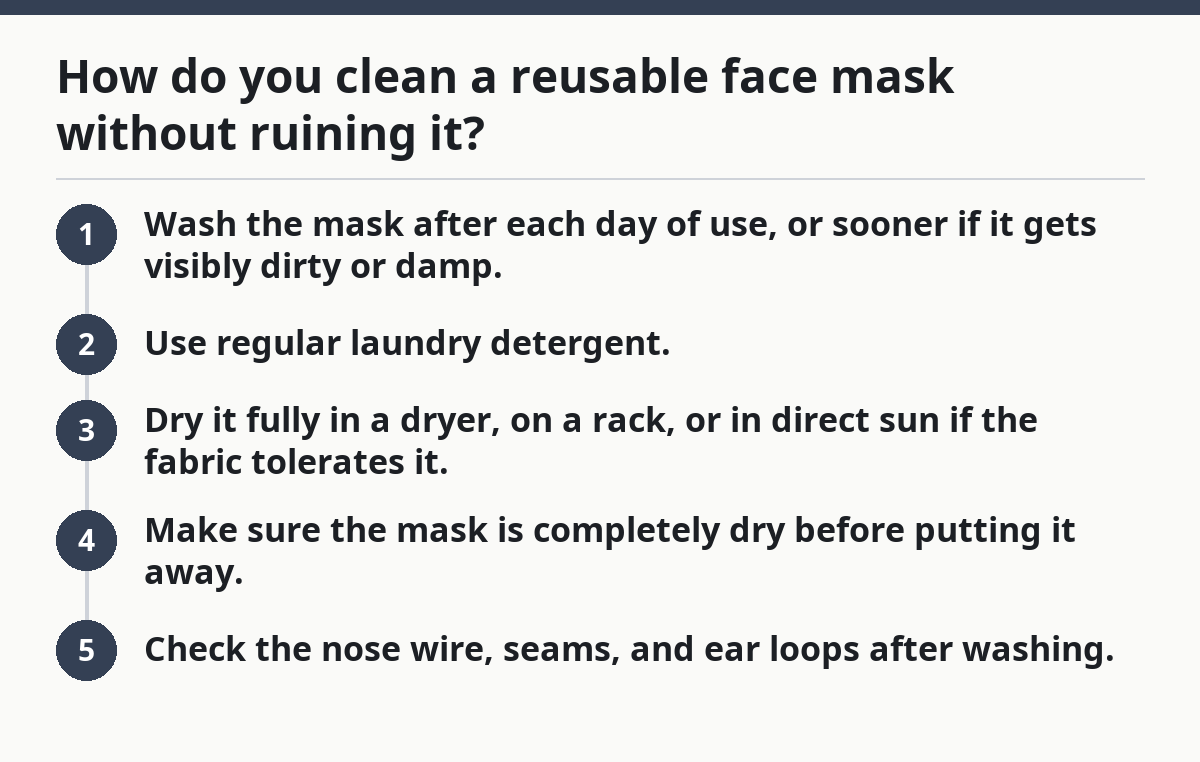
A simple routine works best:
- Wash the mask after each day of use, or sooner if it gets visibly dirty or damp.
- Use regular laundry detergent.
- Dry it fully in a dryer, on a rack, or in direct sun if the fabric tolerates it.
- Make sure the mask is completely dry before putting it away.
- Check the nose wire, seams, and ear loops after washing.
For a mask with a removable filter, remove the filter before washing unless the maker says otherwise. If the mask includes special coatings, decorations, or bonded layers, follow the maker’s label first. A label that says hand wash only is not decoration — it is the limit.
A few things can ruin a reusable mask fast:
- High heat that warps the shape
- Bleach used too aggressively
- Fabric softener that leaves residue
- Tumble drying that stretches ear loops
- Storing it while still damp
The CDC’s cleaning advice for cloth face coverings is straightforward: wash with regular detergent and dry completely. If the material can’t survive that, it is not a good everyday mask.
- CDC cleaning guidance: https://www.cdc.gov/coronavirus/2019-ncov/prevent-getting-sick/how-to-wear-cloth-face-coverings.html
The American Academy of Dermatology also notes that fragrance and harsh additives can irritate skin, which matters when you are washing something that sits on your face for hours.
- AAD skin-care basics: https://www.aad.org/public/everyday-care/skin-care-basics
A clean mask is also easier on skin. Dried sweat and dirt are common reasons people keep touching their face covering, which defeats the point.
How often should you replace an at-home face mask?
You should replace a reusable mask when the fit changes, the fabric thins, or the parts that hold it on stop working. There is no universal calendar date that fits every mask, because wear depends on washing, materials, and how often you use it.
Picture this: the mask still looks “okay” from a distance, but the ear loops are loose and the nose bridge no longer bends back into place. That is a replacement problem, not a cosmetic one.
Replace a mask when you notice:
- Stretched ear loops or ties
- Torn seams
- Holes or thinning fabric
- A nose wire that won’t hold shape
- Permanent stains that survive washing
- Odor that stays after cleaning
- A fit that leaves gaps at the cheeks or chin
Disposable masks have an even shorter life. Once they become wet, dirty, crushed, or hard to breathe through, they should go. A soaked disposable mask is not “still good for later.”
For reusable masks, wear-and-tear is the real clock. A mask that survives 20 washes and still fits well is more useful than one that starts fraying after a few rounds. If you can’t tell whether it still works, treat that as a warning sign and ask a professional or the maker for guidance if the mask has special construction or intended medical use.
A mask is not a forever item. That sounds obvious, but many people keep using one long after the elastic says otherwise.
What should you do with a mask between wears?
Keep a reusable mask in a clean, dry place where it won’t touch keys, coins, or a dirty pocket. A paper bag, clean container, or dedicated hook works better than tossing it on a counter.
Picture this: you take a mask off in the car, fold it once, and leave it under the seat until tomorrow. That turns the mask into a dust catcher.
Good between-use habits are plain:
- Wash or sanitize your hands before handling the mask.
- Remove it by the loops or ties, not the front.
- Keep used masks separate from clean ones.
- Let a reusable mask dry fully before storing it.
- Keep spare masks in a clean pouch or bag.
If you must take a mask off temporarily, avoid setting it on tabletops, bathroom sinks, or your phone. Those surfaces add germs and grime without warning.
Here’s the catch: the front of the mask is the dirty side. Touching, folding, and reusing it like a napkin is where many people go wrong.
What are the biggest safety mistakes people make at home?
The biggest mistakes are wearing a wet mask, reusing a dirty one, and relying on a poor fit. A mask with gaps around the nose or cheeks can undercut the whole point, even if the fabric itself is decent.
Picture this: you keep pulling the mask down to talk, then back up to cover your mouth. That tugging often loosens the fit and pushes you to touch the same spot again and again.
The most common errors are:
- Rewearing a damp mask
- Reusing a disposable mask too many times
- Touching the front while adjusting it
- Washing too gently to remove soil, or too harshly and damaging the mask
- Letting the nose wire flatten out permanently
- Wearing a mask below the nose
- Using a mask with visible damage because “it still works fine”
There is also a hygiene trap people miss: makeup, skincare, beard oil, and sunscreen can build up inside the fabric. That build-up can make the mask slick, smelly, and harder to clean. If a mask starts feeling grimy after only a short wear, it needs a better wash routine or replacement.
Not even close.
A safe mask routine is boring. That is a compliment.
When is a different mask better than a cloth one?
A different mask is better when you need a better seal, a disposable barrier, or a mask that holds up to a specific job. Cloth is fine for many routine uses, but it is not always the best tool.
Picture this: you’re doing a quick indoor task, and the room is crowded or poorly ventilated. A plain cloth mask may still help, but a better-fitting disposable option may be the smarter choice if comfort and seal are the main issues.
Choose a different mask when:
- The cloth mask keeps slipping
- The fabric is too thin or loose
- You need a fresh, disposable option for a single outing
- Skin irritation makes one fabric intolerable
- The mask has a shape that fits your face better than your current one
A reusable mask is the better choice when you want lower waste and a repeatable routine. A disposable mask is the better choice when you want easy turnover and no laundry step. The wrong choice is the one you won’t wear correctly.
The truth is, the best mask is the one you can keep on your face, keep clean, and keep fitting properly. A fancy design that rides up your cheeks is a bad bargain.
What changes if a child or sensitive skin is involved?
A child or anyone with sensitive skin needs a softer, simpler mask setup with close supervision and fewer irritants. The mask should fit without pinching, rubbing, or forcing repeated face touching.
Picture this: the straps itch, the fabric scratches, and the child keeps yanking the mask off. That is not a discipline problem first — it is a fit and comfort problem.
For sensitive skin, look for:
- Smooth fabric inside and out
- A nose wire that bends without poking
- Soft ear loops or ties
- Minimal seams near the mouth and cheeks
- Detergent with no heavy fragrance residue
For children, a mask that is too large is unsafe because it slides, gaps, and gets touched constantly. A mask that is too tight causes the opposite problem: it gets pulled off and ignored.
If skin breaks out under the mask, change the routine before blaming the mask alone. Clean the face before wear, wash the mask with a mild detergent, and rotate to a second mask so each one fully dries. A skin reaction can come from residue, sweat, friction, or fit — not just from the fabric itself. The AAD recommends fragrance-free products for sensitive skin, which makes detergent choice part of the mask routine.
- AAD sensitive-skin guidance: https://www.aad.org/public/everyday-care/skin-care-basics/dry-sensitive-skin
What the rulebook says, and what it means in real life
The rulebook says reusable masks should be washed, dried, and inspected; disposable masks should be discarded when they are dirty, damaged, or hard to breathe through. That sounds simple until real life adds sweat, makeup, lunch breaks, and a mask tossed into a bag.
Picture this: you have three masks in a drawer, but only one still seals correctly. The right move is not “rotate them forever.” The right move is to keep the one that still fits and retire the rest.
The public guidance from the CDC and WHO lines up on the same core ideas:
- Keep the mask clean.
- Keep it dry.
- Keep it fitted.
- Replace damaged masks.
- Avoid touching the front.
A home routine only works if it is easy enough to repeat. A complicated cleaning ritual that nobody follows is weaker than a simple one done every time.
The most useful rule is this: if a mask cannot be cleaned without damage, or if it no longer fits after cleaning, it is no longer a safe everyday option. CDC and WHO guidance both stress that the routine has to be practical enough to repeat.
- CDC respiratory virus prevention: https://www.cdc.gov/respiratory-viruses/prevention/index.html
- WHO mask guidance: https://www.who.int/publications/i/item/WHO-2019-nCoV-IPC_Masks-2020.4
Questions people ask before they start using masks at home
Can I reuse the same face mask the next day?
Yes, if it is a reusable cloth mask that has been washed, dried, and still fits well. A mask that was worn for hours, got damp, or touched dirty surfaces should be cleaned before reuse.
Is it safe to spray a mask with disinfectant?
Usually no, not unless the maker specifically allows it. Sprays can leave residue, damage fabric, and make breathing less comfortable; washing is the safer default for cloth masks.
How do I know when a mask is too worn out?
A mask is too worn out when the seams fail, the fabric thins, the ear loops stretch, or the fit changes enough to create gaps. If you keep adjusting it all day, it has stopped doing its job.
Should I wash a mask after every use?
Yes for most reusable masks, because sweat, skin oil, and outdoor grime build up fast. If a mask is visibly dirty or damp, it needs washing immediately rather than waiting for the end of the week.
Is a double mask always better?
No. A double mask can help in some cases, but it can also make breathing harder and cause gaps if the layers do not sit right. A single well-fitting mask often beats two poor-fitting ones.
The bottom line for safe mask care at home
The safest home mask is the one that still fits, still feels clean, and still survives washing without falling apart. A mask that is damp, damaged, or loose is not worth keeping in rotation.
Use a reusable mask only if you can wash and dry it correctly. Use a disposable mask only if you replace it when it gets dirty, wet, or worn. If you are unsure whether a mask is still good, that uncertainty is the answer.
Drafted with AI; not yet reviewed by a person.



Leave a Reply