




Last updated: November 19, 2026
Key Takeaways
- The right mask depends on the setting, which is where many shoppers go wrong.
- A good fit stays sealed around the nose and cheeks without constant adjusting.
- Filtration matters on paper, but comfort determines whether you wear the mask long enough for it to help.
- Respirator-style masks are often the strongest default for people who want fit and filtration.
Face mask shopping and selection — The Complete Guide can feel confusing because the wrong mask can fit badly, fog glasses, or feel useless in daily use. Quick answer: for many people, a well-fitted respirator-style mask is the strongest starting point, but the best mask still depends on your face, your task, and your tolerance for heat, pressure, and upkeep. This guide to face mask shopping and selection — The Complete Guide settles which type to buy, what to check, and what to skip.
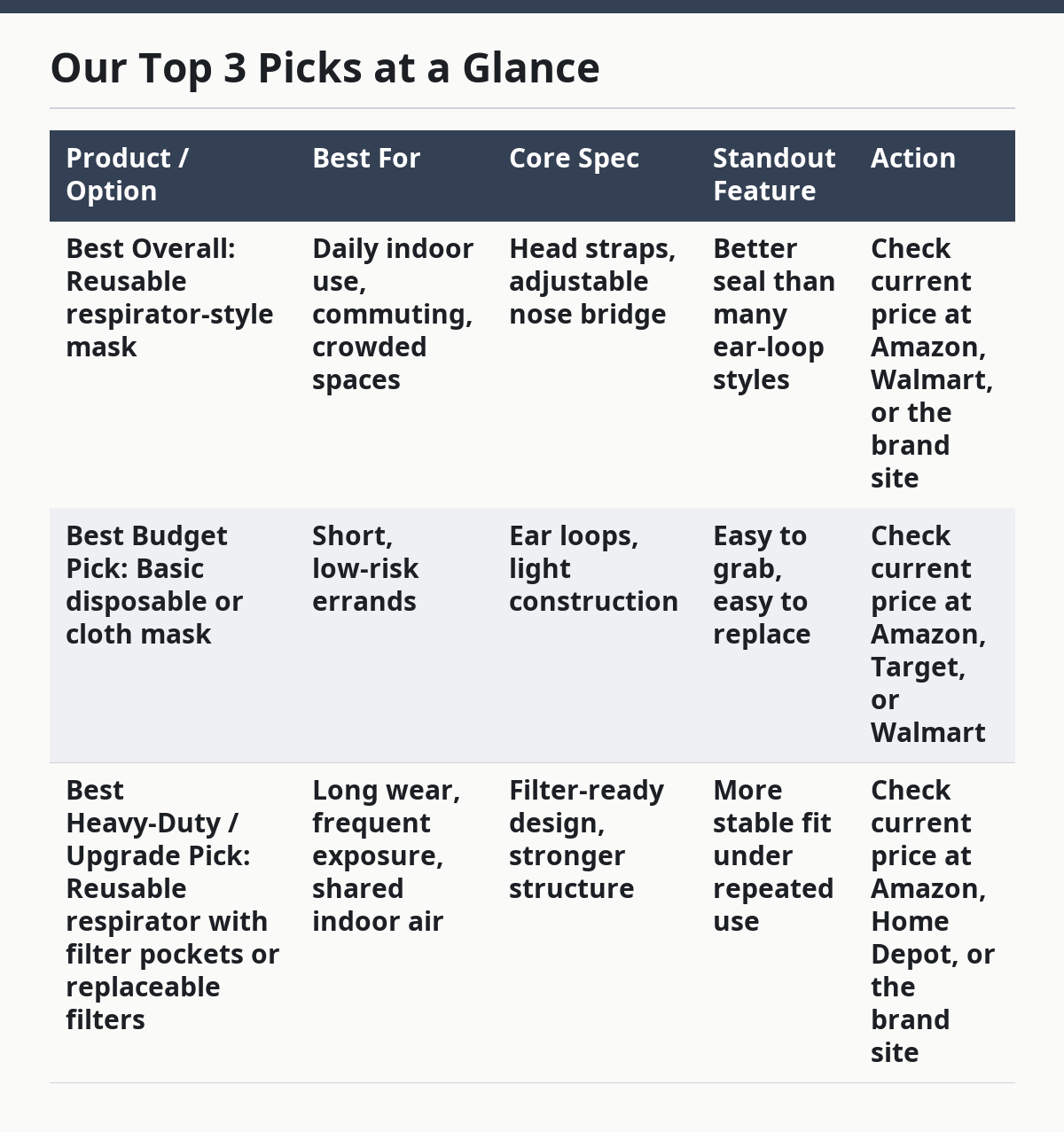
Our Top 3 Picks at a Glance

- #1 Best Overall: A well-fitted everyday respirator-style mask with a firm nose seal and head straps for a strong balance of fit and filtration.
- #2 Best Budget Pick: A simpler ear-loop disposable or cloth option for short errands, school drop-offs, or quick indoor stops.
- #3 Best Heavy-Duty / Upgrade Pick: A reusable respirator with replaceable filters for longer wear, higher exposure settings, or frequent use.
| Product / Option | Best For | Core Spec | Standout Feature | Action |
|---|---|---|---|---|
| Best Overall: Reusable respirator-style mask | Daily indoor use, commuting, crowded spaces | Head straps, adjustable nose bridge | Better seal than many ear-loop styles | Check current price at Amazon, Walmart, or the brand site |
| Best Budget Pick: Basic disposable or cloth mask | Short, low-risk errands | Ear loops, light construction | Easy to grab, easy to replace | Check current price at Amazon, Target, or Walmart |
| Best Heavy-Duty / Upgrade Pick: Reusable respirator with filter pockets or replaceable filters | Long wear, frequent exposure, shared indoor air | Filter-ready design, stronger structure | More stable fit under repeated use | Check current price at Amazon, Home Depot, or the brand site |
Picture this: you’re standing in an aisle or scrolling a product page, and every option looks the same until you notice the strap style, nose piece, and how often you’ll actually wear it. The right choice is fit first, then filtration, then comfort, because a high-spec mask that slips or feels miserable gets abandoned fast.
A beginner usually needs three answers, not thirty. Which style fits the job, which details matter on the label, and which “features” are just marketing paint.
What kind of face mask do you actually need?
The right mask depends on the setting, and that is where most shoppers go wrong. A loose face covering for a quick outdoor stop is not the same choice as a snug respirator for a crowded train or an all-day shift.
The main split is simple: disposable, cloth, and respirator-style. Disposable masks are fast and convenient. Cloth masks can be reusable and comfortable, but performance varies a lot by fabric and fit. Respirator-style masks usually give the most dependable seal when the job calls for it.
Here’s the catch: the “best” type changes with the risk level and the length of wear. A mask for a 10-minute errand can be light and easy. A mask for a full workday needs a better seal and less pressure on the ears or face.
- Disposable masks: good for convenience, short use, and simple replacement.
- Cloth masks: good for reuse and comfort if the fabric and layers are well made.
- Respirator-style masks: useful when you need a firmer fit and more control over leakage.
The CDC’s mask guidance and the CDC’s respirator page are useful starting points for the language around fit and filtration. A standards body such as NIOSH is also worth knowing, because it defines respirator performance categories, not just marketing claims. For example, CDC guidance emphasizes fit and correct use, and NIOSH categories such as N95 describe tested filtration performance.
Key takeaway: choose the style by task first, not by color, packaging, or brand hype.
How do I know if a mask will fit my face?

A mask fits well when it stays sealed around the nose and cheeks without constant adjusting. That sounds obvious, but it is the part most shoppers skip, and it is the reason many masks fail in real life.
A good fit usually comes from three details: adjustable nose bridge, strap style, and face shape compatibility. Nose bridges help cut air leaks near the glasses. Head straps often seal better than ear loops for many people. Face shape matters because a mask that sits fine on one jawline may gap on another.
The truth is, fit beats almost everything else on the package. A high-filtration mask with gaps can underperform a simpler one that sits properly. That is why “one size fits all” is more promise than fact.
- Look for a moldable nose wire that holds its shape.
- Prefer head straps if ear loops pull the mask down.
- Check whether the mask offers multiple sizes or a more structured shape.
- Watch for chin gaps, especially if the mask rides up when you talk.
A good test is boring but useful: put the mask on, talk, turn your head, and breathe normally for a minute. If it slides, pinches, or leaves open edges, keep looking. The face is not flat, and the mask should not pretend it is.
What matters more: filtration, comfort, or breathability?
Filtration matters most on paper, but comfort decides whether you wear the mask long enough for it to matter. That trade-off is the center of smart shopping.
A tighter, more structured mask often filters better because it seals better. The downside is pressure, heat, and harder breathing for some wearers. A softer mask may feel easier at first, but if it leaks around the edges, the comfort does not buy much protection.
The best part is simple: you do not need to chase the most complicated spec sheet. You need a mask that matches the job and stays on your face without constant correction. That is especially true for long commutes, flights, classrooms, or any indoor setting where you wear it for hours.
| Criterion | Higher-filtration, tighter mask | Softer, easier mask | Winner for this condition |
|---|---|---|---|
| Seal around nose and cheeks | Usually stronger | Often weaker | Crowded indoor spaces |
| Breathability | Can feel harder | Usually easier | Short errands |
| All-day comfort | Can cause pressure points | Usually gentler | Long wear with low risk |
| Glasses fog control | Better if fitted well | Less reliable | Glasses wearers |
| Reuse potential | Often better | Often limited | Frequent use |
| Ease of putting on | Slightly slower | Faster | Quick stops |
| Mask stability during movement | Better with head straps | Can shift more | Walking or commuting |
| Heat buildup | Often higher | Often lower | Hot weather |
If you shop by comfort alone, you may end up with a mask you like and do not trust. If you shop by filtration alone, you may end up with a mask you hate and stop wearing. The smarter move is to pick the highest-performing mask you can actually tolerate.
Disposable, cloth, or respirator-style: which one should I buy?
Respirator-style masks are often the safest default for many people who want the strongest combination of fit and filtration. Disposable masks win on convenience. Cloth masks win when reusability and softness matter more than top-tier performance.
That answer changes with the setting. A disposable mask can be fine for a quick trip or backup use. A cloth mask may be reasonable for low-risk situations if it fits snugly and is made with decent material. A respirator-style mask is the better call when the stakes are higher, the indoor air is shared, or the wear time is long.
Picture this: you’re choosing between three masks that all look tidy in photos, but only one has a stiff frame, a real nose seal, and straps that won’t stretch out by noon. That one usually earns its keep, even if it looks less sleek.
Disposable masks: who they suit and who should skip them
Disposable masks suit people who want a simple, low-effort option for short use. They are also useful as spares in a bag, car, or desk drawer.
The problem is that many disposable masks fit loosely, especially around the cheeks and nose. Ear loops can pull unevenly, and the material may collapse when you talk or breathe hard. That makes them a weaker choice for long wear or repeated use.
Who Should Skip This: people who wear glasses all day and need a stronger nose seal should look at a respirator-style mask instead, and if their needs are high-risk they should consult a clinician or other qualified professional for fit advice.
Buy this if: you want a quick, inexpensive backup for short indoor stops and do not need the strongest seal.
Skip this if: you need all-day comfort, a stable fit, or a tighter seal for repeated indoor exposure.
Cloth masks: who they suit and who should skip them
Cloth masks suit buyers who value reuse, softer fabric, and a less disposable feel. They can also be easier on skin if the fabric is well chosen and the seams are smooth.
The drawback is inconsistency. Fabric choice, layer count, shape, and wash wear all change performance. A cloth mask can be comfortable but still leak at the sides, and that hurts its value if you rely on it for more than casual use.
Who Should Skip This: anyone shopping for the strongest possible seal should choose a respirator-style mask with a molded nose bridge and secure straps.
Buy this if: you need a reusable mask for low-risk settings and can find one with a close fit.
Skip this if: you want dependable performance in crowded indoor spaces or need a mask that stays stable through a long day.
Respirator-style masks: who they suit and who should skip them
Respirator-style masks suit people who need a firmer face seal, especially in busier indoor settings, shared workspaces, or travel days. They are the strongest choice for buyers who care about control, not just convenience.
The trade-off is obvious: they can feel more structured, warmer, and less relaxed on the face. Some people also dislike the look or the pressure from tighter straps. If you wear a mask for only a few minutes at a time, this may be more mask than you need.
Who Should Skip This: people who only need a brief, low-stakes option for rare use may be happier with a simple disposable mask, though if they are unsure about respiratory risk they should consult a professional.
Buy this if: you need the best chance of a stable seal and plan to wear it often or for long stretches.
Skip this if: you cannot tolerate pressure, heat, or a more structured fit.
What should I check on the box before I buy?
The box tells you more than the photos do, if you know what to read. The right details are the ones that change fit, upkeep, and day-to-day use.
Start with size, strap type, nose bridge, and cleaning instructions. If the packaging does not say how to clean it, replace filters, or adjust the fit, that is a warning sign. A mask that looks fine in a photo but gives no practical details is usually a gamble.
Here’s the catch: the best listing is often the least flashy one. It tells you the strap material, whether the nose piece is adjustable, and whether the mask is meant for reuse or one-time wear. Those are the details that matter after the purchase.
- Size range: one-size claims can hide a poor fit.
- Strap style: ear loops are easier; head straps often seal better.
- Nose piece: adjustable is better than fixed.
- Cleaning care: if it is reusable, the care steps should be clear.
- Filter notes: if filters are used, the listing should explain replacement.
If you see only lifestyle photos and broad claims, keep moving. The package should answer the boring questions first.
What are the common shopping mistakes?
The most common mistake is buying for looks and not for face shape. A mask that matches your outfit but leaks at the nose is a poor trade.
The second mistake is assuming all fabric masks or all disposable masks perform the same. They do not. Construction, layer layout, nose seal, and strap tension all change the result, and those details are not always obvious from a product image.
A third mistake is ignoring the way the mask behaves during speech. If it drops when you talk, slides up under your eyes, or leaves a gap near the chin, that will happen every time you wear it. The problem is not theoretical.
- Buying one size only when your face needs a better fit.
- Choosing soft comfort over real seal.
- Ignoring whether you wear glasses.
- Skipping the care instructions on reusable masks.
- Treating all straps as equal.
On the flip side, the smartest shopper often buys two types: one stronger mask for serious use and one easy mask for backup. That gives you flexibility without pretending one product solves every situation.
How should I care for a reusable mask?
A reusable mask only stays useful if you clean it the way the maker says. If the listing gives washing or filter-change instructions, follow those first.
For simple reusable cloth masks, that usually means regular washing and full drying before the next use. For respirator-style reusable designs, the cleaning method may be different, especially if the structure includes a molded shell, separate filters, or a shape that should not be soaked. If the care steps are unclear, the mask is harder to trust.
The best rule is simple: a reusable mask should be easy enough to maintain that you will actually maintain it. Complicated care kills good intentions fast.
- Check whether the mask can be machine washed or needs hand care.
- Make sure it dries fully before reusing.
- Replace filters if the design uses them.
- Keep a spare so you are not tempted to reuse a damp mask.
A reusable option is only a good buy if you can keep it clean without fuss. If the care routine feels like a chore, you will eventually stop following it.
The honest side-by-side: what wins for which buyer?
The clearest winner for most shoppers is a respirator-style mask with a strong fit, because it balances seal, stability, and repeat use better than the other types. A basic disposable mask still has a place, and a cloth mask can make sense, but each one has a narrower job.
Picture this: you need one mask that covers the most situations without becoming annoying to wear. You do not want to overbuy, but you also do not want to keep replacing weak options that slip, fog, or stretch out.
| Criteria | Disposable mask | Cloth mask | Winner for this condition |
|---|---|---|---|
| Best for quick use | Yes | Sometimes | Disposable mask |
| Best for reuse | Limited | Yes | Cloth mask |
| Best for stable seal | Sometimes | Sometimes | Respirator-style mask |
| Best for long wear | Depends on fit | Depends on fit | Respirator-style mask |
| Best for glasses wearers | Not always | Not always | Respirator-style mask |
| Best for low effort | Yes | Yes | Disposable mask |
| Best for lower waste | No | Yes | Cloth mask |
| Best for higher-risk settings | Weaker choice | Mixed | Respirator-style mask |
The verdict is not complicated. If the mask is for everyday indoor use, commuting, or any setting where you want a better seal, the respirator-style option wins. If the mask is for quick errands and backup use, a disposable mask is easier. If your main goal is reuse and softness in lower-risk settings, cloth can still earn a place.
When should you choose a different option entirely?
You should rethink the whole purchase if the mask you want cannot fit your face properly, cannot stay in place during speech, or cannot be worn long enough to matter. At that point, the wrong style is the problem, not the brand.
The first exception is skin irritation. If elastic, seams, or stiff edges bother your skin, a different strap style or a softer cloth construction may work better. The second is eyewear. If fogging is constant, a better nose bridge or a different frame shape may matter more than the material. The third is long daily wear. If you need a mask for many hours, comfort and heat management start to matter as much as filtration.
The fourth exception is maintenance. If you will not wash a reusable mask on schedule or replace parts on time, a simple disposable option may be more realistic. A perfect mask you do not maintain becomes a bad mask fast.
- Switch to head straps if ear loops tug your ears or slide.
- Choose a more structured mask if the fabric collapses when you talk.
- Choose a softer reusable mask if pressure points keep you from wearing it.
- Stick with simple disposables if you need a backup that lives in a bag.
The verdict: which mask should you choose?
Choose respirator-style if you need the best seal, wear the mask often, or spend time in crowded indoor spaces. Choose disposable if you want a simple backup for short errands and low-effort use. Neither if the mask does not fit your face, fogs your glasses badly, or feels so uncomfortable that you will stop wearing it.
That is the real shopping rule. The best mask is not the prettiest, the cheapest, or the most marketed one. It is the one you can fit, wear, and keep using without fighting it every time.
What if I only need a mask for a quick trip?
A disposable mask is usually the easiest buy for a short trip. It is simple, light, and easy to replace.
The catch is fit. If the ear loops pull the mask down or the nose piece gaps open, the convenience is not worth much. A better-fitting reusable option may still be the smarter pick if you wear masks often.
Are cloth masks still worth buying?
Cloth masks are worth buying if you want reuse, softness, and a lower-stress option for low-risk situations. They are less convincing when you need a stronger seal.
The main issue is inconsistency. Two cloth masks can look alike and perform very differently, so the construction details matter more than the fabric name.
Should I choose ear loops or head straps?
Head straps are usually the better choice when you care about seal and stability. Ear loops are easier to put on and take off, but they can pull the mask down or let it shift.
If you wear glasses, move a lot, or keep your mask on for hours, head straps often make more sense. If you only need the mask for a short stop, ear loops may be good enough.
How do I know if a mask is worth the money?
A mask is worth the money if it fits well, matches your use case, and gives clear care instructions. The price tag matters less than whether you will actually wear it and reuse it properly.
Look for clear details on size, strap style, nose bridge, and cleaning. If those details are missing, the listing is doing less work than it should.
Drafted with AI; not yet reviewed by a person.

Leave a Reply