



Last updated: November 19, 2026
Key Takeaways
- Overnight face masks are leave-on treatments worn for 6 to 8 hours, usually after cleansing and before bed.
- Use an overnight face mask when skin needs extra cushioning rather than just another product.
- An overnight face mask usually goes on last, after serum and moisturizer, unless the label says otherwise.
- Dry, dehydrated, and normal-to-dry skin types often see the clearest benefit from an overnight face mask.
An overnight face mask is a leave-on skincare treatment made to stay on while you sleep. For overnight face masks, it makes sense when your skin needs more moisture support than a regular moisturizer alone can give, though if you have persistent irritation or acne concerns, consult a dermatologist or other skincare professional. It is not just a thicker cream in a fancy jar; it is a separate format, often called a sleeping mask, that sits on top of your last skincare step and works for hours instead of minutes.
What an overnight face mask actually is
An overnight face mask is a leave-on mask designed for 6 to 8 hours of wear, usually applied after cleansing and before bed. The name “sleeping mask” is common in skincare, and the format exists to reduce water loss from the skin surface while you sleep, when you are not washing, sweating, or reapplying products. For general guidance on skin-barrier care, see the American Academy of Dermatology’s advice on dry skin care.
That matters because this product fills a different role from a wash-off mask. A rinse-off clay mask is built to be removed after a short set time. A sheet mask usually stays on for about 10 to 20 minutes. An overnight mask stays in place much longer, so it needs a texture that can sit comfortably on the skin without dripping into your pillow.
Most overnight face masks look like a richer moisturizer, a balm, or a gel-cream. The difference is usually in the formula’s job, not just its label. If a product is marketed as a sleeping mask, it is generally meant to act as a final occlusive or moisture-sealing layer rather than a quick treatment, though you should still check the instructions and consult a professional if you are unsure how it fits with prescription products.
This is where the format earns its keep. A normal moisturizer may be enough for many people, especially if the room is not dry and the rest of the routine is simple. An overnight face mask makes more sense when skin feels tight by morning, flakes around the nose or cheeks, or needs a heavier seal over serum and moisturizer. It is also useful after travel, air conditioning, or a day that left the skin barrier feeling stressed.
The catch is that “more” is not always better for every skin type or routine. A leave-on mask can feel too heavy for oily skin, clog-prone skin, or anyone who hates the film-like finish some formulas leave behind. The format solves one problem by creating another: longer contact time, but also more chance of greasiness, pilling, or transfer onto fabric.
When should you use an overnight face mask?
Use an overnight face mask when your skin needs extra cushioning, not when it simply needs another product. The best time is often before bed on nights when your routine is otherwise simple and your face feels dry, tight, or overworked.
A few common situations make the most sense:
- Dry indoor air or winter weather. Heating can leave skin feeling parched by morning, especially if you sleep in a room with low humidity.
- After a long travel day. Airplanes and hotel rooms often mean more dehydration and less consistent skincare.
- When your skin is flaky but not irritated. A sleeping mask can soften the feel of rough patches better than a light lotion.
- When your moisturizer is not enough. If you already use a serum and moisturizer but still wake up with a thirsty-looking face, a leave-on mask can be the top layer.
- On recovery nights. If your routine has active ingredients like retinoids or exfoliating acids, a plain, nourishing sleeping mask can be a gentler night off.
The product is less useful when the issue is oiliness, acne flare-ups, or sensitivity to heavy textures. A thick leave-on formula can feel like too much on skin that already produces a lot of oil. It can also interfere with how well some treatments sit on the skin if you pile it on top of several layers, so if you use prescription or active products, consult a dermatologist or pharmacist before combining them.
A good rule: if your main complaint is that skin looks dull, feels tight, or loses comfort overnight, the format may help. If your main complaint is breakouts, redness, or stinging, a mask is not the first thing I would reach for.
This is also the moment to think about the room, not just the product. A fan pointed at your face, very low humidity, or sleeping with your mouth open can all make skin feel drier by morning. An overnight face mask may help, but it cannot fix every cause of overnight dryness.
For ingredient context, the guide to face mask materials explained on this site covers the broader material side of mask design without getting into routine timing here. See also the site’s face mask materials explained hub and the related moisturizer guide for routine basics.
How to layer skincare before bed
An overnight face mask goes on last, after serum and moisturizer, unless the product label says otherwise. That order matters because the mask is meant to seal in the steps beneath it, not compete with them. The American Academy of Dermatology’s skin-care guidance also supports layering from thinnest to thickest.
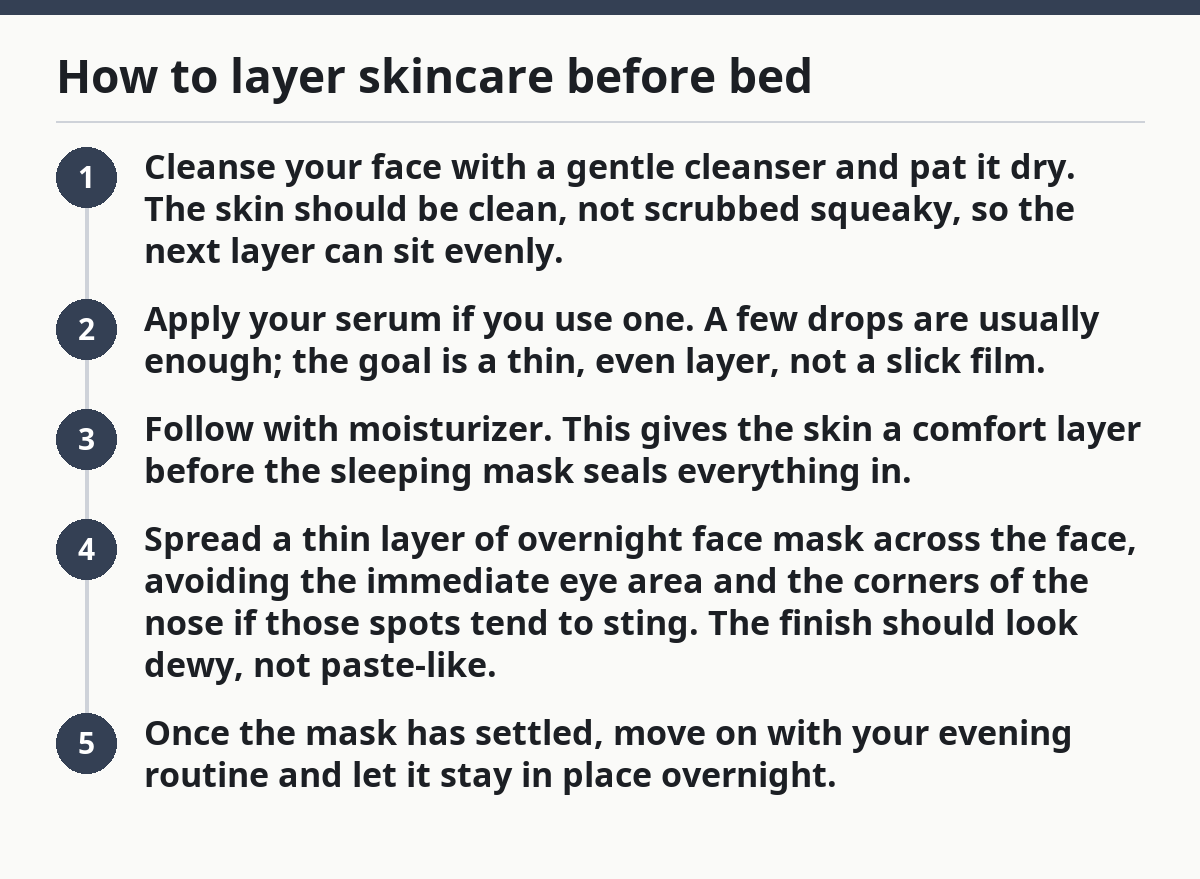
Here is the simplest way to layer it:
- Cleanse your face with a gentle cleanser and pat it dry. The skin should be clean, not scrubbed squeaky, so the next layer can sit evenly.
- Apply your serum if you use one. A few drops are usually enough; the goal is a thin, even layer, not a slick film.
- Follow with moisturizer. This gives the skin a comfort layer before the sleeping mask seals everything in.
- Spread a thin layer of overnight face mask across the face, avoiding the immediate eye area and the corners of the nose if those spots tend to sting. The finish should look dewy, not paste-like.
- Once the mask has settled, move on with your evening routine and let it stay in place overnight.
That order works for most people because it keeps the strongest seal on top. If you reverse the order and put a heavy mask under a lighter moisturizer, the final step may not stay put the way you want.
The most common layering mistake is using too much product. With sleeping masks, a 2- to 3-mm layer is usually plenty; you do not need to cake it on. A thick coat can feel greasy, slide around on the pillowcase, and make morning cleansing harder.
The second mistake is stacking too many actives before bed. If your serum already contains a strong exfoliating acid or a retinoid, adding a rich overnight mask on top can make the routine feel uncomfortable. The better move is usually to keep the base routine simple and use the mask as the final seal, not as another treatment layer, though you should consult a professional if you are building a routine around prescription-strength products.
If you prefer a short routine, you do not need three or four products every night. A cleanser, moisturizer, and sleeping mask can be enough on some evenings. On other nights, the moisturizer alone may be the smarter choice.
Which skin types usually benefit most?
Dry, dehydrated, and normal-to-dry skin types usually get the most obvious benefit from an overnight face mask. The reason is simple: these skin types tend to lose comfort faster overnight, so a leave-on layer can make the morning feel less tight.
Dry skin often likes richer textures such as balm-like or cream-based sleeping masks. Dehydrated skin, which can happen even on oily faces, often responds well to a lighter gel-cream sleeping mask because the goal is comfort and water retention rather than extra oil. Normal skin may use the format occasionally, especially in winter or after travel.
Oily or acne-prone skin is more complicated. That does not mean overnight masks are off-limits, but it does mean the texture matters. A heavy, shiny formula can feel suffocating and may be a bad fit if your skin already dislikes thick occlusives. A lighter sleeping mask, or skipping the format entirely, may work better.
Sensitive skin sits in the middle. A fragrance-heavy product, a very dense balm, or a formula with a long ingredient list can be a problem if your skin reacts easily. In that case, the mask should be treated like any other leave-on skincare product: patch test if you are prone to reactions, and keep the first use to one night rather than making it the centerpiece of your routine.
The main trade-off is comfort versus containment. The more a sleeping mask seals the skin, the better it can reduce overnight water loss. That same seal can feel too occlusive for some faces. If the formula leaves you shiny, itchy, or congested-looking by morning, that is a sign to step down to a lighter moisturizer instead.
What the label should tell you before you buy one
The label should tell you whether the product is meant to be a sleeping mask, how heavy the texture is likely to feel, and whether it fits your routine. That is more useful than the marketing language on the front of the jar.
Look for these details first:
- Product format. If it says sleeping mask, overnight mask, or leave-on mask, that is a strong sign it is meant for bedtime use.
- Texture cue. Words like gel, cream, balm, or gel-cream tell you a lot about how it will sit on skin.
- Finish. If the label or description mentions “rich,” “occlusive,” or “barrier-supporting,” expect a heavier feel.
- Routine fit. A product that says it can be used as the last step is usually easier to place in a nighttime routine than one that gives vague directions.
- Sensitive-skin clues. Fragrance-free is often helpful, though it is not a guarantee of gentleness.
This is also where the distinction between a moisturizer and a sleeping mask gets practical. Some products are basically richer moisturizers with a sleeping-mask label. Others are distinct formulas meant to sit on top of a regular moisturizer for extra sealing. If you already own a moisturizer that leaves your skin comfortable until morning, you may not need a separate overnight mask at all.
A common mistake is buying based only on the word “overnight.” That label does not tell you whether the product is lightweight, heavy, fragranced, or suited to oily skin. A second mistake is treating all leave-on masks as interchangeable. They are not. A gel sleeping mask and a balm sleeping mask can feel and behave very differently, especially on the pillow.
For a broader look at how mask construction changes performance, the site’s face mask materials explained hub covers the material side without turning this page into a materials lesson. The moisturizers page on this site can also help you compare a sleeping mask with a standard night cream.
What are the downsides of sleeping masks?
The main downside of a sleeping mask is that it can be too much product for the skin you have today. A formula that feels comforting on a dry night can feel greasy, sticky, or congested on another night.
Three practical drawbacks show up most often:
- Transfer. Some formulas rub off on pillows or hairline edges if you apply them too close to bedtime. Waiting 1 to 2 minutes helps, but it does not remove the risk.
- Pilling. If you layer too many products, the mask can roll into little flakes on the skin instead of settling smoothly.
- Overuse. A leave-on mask every night is not automatically better than a simple moisturizer. For some people, too much occlusion leads to an unpleasant, heavy feel.
There is also a simple budgeting problem. If a product is priced like a specialty treatment but functions like a richer moisturizer, it may not earn a permanent spot in the routine. A lot of people get the same comfort by adjusting their moisturizer or adding a thin layer of petrolatum over dry patches, though that is a different approach and not always the feel they want.
The right question is not “Is an overnight face mask good?” It is “What job does it do that my current routine does not?” If the answer is “none,” it is probably unnecessary. If the answer is “my skin still feels dry by morning even after moisturizer,” it may be a good fit.
What should you do in the morning after using one?
You should cleanse gently in the morning, then continue with your normal daytime skincare. The goal is to remove any leftover film without stripping the skin.
If the product feels like it has mostly absorbed, a light rinse or gentle cleanser is usually enough. If the mask left a noticeable residue, wash it off so sunscreen and makeup can sit properly on top. After that, apply your usual morning moisturizer if needed, then sunscreen.
The morning step matters because overnight masks are designed for extended contact, not all-day wear. Leaving a heavy residue on the skin can make your face feel slick under sunscreen or makeup. If you wake up with skin that feels calm and comfortable, that is the intended result. If you wake up oily or coated, the formula was probably too rich or the layer was too thick.
A practical clue: if you can still feel the mask in the morning like a film, you likely used too much. The next time, apply a thinner layer, choose a lighter texture, or use the mask less often. A sleeping mask should support skin overnight, not make the next morning more complicated.
What does an overnight face mask do?
An overnight face mask helps hold moisture against the skin while you sleep. It usually acts as a final layer over serum and moisturizer, which can make skin feel softer and less tight by morning. The exact effect depends on the formula, but the basic job is to seal in comfort rather than wash off quickly.
Can you use an overnight mask every night?
You can use an overnight mask every night only if your skin tolerates it well and the formula is light enough for daily use. Many people do better using one a few nights a week or only when skin feels dry. If the product feels greasy, causes congestion, or makes your routine too heavy, nightly use is probably too much.
Do you wash off an overnight face mask in the morning?
Yes, you usually wash off an overnight face mask in the morning with a gentle cleanser or at least a thorough rinse. Some residue can remain on the skin after hours of wear, and removing it helps sunscreen and makeup sit more cleanly. If the formula absorbed fully, the morning cleanup may be very light.
Drafted with AI; not yet reviewed by a person.



Leave a Reply