



Last updated: November 19, 2026
Choose a bio-cellulose face mask when fit matters more than price, serum retention matters more than speed, and you want the mask to hug the face instead of sit loosely on it. A standard sheet mask is fine for a quick, general-use routine; bio-cellulose earns its place when you want closer contact, more precise placement, and a wetter, more serum-heavy feel.
Key takeaways
- Bio-cellulose is the better pick when the mask needs to cling to skin curves, not float over them.
- Standard sheet masks make more sense for simple, low-cost use and a wider range of skin shapes.
- The main advantage is contact: the closer the material sits, the more even the mask feels on the face.
- Bio-cellulose is not the cheapest choice, and it is not always the smartest choice for a fast, casual routine.
- If the goal is heavy serum payoff and a snug fit around the nose, chin, and cheeks, bio-cellulose usually wins.
What makes bio-cellulose different?

Bio-cellulose is a fermented fiber material that behaves differently from the typical nonwoven sheet used in many sheet masks. It forms a finer, denser web that can sit very close to skin, which is why people look at it as the more specialized option. A standard sheet mask is still a sheet mask, but it usually feels thinner, drier, and less clingy.
That difference matters because the material changes how the serum stays in place. Bio-cellulose tends to feel wetter and more saturated, so the mask can stay in contact with skin better over the wear time. A standard sheet mask can be perfectly serviceable, but it is more likely to lift at the edges or feel looser on faces with sharper contours.
The simplest way to think about it is this: bio-cellulose is for fit and contact; standard sheet masks are for convenience and broad use. The first is usually the better choice when the mask needs to act like a second skin. The second is usually the better choice when you want something familiar, inexpensive, and easy to find.
For a broader overview of mask materials, this page fits inside the larger guide to face mask materials explained: sheet, cream, clay, gel and overnight masks.
When should I choose a bio-cellulose mask?
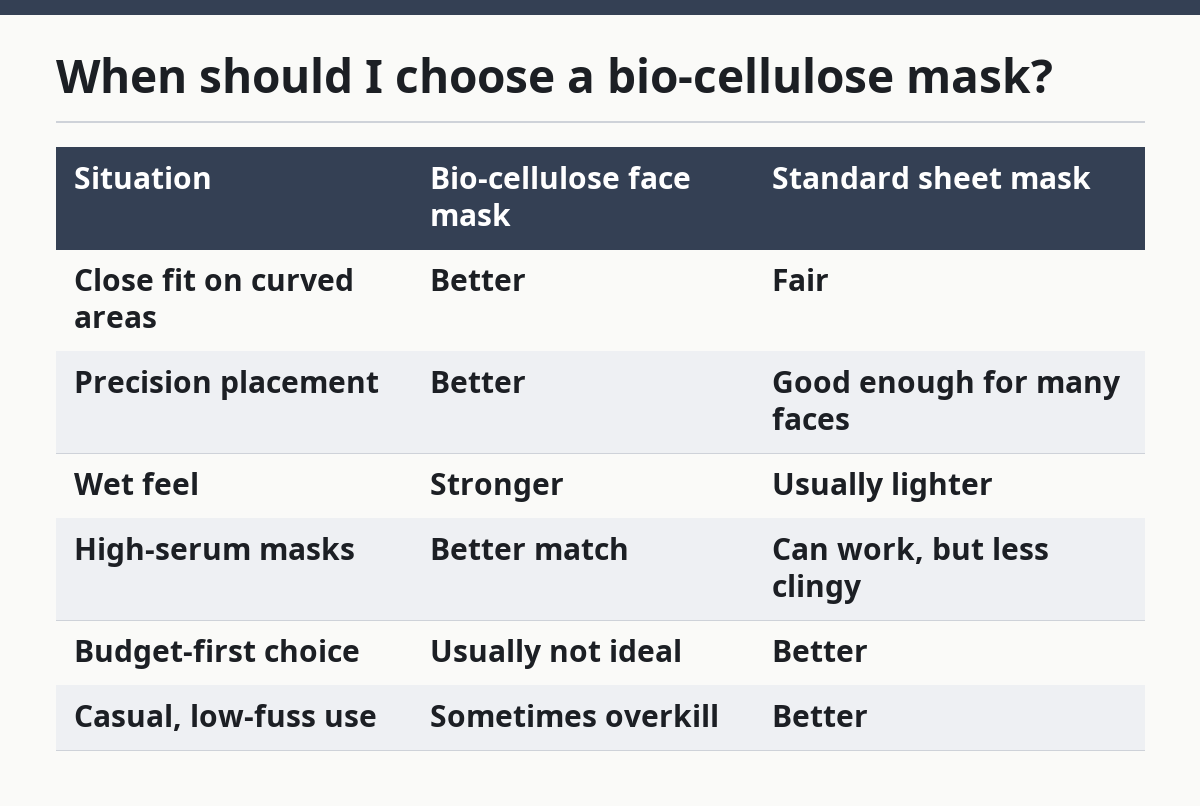
Choose a bio-cellulose mask when you want the closest possible fit and the most precise placement across the face. It is the better option for skin that is hard to cover evenly with a looser sheet, especially around the nose, jawline, and the small dips beside the mouth. That close fit is the main reason people reach for it over a standard sheet mask.
This is also the better pick when the mask itself is especially serum-heavy. Bio-cellulose works well when the formula is meant to sit on skin for a longer, wetter wear rather than dry down quickly. A standard sheet mask can handle a lighter formula, but bio-cellulose is usually the stronger match for high-serum masks that should stay in place without sliding around.
Here is the practical rule: if the benefit you want is “better contact,” choose bio-cellulose. If the benefit you want is “simple and easy,” a standard sheet mask is enough. The material choice is not about luxury for its own sake. It is about how the mask behaves on the face once it is on.
| Situation | Bio-cellulose face mask | Standard sheet mask |
|---|---|---|
| Close fit on curved areas | Better | Fair |
| Precision placement | Better | Good enough for many faces |
| Wet feel | Stronger | Usually lighter |
| High-serum masks | Better match | Can work, but less clingy |
| Budget-first choice | Usually not ideal | Better |
| Casual, low-fuss use | Sometimes overkill | Better |
Why does the fit feel so different?

Bio-cellulose fits better because the material is finer and closer to skin than a standard sheet. That is why it can look almost painted on once it is smoothed down. The shape matters, but the material does most of the work.
A close fit helps in three ways. First, it reduces air gaps, so the mask does not slide as easily. Second, it keeps the serum spread more evenly across the face instead of pooling in loose folds. Third, it makes the mask easier to place in exact spots, which matters if you care about the nose bridge, cheeks, or chin.
That said, the better fit can also make bio-cellulose feel less forgiving if you rush placement. Once it sticks well, repositioning can take more effort than with a standard sheet mask. If you like to adjust a mask several times after it goes on, a looser sheet may feel easier to handle.
The body benefit is simple: the material does more of the conforming, so the mask follows the face more closely. A standard sheet mask depends more on the cut and the amount of serum to stay comfortable. Bio-cellulose depends more on the structure of the material itself.
How do I use bio-cellulose masks well?
Use a bio-cellulose mask by placing it carefully the first time, smoothing it once, and then leaving it alone long enough for the serum to stay in contact with the skin. The whole point is the fit, so the first minute matters more than it does with many standard sheet masks.
- Open the mask and separate the layers as directed on the package. Bio-cellulose masks often have a slippery, wet feel, so this is the moment to be careful rather than fast.
- Line up the center of the mask with the center of the face. The result should be even coverage across the nose and mouth, not a crooked fit that wastes the material’s main advantage.
- Press the mask lightly along the cheeks, nose, and chin. The goal is close contact, not hard pressure, so the material lies flat without bunching.
- Leave it on for the time shown on the package. The mask should stay wet and snug rather than drying into stiff edges.
- Remove it once the wear time ends and handle any leftover serum as directed by the product. The face should feel coated, not patchy or dry.
A standard sheet mask can forgive rougher placement because it is often less clingy. Bio-cellulose rewards patience. If the mask is twisted or folded badly at the start, the close-fit advantage drops fast.
For readers who want a quick source check on cosmetic mask materials and skin-contact products, the FDA cosmetics page and PubMed both cover the broader topic of cosmetic ingredients and skin-facing materials.
When is a standard sheet mask the better pick?
A standard sheet mask is the better pick when you want a simpler, cheaper, and less fussy option. If the main goal is a short skin-care step and not a perfect seal, the extra structure of bio-cellulose may not buy you much. In that case, standard sheet masks do the job with less cost and less concern over fit.
This matters for people who use masks casually rather than strategically. A standard sheet mask is usually easier to keep on hand, easier to replace, and easier to use when the face is not a perfect match for a more precise material. It also makes more sense if you do not care whether the mask clings tightly to every curve.
The trade-off is straightforward. You lose some close contact and some of the “second-skin” feel, but you gain a more ordinary, lower-commitment routine. For many people, that is the right balance. Bio-cellulose is the specialist; standard sheet masks are the generalist.
A reader who only wants one mask for occasional use does not need to chase the more advanced material. The better choice is the one that matches the level of fuss the routine can actually support.
What are the trade-offs?
Bio-cellulose gives you better contact, but it usually asks for more money and more care than a standard sheet mask. That is the central trade-off. If the fit is not important to you, the upgrade can feel unnecessary.
The material can also feel heavier or wetter on the face, which some people love and others do not. That wet feel is part of the appeal, but it is not automatically more comfortable for everyone. A standard sheet mask can feel lighter and more familiar, especially for someone who does not like a strong damp sensation.
There is also a simple mismatch problem. Bio-cellulose is a strong choice for high-serum masks and precision placement, but it is a poor use of effort if you just want a quick, no-drama routine. In that case, the material’s advantages are real but not useful. That makes it the wrong choice for someone who wants the easiest possible mask experience.
The honest bottom line is that bio-cellulose is not “better” in every situation. It is better when contact, fit, and serum hold matter more than cost and convenience. If those three things are not part of the problem, the standard sheet mask is the smarter buy.
Bio-cellulose face mask: who it is for and who it is not for
Bio-cellulose face masks are for people who care about fit, placement, and a wetter, more serum-rich feel. They are a strong match for masks that need to stay close to the skin instead of hanging loose. If that is the effect you want, bio-cellulose is the material that earns its keep.
They are not the best choice for someone who only wants a basic, low-cost face mask. They are also not the best choice if the main goal is speed, simplicity, or a light everyday routine. In those cases, a standard sheet mask does enough without asking for the extra attention.
This is the key decision: choose bio-cellulose when the mask itself is doing important work, not when you just want a quick skin-care step. That single difference explains most of the choice between the two materials.
What is a bio-cellulose mask?
A bio-cellulose mask is a face mask made from fermented fibers that form a very fine sheet. It is designed to sit close to the skin and hold a wet, serum-heavy formula in place. That close contact is what separates it from many standard sheet masks.
Why do bio-cellulose masks fit so well?
Bio-cellulose masks fit so well because the material is denser and more flexible than many ordinary sheet materials. It molds to the face, so it can follow curves around the nose, chin, and cheeks more closely. That is why it often feels like it clings better once it is on.
Are bio-cellulose masks worth it?
Bio-cellulose masks are worth it when fit and serum contact matter more than price. If you want a mask that hugs the face and feels especially wet and precise, the upgrade makes sense. If you only want a simple mask for occasional use, a standard sheet mask is usually enough.
Drafted with AI; not yet reviewed by a person.



Leave a Reply