



Last updated: November 19, 2026
Quick Answer: For face mask shopping by ingredient and formula — The Complete Guide, the best starting point is to match the formula to your skin need, then check the ingredient list. In this guide, that usually means one formula choice, one main skin goal, and a short list of supporting ingredients.
In short: the right face mask depends more on the ingredient list and the formula type than on the brand name. Face mask shopping by ingredient and formula — The Complete Guide sorts clay, cream, gel, wash-off, peel-off, overnight, and sheet masks by what they actually do, so you can buy the one that fits your skin.
Key Takeaways
- Pick the formula first, then the ingredient. That order can help you avoid bad buys; if you are unsure about skin conditions or product reactions, consult a professional and check authoritative guidance from the FDA on cosmetic labeling.
- Clay masks suit oily skin best; cream and overnight masks suit dry, tight skin better.
- If your skin stings easily, skip strong acids, hot-tingle formulas, and hard-drying clay.
- Sheet masks are best for quick hydration, not deep pore cleaning.
- The ingredient list matters more than the front label. Fragrance, alcohol, and acids often decide whether a mask helps or backfires.
I write about skin-care formulas the way a buyer should read them: by function, texture, and ingredient load, not by pretty packaging. Face mask shopping by ingredient and formula — The Complete Guide is for the person standing in an aisle or scrolling a product page, trying not to waste money on a mask that will dry them out, sting, or do nothing.
What a face mask is really doing to your skin
A face mask works by changing contact time, water loss, and ingredient concentration compared with a normal cleanser or cream. That means the formula type usually matters more than the hype ingredient on the front of the box.
Picture this: you’re looking at five masks that all promise “glow,” but one is a clay paste, one is a thick cream, one is a jelly, and one is a sheet soaked in serum. The skin result is not the same, even if the marketing copy is.
Here’s the catch: masks are short-contact products, so they are built to do one job fast. Hydration, oil control, softening, or gentle exfoliation are the usual targets. A mask is not a full routine in a jar.
The most useful way to shop is to match three things:
- Your skin need: oil, dryness, dullness, clogged pores, or sensitivity.
- The formula: clay, cream, gel, sheet, peel-off, or overnight.
- The ingredient pattern: humectants, oils, clays, acids, or soothing agents.
Not all masks need active ingredients. A simple formula with glycerin, hyaluronic acid, or ceramides can beat a flashy one loaded with fragrance and a long list of plant extracts. A lot of people buy the wrong mask because they shop by scent or color instead of by function.
Which formula type should you pick first?
Pick the formula first because it tells you the mask’s job before you read the ingredient list. That single choice filters out most mismatches, especially if your skin reacts easily or gets shiny by midday.
Picture this: you want cleaner-looking pores, but you’re tempted by a rich cream mask because the jar looks luxurious. If your skin is oily, that can be the wrong lane. A clay or charcoal formula is the more direct fit.
| Formula type | Best for | What it usually does | Main drawback | Best shopping cue |
|---|---|---|---|---|
| Clay mask | Oily, congestion-prone skin | Absorbs excess oil and can make pores look less obvious | Can leave skin tight or flaky | Look for kaolin or bentonite |
| Cream mask | Dry, dull, or mature skin | Adds slip and moisture, often with emollients | Can feel heavy on oily skin | Look for ceramides, squalane, glycerin |
| Gel mask | Dehydrated, irritated-looking skin | Cools and hydrates without much weight | Often too light for very dry skin | Look for aloe, panthenol, hyaluronic acid |
| Sheet mask | Fast hydration and comfort | Delivers a serum layer for short wear | Poor fit can waste serum and slip around | Check the serum ingredients, not just the sheet |
| Peel-off mask | Surface smoothness and novelty | Lifts away a film after drying | Can tug skin and irritate sensitive faces | Use sparingly; avoid if you react easily |
| Overnight mask | Dry or tired-looking skin | Seals in moisture while you sleep | Can feel greasy or clog-prone for some | Look for barrier-supporting ingredients |
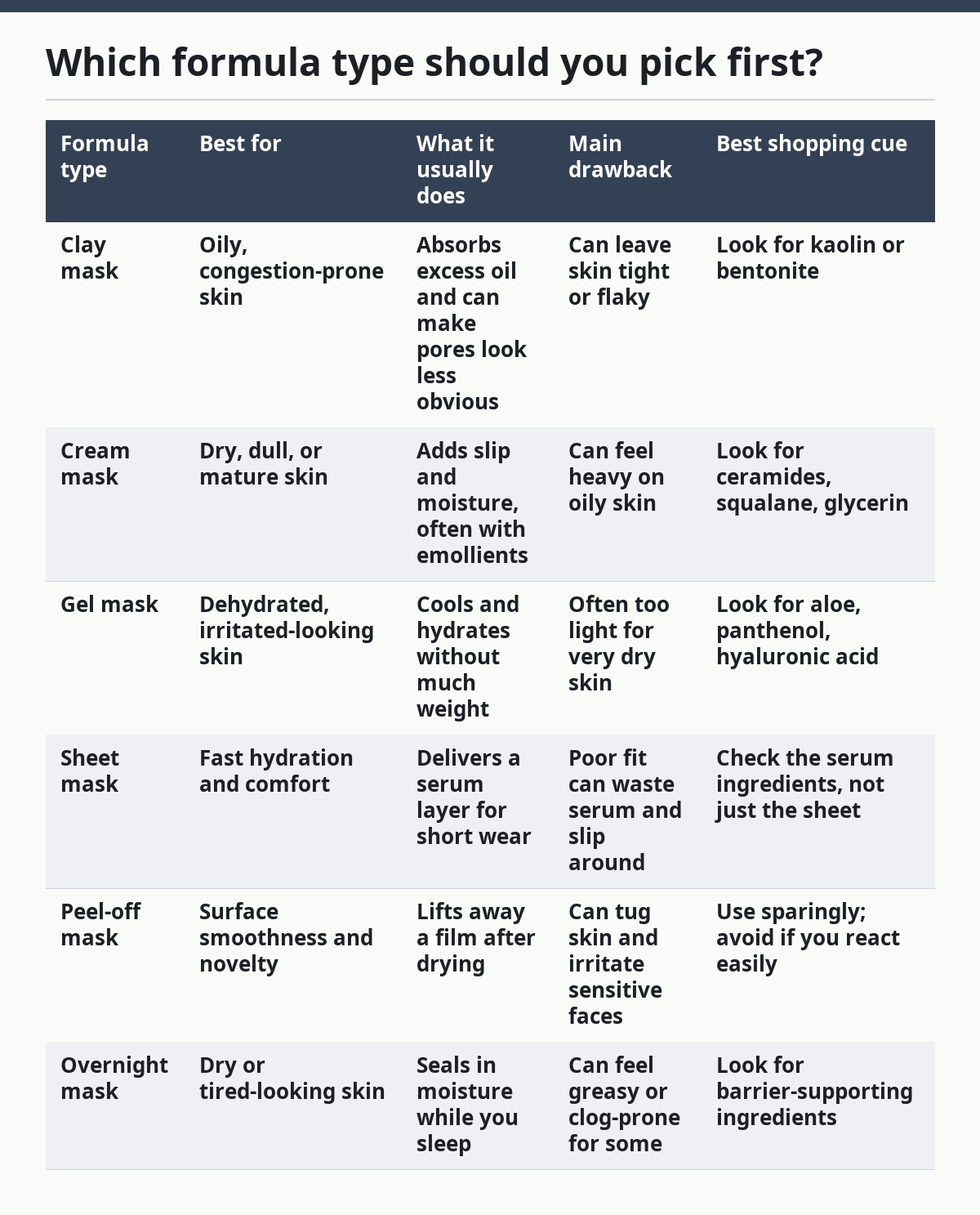
Clay wins for oil control. Cream wins for dryness. Gel wins for comfort. Sheet masks are the easiest to use, but they are not the strongest choice for fixing congestion. Peel-off masks are the riskiest choice for sensitive skin.
The ingredient list can override the formula. A clay mask with added glycerin may feel less harsh than a dry, basic clay paste. A cream mask packed with fragrance and essential oils may be a bad idea even for dry skin.
Clay masks: who should use them, and who should skip them?
Clay masks are best for oily, shiny, or congestion-prone skin because kaolin and bentonite can absorb surface oil and leave the skin looking less greasy. They are a poor choice for dry or barrier-damaged skin because they can strip too much.
Picture this: your T-zone turns shiny by noon, your nose looks clogged, and you want something that feels like a reset. Clay is the obvious first stop. The trick is choosing a clay formula that cleans without turning your face into chalk.
Kaolin is usually the gentler clay. Bentonite is often stronger and better for oilier skin. Some masks combine both, which can be useful if your face is oily in one area and normal in another. Many clay masks also include salicylic acid, zinc, or sulfur for extra pore-focused action.
The trade-off is simple. Clay masks dry down hard, and that drying step can leave skin tight, red, or flaky if you already run dry. If the mask is left on too long, the skin can feel stripped instead of refreshed. A face that tingles, burns, or stays red after rinsing is telling you the formula was too much.
Good clay mask labels often include ingredients that soften the edge: glycerin, panthenol, aloe, or niacinamide. Those do not cancel the clay, but they make the formula easier to live with. A fragrance-heavy clay mask is still a bad idea if you are reactive.
Who Should Skip This: someone with very dry, eczema-prone, or easily irritated skin should skip clay and look at a cream or gel mask instead.
Buy this if: you have oily skin, visible shine, or clogged pores and want a mask built around kaolin or bentonite.
Skip this if: you already feel tight after cleansing and want a gentler moisture-first formula.
Cream and overnight masks: when richer formulas win
Cream and overnight masks are best for dry, tight, or rough skin because they add emollients and seal in water instead of stripping it away. If your face feels parched after washing, this is usually the smarter lane.
Picture this: you wash your face, wait ten minutes, and your skin already feels stiff. A clay mask will make that worse. A cream or overnight mask can make the skin feel softer because it puts moisture back where the cleanser took it out.
The stronger cream formulas often lean on glycerin, ceramides, squalane, fatty alcohols, and sometimes cholesterol. These ingredients help support the barrier and reduce the feel of dryness. Overnight masks often use the same building blocks, just in a heavier base that stays on longer.
The weakness is obvious. Rich masks can be too much for oily or acne-prone skin, especially if the formula uses heavy oils, butters, or strong fragrance. They can also feel sticky on hot nights, which is enough to make people stop using them.
A lot of buyers make the mistake of assuming “hydrating” means “safe for everyone.” It does not. A thick cream mask can still break out some skin types if the base is too occlusive or if it contains perfume and essential oils that irritate.
Look for formulas that mention barrier support, not just “moisture.” If the label highlights ceramides, glycerin, or panthenol, that is a better sign than vague spa language. If your skin is reactive, keep the ingredient list short.
Who Should Skip This: someone with very oily skin or frequent closed comedones should look at a gel mask or a simple hydrating sheet mask instead.
Buy this if: your skin feels dry, rough, or tight and you want a richer mask with ceramides, glycerin, or squalane.
Skip this if: your skin gets greasy fast or clogs easily under thick products.
Gel and sheet masks: which hydration formula is better?
Gel and sheet masks are both hydration-first choices, but gel is better for comfort and sheet is better for convenience. If you want a fast moisture hit without heaviness, either can work — but they solve slightly different problems.
Picture this: you want something cooling after a long day, and your face is red from wind, travel, or a strong cleanser. A gel mask gives that fresh feel without much residue. A sheet mask gives a similar moisture boost, but it comes preloaded with serum.
Gel masks usually rely on aloe, hyaluronic acid, panthenol, or beta-glucan. They tend to feel light, which makes them a strong choice for combination skin and for anyone who hates heavy textures. Sheet masks often use the same ingredient families, but the serum base can vary a lot from brand to brand.
The weak point of sheet masks is fit. If the openings are poorly placed or the sheet slides, the serum may not stay evenly on the face. Some sheets also leave a tacky finish that people hate. Gel masks avoid the fabric problem, but they can be too mild for very dry skin.
Here’s the catch: a sheet mask is only as good as the serum it carries. If the serum is mostly fragrance and water, the sheet itself does very little. If the formula includes humectants and soothing agents, it can be a useful quick fix.
This is the place to read the ingredient list closely. A simple hydrating gel with glycerin and panthenol can be better than an expensive sheet full of botanical names. If you are sensitive, a fragrance-free gel is usually the safer bet.
Who Should Skip This: someone with very dry skin that needs a heavier seal should move to a cream or overnight mask instead.
Buy this if: you want a light, cooling, easy-to-wear hydration mask with aloe, panthenol, or hyaluronic acid.
Skip this if: your main issue is flaking, rough patches, or a compromised barrier that needs more occlusion.
What ingredients matter most on the label?
The most important ingredients are the ones that match the skin job you want done. That means humectants for water, clays for oil, soothing agents for irritation, and exfoliants only when your skin can tolerate them.
Picture this: you are staring at an ingredient list longer than the product description. You do not need to decode every plant extract. You only need to spot the few ingredients that control the formula’s behavior.
Start with these groups:
- Humectants: glycerin, hyaluronic acid, panthenol, beta-glucan. These draw water into the skin.
- Emollients: squalane, fatty alcohols, plant oils. These soften and smooth.
- Occlusives: petrolatum, dimethicone, heavier oils. These hold moisture in.
- Clays: kaolin, bentonite, rhassoul. These absorb oil and can dry down.
- Soothing agents: aloe, allantoin, centella asiatica, colloidal oat. These can calm the feel of skin.
- Exfoliants: salicylic acid, lactic acid, glycolic acid. These can help with texture but raise irritation risk.
The most effective masks often keep the ingredient list focused. A formula with three jobs is better than one trying to do ten. That is especially true for sensitive skin, where fragrance, essential oils, and strong acids can turn a useful mask into a problem.
Do not overrate “natural” labels. A mask can be packed with essential oils and still sting. A synthetic formula can be cleaner, simpler, and easier on the skin. The ingredient deck matters more than the marketing style.
How do you shop if your skin is sensitive?
Sensitive skin should shop by the shortest workable ingredient list, not by the prettiest front label. The safest masks are usually fragrance-free, low-irritant, and built around one main job.
Picture this: your skin turns red after new products, and a mask that feels “spa-like” can leave you burning by bedtime. That usually means the formula is too busy or too strong for your skin right now.
Look for these signs:
- Fragrance-free or at least low-fragrance
- No strong acids unless your skin already tolerates them
- No menthol, strong essential oils, or heavy peel-off action
- Soothing ingredients like panthenol, allantoin, or colloidal oat
- A simple base rather than a crowded ingredient deck
The problem with many masks for sensitive skin is that they try to feel luxurious. That often means scent, cooling agents, or a sharp tingle. None of those are required for a good result. In fact, a tingling mask is often a bad sign, not a sign it is “working.”
If your skin is reactive, patch testing is worth the time. Apply a small amount behind the ear or along the jaw before using it on the whole face. If it burns, itches, or stays red, that mask is not a fit.
Who Should Skip This: anyone who already knows they react to fragrance, essential oils, or acids should avoid “active” masks and choose a basic hydrating formula instead.
Which ingredient combinations are worth buying?
The best combinations are the ones that solve one problem without causing another. A good mask does not need ten trendy ingredients; it needs the right mix for your skin type and tolerance.
Picture this: you want clearer pores, but you also do not want to dry out your cheeks. A balanced clay formula with a little glycerin or niacinamide can be more useful than a harsh mask that strips everything.
These combinations are usually worth a closer look, but if your skin is reactive or you are unsure about a new active, consult a professional before trying a stronger formula:
- Clay + glycerin for oily skin that still gets tight
- Ceramides + squalane for dry or barrier-stressed skin
- Hyaluronic acid + panthenol for hydration without heaviness
- Salicylic acid + soothing agents for congestion-prone skin that can handle actives
- Aloe + beta-glucan for cooling comfort after dryness or mild irritation
The combinations to treat carefully are the loudest ones. A mask with clay, acid, fragrance, and menthol all at once may feel dramatic, but drama is not the same as results. Those formulas often create more sting than benefit.
On the flip side, a plain hydrating mask can still be a good buy if your skin only needs comfort. Not every mask has to exfoliate or “purify.” Sometimes the right choice is the boring one that your skin can handle twice a week without complaint.
If you are shopping by ingredient, a clean pattern beats a long promise. Pick one main function and a support cast that keeps the formula tolerable.
The honest verdict: which one should you choose?
Choose clay if your skin is oily, shiny, or congested and you want a mask built around oil absorption. Choose cream or overnight if your skin feels dry, tight, or rough and needs moisture plus a barrier-friendly base. Choose gel or sheet if you want light hydration with less weight. Neither if your skin is currently irritated, peeled, or burning.
Picture this: you are one checkout decision away from buying a mask that will either help your skin or annoy it for the next month. The right answer is not the fanciest jar. It is the formula that matches your skin’s actual problem.
For most readers, the clearest hierarchy is this:
- Clay for oil and visible congestion.
- Cream/overnight for dryness and comfort.
- Gel/sheet for simple hydration.
- Peel-off only if you have resilient skin and no better option.
The biggest mistake is buying a mask for the feeling it gives in the moment. Tingling is not proof of quality. Heavy fragrance is not proof of luxury. A cooling effect is not proof of deep hydration. Formula is what counts.
When should you rethink mask shopping entirely?
You should rethink masks if your skin is already inflamed, broken, or reacting to basic products. At that point, the right move is usually to simplify, not to add another active product.
Picture this: your face burns after cleanser, stings after moisturizer, and every new mask seems to make things worse. That is not a “find the perfect mask” problem. That is a pause-and-strip-back problem.
Three situations deserve a stop:
- Your skin is peeling from over-exfoliation.
- You are reacting to fragrance, acids, or essential oils in multiple products.
- Your main issue is not skin care at all, but a rash, eczema flare, or persistent irritation that needs a professional look.
A mask can be useful, but it should not be a rescue plan for a damaged barrier. If your face is already angry, even a gentle mask may be one product too many. Better to keep the routine short until your skin settles.
The best shopping move in that state is to step away from “treatment” language and look for the plainest hydrating option possible. If even that stings, stop and get advice from a qualified clinician.
FAQ: face mask shopping by ingredient and formula
How do I know whether a mask is hydrating or drying?
A hydrating mask usually lists glycerin, hyaluronic acid, panthenol, ceramides, or squalane near the top of the ingredient list. A drying mask usually centers on clay, sulfur, strong acids, or a formula that dries down hard. If the label promises “purifying” and your skin is already tight, be cautious.
Are clay masks bad for dry skin?
Clay masks are not automatically bad, but they are usually the wrong first choice for dry skin. Kaolin and bentonite can pull out surface oil and leave the face feeling tight. If dry skin wants a mask, a cream or overnight formula is usually a better fit.
Is a sheet mask better than a cream mask?
A sheet mask is better for quick, light hydration and convenience, while a cream mask is better for richer moisture and barrier support. Sheet masks often feel cleaner and faster, but cream masks usually last longer on very dry skin. The better choice depends on texture tolerance and skin type.
What ingredients should sensitive skin avoid?
Sensitive skin usually does better without fragrance, menthol, strong essential oils, and high-strength acids. Peel-off formulas can also be rough because they tug on the skin. A short, fragrance-free formula with soothing ingredients is the safer place to start.
Do expensive masks work better?
Not necessarily. A higher price does not guarantee a better formula, and some expensive masks are mostly scent and packaging. The ingredient list tells you more than the price tag. A simple, well-built formula can be the smarter buy.
Sources: FDA cosmetic labeling guidance; American Academy of Dermatology guidance on sensitive skin and choosing skin-care products; Cleveland Clinic guidance on facial masks and skin irritation.
Drafted with AI; not yet reviewed by a person.



Leave a Reply