


Last updated: November 20, 2026
Quick answer: emulsifiers keep cream masks from splitting and help clay masks hold a smooth, even texture. In what emulsifiers do in cream and clay face masks, they let the oil phase and water phase stay mixed long enough for the mask to spread, sit on skin, and rinse off without turning greasy, watery, or grainy.
Key takeaways
- Emulsifiers are the bridge between water and oil in a mixed-phase mask.
- In cream masks, they help the formula stay uniform from the first squeeze to the last.
- In clay masks, they are often there to keep added oils, humectants, and watery ingredients from separating.
- They are not the same thing as thickeners, stabilizers, or fillers.
- A mask can feel better or worse because of its emulsion system, not just because of the clay or oil it contains.
What do emulsifiers do in a face mask?
Because of that, emulsifiers keep a face mask from separating into a watery layer and an oily layer. In plain terms, they let ingredients that do not naturally mix stay suspended in one usable formula.
In particular, that matters in cream masks because the product often contains both an oil phase and a water phase. Without an emulsifier, the water can pool, the oils can rise, and the jar or tube can end up with a broken texture. In clay masks, emulsifiers are useful when the formula includes oils, butters, or water-based actives alongside the clay.
For example, a face mask formula is usually built as an emulsion system. That means the emulsifier sits at the boundary between droplets of oil and water and helps keep those droplets small and evenly dispersed. The result is a mask that spreads more predictably and does not change much after a week on the shelf or a month in the bathroom.
Therefore, this is not the same job as a thickener. A thickener makes a product feel heavier or less runny. An emulsifier keeps mixed phases from separating. A formula can have one without the other, but many cream masks use both. For readers comparing ingredient labels, that difference is the key one to remember.
Meanwhile, the U.S. Food and Drug Administration’s cosmetics overview is a useful starting point for how cosmetic products are defined and regulated: FDA cosmetics page. For ingredient safety discussions, the Cosmetic Ingredient Review is another useful reference point.
Why cream masks need emulsifiers
Since cream masks are usually mixed systems, not single liquids, they often need emulsifiers to stay uniform. A cream mask usually contains water, oils, and other ingredients that do not want to stay together on their own.
Because a stable cream mask should dispense the same way from top to bottom. If the formula breaks, the first use may feel rich and the next one may feel thin or greasy. That is a quality problem, not just a texture issue. It changes how much product comes out, how it spreads, and how evenly the skin gets coated.
Specifically, here is the basic way emulsifiers support a cream mask:
- The formula is heated so the oil phase and water phase can be blended into one batch.
- The emulsifier is added while the phases are combined.
- Mixing breaks one phase into tiny droplets inside the other.
- As the batch cools, the emulsifier helps those droplets stay dispersed.
- The finished cream remains smooth enough to package in a jar, tube, or sachet.
However, the exact setup depends on the formula, but the goal is usually the same: a mask that stays consistent for the user. In a cream mask, that means less chance of separation, less need to remix before use, and a more even coat on the skin.
On the other hand, the drawback is that emulsifiers can also influence feel. A strong emulsion system may keep the formula stable but make it feel heavier, more waxy, or less slip-like. That is one reason a mask can be technically sound and still not suit everyone.
How do emulsifiers work in clay masks?
Likewise, emulsifiers help clay masks hold mixed ingredients together when the mask is not just plain clay and water. A simple clay paste may not need much help, but many commercial clay masks include oils, moisturizers, botanical extracts, or other water-based ingredients that require an emulsion system.
For instance, clay itself can absorb oil and water on skin, but that does not mean it can hold a formula together in the jar. If a clay mask contains added emollients or humectants, the batch can separate without the right emulsifier system. The emulsifier keeps the watery part and the oily part distributed so the mask does not look patchy or develop a slick top layer.
As a result, that matters because clay masks already have a specific job: they dry down, cling to the skin, and lift away excess surface oil. If the formula separates, the user may get one spoonful that is mostly water and another that is mostly clay or oil. The same jar then performs differently from one use to the next.
So, a common mistake is to assume clay itself is enough to stabilize everything. It is not. Clay can thicken a mixture, but it does not reliably replace an emulsifier when the formula contains both oil and water. That is why clay masks can still need a carefully chosen emulsifier even when the ingredient list looks simple.
Which part of the formula does the emulsifier hold together?
Overall, emulsifiers hold together the oil phase and the water phase, not the clay, the scent, or the marketing story. That is the narrow job, and it is easy to miss when a label lists many ingredients.
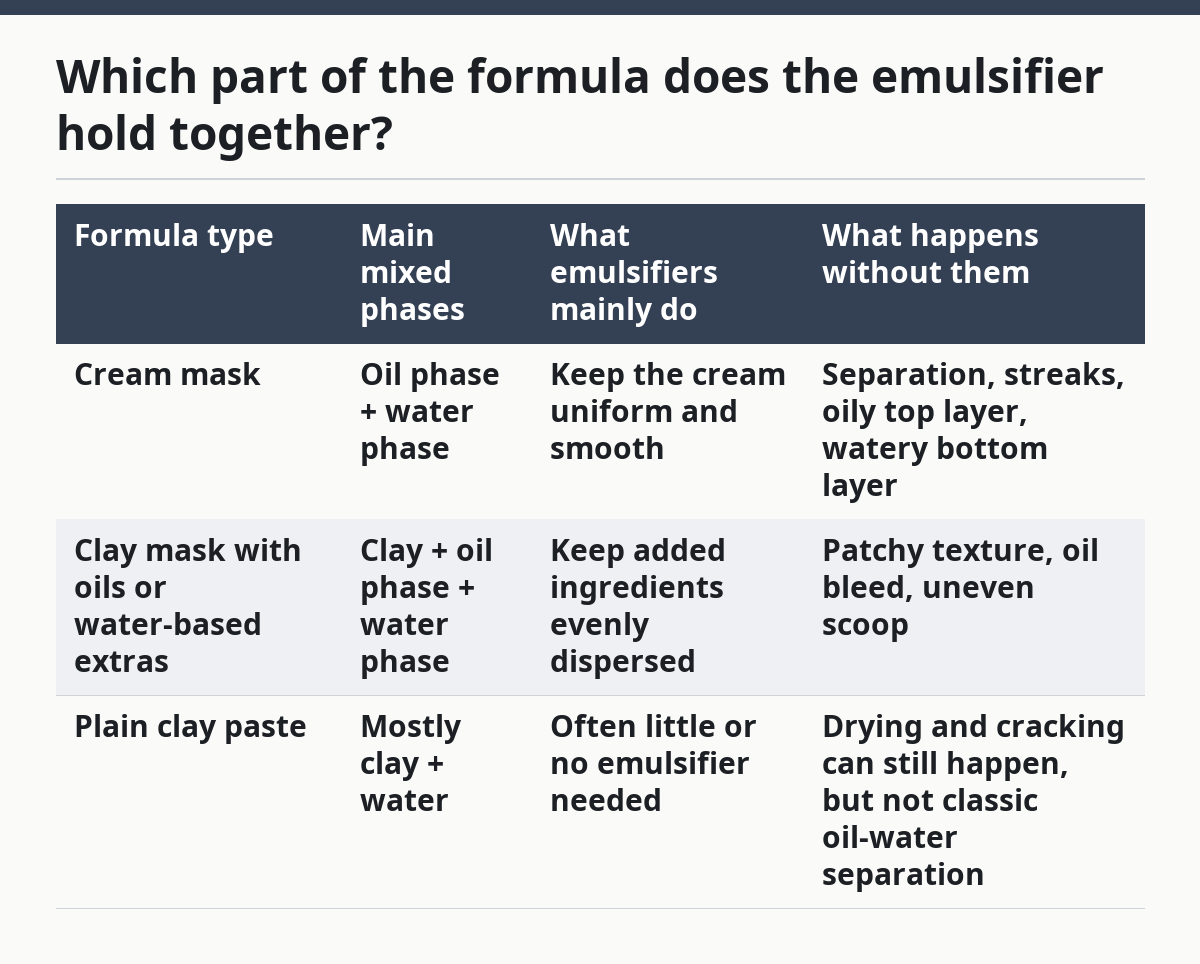
For example, a practical comparison helps:
| Formula type | Main mixed phases | What emulsifiers mainly do | What happens without them |
|---|---|---|---|
| Cream mask | Oil phase + water phase | Keep the cream uniform and smooth | Separation, streaks, oily top layer, watery bottom layer |
| Clay mask with oils or water-based extras | Clay + oil phase + water phase | Keep added ingredients evenly dispersed | Patchy texture, oil bleed, uneven scoop |
| Plain clay paste | Mostly clay + water | Often little or no emulsifier needed | Drying and cracking can still happen, but not classic oil-water separation |
In short, this is why an emulsifier is not a general fix for every texture problem. If a mask is gritty, that may come from the clay particle size or another ingredient. If it is too stiff, the problem may be the water level or the thickening system. If it separates, the emulsifier system is the first place to look.
Likewise, a reader shopping by ingredient list should also watch for overlap. Some ingredients can act as both emulsifiers and texture builders, but that does not mean they solve every problem at once. A formula may still need a stabilizer, a thickener, or a better balance between the phases. The emulsifier alone is only one part of the system.
What goes wrong when a mask has the wrong emulsifier?
However, the wrong emulsifier can make a mask unstable, greasy, hard to spread, or awkward to rinse off. That is the main trade-off, and it is why “has an emulsifier” is not enough information by itself.
For instance, a common problem is separation in storage. If the emulsifier cannot hold the oil phase and water phase together, the mask can split in the jar or tube. Another problem is poor spreadability: the formula may drag on the skin or break into beads instead of forming a smooth film. A third problem is rinse-off. A mask that holds together too strongly can leave a waxy film, while one that is too weak can rinse unevenly.
Meanwhile, the wrong choice can also clash with the rest of the formula. A clay-heavy mask may need a different balance than a rich cream mask. A formula with a lot of oil can behave differently from one that is mostly water with a small amount of emollient. That is why ingredient function matters more than ingredient name alone.
Therefore, for a reader who is trying to judge a mask from the label, the practical rule is simple: if a cream mask separates, or a clay mask looks oily on top, the emulsion system may be the issue. If the formula feels fine but dries badly, the emulsifier may not be the problem at all.
How do you read an ingredient list for emulsifiers?
Next, you read the ingredient list by looking for ingredients that are used to join oil and water, then checking whether the formula is a cream mask or a clay mask. That gives you a better guess about stability than judging by marketing words like “nourishing” or “detoxifying.”
Specifically, use this order when you scan the label:
- Find the ingredient list and look for the ingredients near the middle and lower part of the formula, where functional helpers often appear.
- Check whether the mask includes both oil-phase ingredients and water-phase ingredients. If it does, an emulsifier system is likely part of the design.
- See whether the product is a cream mask or a clay mask. Cream masks usually depend more heavily on emulsifiers for structure.
- Look for signs of a system built to stay mixed, not just to thicken. A stable emulsion usually needs more than one supporting ingredient.
- Judge the formula by its use case: a leave-on cream mask and a wash-off clay mask do not need the same balance, even if both feel smooth in the jar.
Then, the useful habit here is restraint. Do not assume every unfamiliar ingredient is an emulsifier, and do not assume every emulsifier will feel light. Some formulas are made to be rich and cushiony. Others are made to dry down fast and rinse clean. The emulsifier choice helps set that behavior.
Finally, if this article is part of a bigger ingredient walk-through, the hub on face mask ingredients and cosmetic formulation basics can fill in the surrounding categories. This page stays focused on the role of emulsifiers inside mixed-phase masks.
What emulsifiers are not
In contrast, emulsifiers are not thickeners, fillers, or active treatment ingredients. That distinction matters because labels and product pages often blur them together.
Because a thickener changes body. A filler adds bulk or supports texture. An active ingredient is added for a skin-facing goal such as soothing or oil control. An emulsifier has a structural job: it helps the oil phase and water phase stay together in one stable product.
Accordingly, that means a mask can contain an emulsifier and still be poor for a given skin type. A heavy emulsion system may feel too rich for someone who wants a lighter rinse-off mask. A weak one may separate before the jar is half used. Neither result tells you much about the skin benefit on its own.
Nevertheless, it also means that not every clay mask needs a dense emulsion system. A simple clay paste may work well with a minimal formula. A cream mask with oils and water almost certainly needs more help keeping its ingredients together. That is the cleanest dividing line a reader can use.
If skin is reactive, patch testing and a dermatologist’s advice are reasonable. For a broader safety overview of cosmetic ingredients, consult the FDA cosmetics page and Cosmetic Ingredient Review.
FAQ
Are emulsifiers safe in face masks?
Generally, emulsifiers used in face masks are common cosmetic ingredients, and their safety depends on the specific ingredient and the full formula. The same ingredient can behave differently in a rinse-off clay mask than in a rich cream mask, so a full ingredient list matters more than one name by itself. If skin is reactive, patch testing and a dermatologist’s advice are reasonable.
Why do some masks separate?
Because some masks separate when the oil phase and water phase are not held together well enough over time. Heat, storage, and an unbalanced formula can make the separation more obvious, especially in jars that sit for weeks. Separation is often a sign that the emulsion system is too weak for the formula, not that the mask has no useful ingredients.
Do emulsifiers affect how a mask feels?
Yes, emulsifiers do affect how a mask feels because they shape the texture of the whole emulsion system. A mask can feel creamier, heavier, waxier, or lighter depending on the emulsifier choice and the rest of the formula. The feel is part of the system, not an extra detail added at the end.
Drafted with AI; not yet reviewed by a person.

Leave a Reply