



Last updated: November 20, 2026
Quick answer: Surfactants in rinse-off face masks do 3 core jobs—help the mask spread, lift oil and residue, and rinse away cleanly. In the topic of what surfactants do in rinse-off face masks, they are the cleansing agents that make the formula feel slick at first and then wash away with water, rather than clinging to skin like an oil-heavy cream.
Key takeaways
- Surfactants in rinse-off masks do three main jobs: they help the mask spread, they help bind oil and dirt so water can carry them away, and they help the formula rinse clean.
- A foaming mask is not automatically stronger than a non-foaming one. Foam can come from the surfactant system, while slip and residue control come from the full formula.
- Solubilizers and emulsions matter because many masks mix water, oils, and other ingredients that do not naturally stay together.
- The right surfactant choice is about feel and rinse, not just “cleaner is better.”
- Surfactants can be a poor fit for very dry or easily irritated skin if the formula is too stripping or if the mask is left on too long.
What does a surfactant do in a rinse-off face mask?
A surfactant makes a rinse-off face mask easier to spread and easier to remove. It sits at the border between water and oil, so the formula can coat the skin evenly, pick up oily residue, and rinse away without leaving a thick film behind.
That matters in a mask because the product has a short job window. Unlike a leave-on cream, a rinse-off mask only needs to stay on the skin long enough to work, then disappear with water. Surfactants are what let that happen in a controlled way.
In plain terms, surfactants act like the cleanup crew for the mask itself. They help the product break up leftover sebum, sunscreen, makeup, and the oily feel of the formula, then carry that mix off the skin when you rinse.
This is why the same mask can feel silky during application and cleaner after rinsing. The surfactant does not just clean; it changes texture, spread, and how much residue stays on the face after the water goes down the drain.
For the bigger ingredient picture, the face mask ingredients and formulation science guide sits above this topic and shows how surfactants fit beside humectants, thickeners, and emollients.
Why do mask formulas need cleansing agents at all?
Rinse-off mask formulas need cleansing agents because water alone does not remove oil-based residue well. Skin carries sebum, many mask formulas contain oils or waxes, and some active ingredients are easier to disperse when a cleansing agent is present.
Without a surfactant system, a mask can leave behind a waxy or greasy layer. That may feel rich at first, but it can also make the product hard to rinse and can leave skin looking shiny after washing.
This is where emulsions matter. Many rinse-off masks are emulsions, meaning they combine water and oil phases in one product. Surfactants help hold those phases together long enough for the product to perform, then help the whole mix break apart under running water.
Solubilizers play a related role. They help small amounts of oil-soluble ingredients stay evenly distributed in a water-based formula, which can improve clarity, scent delivery, and rinse behavior. They are not the same as a full cleansing surfactant system, but they often work beside one.
A generic article often skips this part and makes surfactants sound like a single ingredient. In practice, the mask usually uses a system: one part helps mix ingredients, another helps with cleansing, and another controls feel. That is why two masks can rinse very differently even if both contain a surfactant.
Two broad sources explain this kind of formulation logic well: the Cosmetic Ingredient Review and the Personal Care Products Council. Their material is useful for ingredient function, even when the exact mask formula changes from product to product.
How do surfactants change the feel on skin?
Surfactants change the feel by adding slip, shaping foam, and controlling how the mask breaks under water. The same ingredient family can make a formula feel creamy, slippery, lightly foamy, or almost lotion-like depending on the rest of the base.
Slip matters because a mask has to spread in a thin, even layer. If it grabs too fast, it can drag on skin. If it has enough slip, it glides across the face and covers dry patches, oily zones, and hairline edges with less tugging.
Foam is a side effect, not the whole story. Some surfactants create visible bubbles, while others clean with very little foam. A low-foam mask can still rinse clean, and a foamy one can still leave residue if the formula has too much oil or wax. If you are unsure which surfactant level suits your skin, consult a dermatologist or cosmetic professional.
The trade-off is obvious: more cleansing action can mean less residue, but it can also mean a more stripped feel. That is why surfactant choice in a face mask is not the same as in a shampoo or body wash. Facial skin usually needs a gentler balance, especially around the cheeks and jawline.
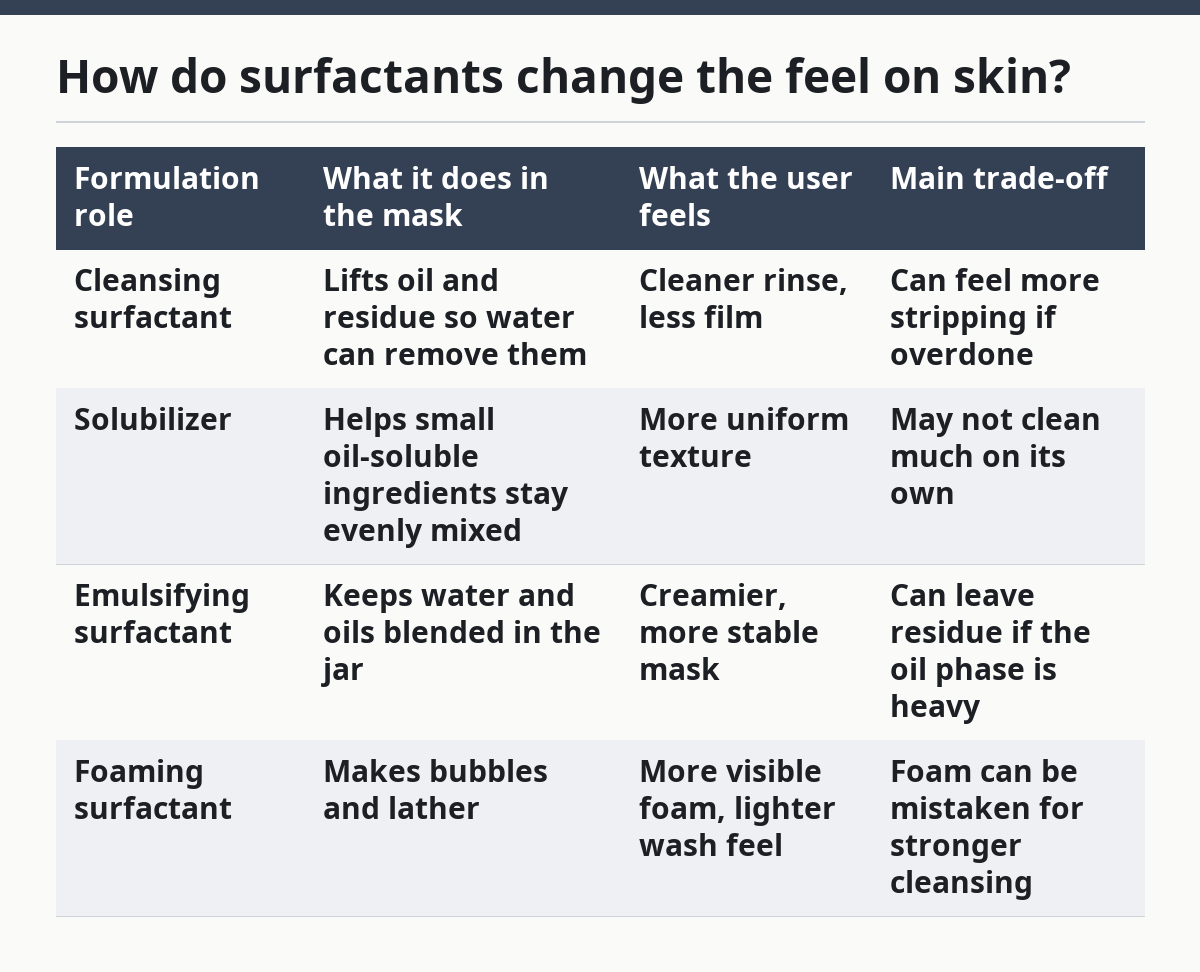
Here is a simple comparison of how common surfactant roles affect the finished mask:
| Formulation role | What it does in the mask | What the user feels | Main trade-off |
|---|---|---|---|
| Cleansing surfactant | Lifts oil and residue so water can remove them | Cleaner rinse, less film | Can feel more stripping if overdone |
| Solubilizer | Helps small oil-soluble ingredients stay evenly mixed | More uniform texture | May not clean much on its own |
| Emulsifying surfactant | Keeps water and oils blended in the jar | Creamier, more stable mask | Can leave residue if the oil phase is heavy |
| Foaming surfactant | Makes bubbles and lather | More visible foam, lighter wash feel | Foam can be mistaken for stronger cleansing |
A mask that feels luxurious at application can still rinse badly if the surfactant system is weak. The opposite is true too: a formula can foam a lot and still leave the skin feeling tacky if the emulsion is not balanced.
What happens during rinse-off?
A rinse-off mask cleans in stages: it loosens soil, emulsifies oil, and then lets water carry the mix away. That sequence is why the rinse step matters as much as the application step.
- Apply a thin, even layer to clean skin, usually enough to cover the face without a heavy ridge at the edges. A thinner layer gives the surfactants a better chance to contact the residue you want removed.
- Leave it on for the formula’s intended window, often about 5 to 15 minutes if the label says so. The mask has time to soften oil and spread ingredients across the skin.
- Add water before wiping or rinsing. Water activates the surfactant system and starts breaking the mask into a washable film instead of a sticky layer.
- Massage lightly for a few seconds. That extra motion helps loosen remaining residue, especially around the nose, chin, and hairline.
- Rinse until the skin feels free of slip, not squeaky. The goal is clean skin with no obvious coating, not a tight, dragged feeling.
- Pat dry with a towel. Rubbing can leave the skin red, especially if the mask had a stronger cleansing system.
This process is why surfactants are so useful in rinse-off masks for people who want a cleaner finish after a short treatment, but if a skin concern is present, consult a professional before choosing a stronger formula. They do not need a long soak or a hard scrub to work. They just need enough water and motion to help the formula let go.
A common mistake is treating rinse-off masks like they should strip every trace of oil from the skin. That can backfire. If the rinse leaves the skin tight or hot, the formula may be too strong for that face, that day, or that area, so consider professional guidance if the skin is reactive.
Which surfactant setups fit different mask textures?
Different surfactant setups fit different textures because the formula has to match the mask’s job. A clay mask, a cream mask, and a gel mask can all be rinse-off products, but they do not need the same surfactant balance.
| Mask texture | Typical surfactant need | What it helps with | Best fit |
|---|---|---|---|
| Cream mask | Mild emulsifying and cleansing support | Smooth spread, easy rinse, less residue | Skin that wants a softer finish |
| Clay mask | Low to moderate cleansing support | Helps rinse clay particles and oil | Oilier skin or a fresher feel |
| Gel mask | Solubilizers and light surfactants | Keeps the formula clear or evenly mixed | Light textures and fast rinse |
| Foaming mask | Stronger surfactant action | Bubble formation and lift | Users who want a very clean wash-off feel |
The main point is that the surfactant system should match the texture, not fight it. A cream mask that foams too much can feel off. A clay mask without enough rinse support can cling to fine facial hair and dry into stubborn patches.
This is also where residue removal becomes obvious. If a formula has clay or other solid particles, the surfactant system must help lift both the solids and the oil they sit in. If it does not, the mask can leave a gritty trace on the skin, especially at the jaw and nose.
The wrong choice for this topic is the idea that all surfactants are there to create bubbles. Some are there to keep the formula uniform. Some are there to help oils mix with water. Some are there to make the rinse feel less sticky. The smallest amount that still does the job is often the most practical starting point, but the right level depends on the formula and the skin.
When do surfactants cause problems?
Surfactants cause problems when the cleansing effect is stronger than the skin can comfortably handle. That risk is higher if the formula foams heavily, has a strong rinse, or is left on longer than the label suggests.
The most common downside is a tight, dry, or squeaky feeling after rinsing. That usually means the surfactant system removed too much of the skin’s surface lipids or the mask simply does not suit the person using it. A formula that rinses very clean may not be the best choice for skin that already feels dry after shaving or cleansing.
Another downside is irritation around the edges of the face. The nose, chin, and areas with fine hair often show residue or sting first if the formula is too aggressive. Even a good surfactant can be a poor match if the rest of the mask is built for a more resilient skin type.
This is where an honest trade-off matters. Surfactants help a mask rinse clean, but a cleaner rinse can come with more bite. A user who wants a soft, cushioned finish may prefer a milder emulsifying system and less foam. A user who hates residue may prefer a stronger rinse and accept a less plush feel.
How do I read a rinse-off mask label?
A rinse-off mask label tells you whether the surfactants are there mainly for cleaning, mixing, or texture. The ingredient list will not spell out “this is the cleanser,” so the job has to be inferred from the whole formula.
Look first for words that suggest cleansing or emulsifying roles, then compare them with the texture claim on the front of the package. A mask marketed as foaming usually has a different surfactant balance than a mask marketed as cream, gel, or clay.
Three label clues matter most:
- Foam clue: If the formula is described as foaming or lathering, the surfactant system is likely doing more visible cleaning work.
- Texture clue: If the mask is rich, creamy, or balm-like, the surfactants may be there to stabilize an emulsion as much as to cleanse.
- Rinse clue: If the product promises a clean rinse or no residue, the surfactant system is part of that claim.
This is not a shopping trick; it is formulation reading. A person trying to avoid a tight finish can look for a gentler rinse-off texture, while a person who hates leftover film can choose a formula built to rinse more completely.
The thing surfactants do best in rinse-off face masks is also the thing that can make them wrong for someone else. If a mask is meant to feel very clean after rinsing, it may be a bad match for very dry or easily irritated skin. If it is meant to feel cushioned and rich, it may leave more residue than some users want.
Are surfactants harsh in face masks?
Surfactants are not automatically harsh in face masks. Their effect depends on the type of surfactant, the amount used, and the rest of the formula around it. A mild emulsifying system can feel very different from a stronger foaming system, even though both are surfactants.
Why do some wash-off masks foam?
Some wash-off masks foam because the surfactant system is built to create bubbles when mixed with water. Foam can make the product feel lighter and help spread it during the rinse, but foam does not guarantee better cleansing. A non-foaming mask can still rinse clean if its surfactants are balanced well.
Do surfactants help a mask rinse clean?
Yes, surfactants help a mask rinse clean by loosening oil, helping water mix with the formula, and reducing leftover film on the skin. They are the main reason a rinse-off mask can feel rich in the jar and still wash away without a greasy layer.
Drafted with AI; not yet reviewed by a person.



Leave a Reply