




Last updated: November 19, 2026
Quick Answer: In most settings, the right choice comes down to one of 3 main formats: cloth masks for low-risk source control, surgical masks for routine barrier use, and respirators for higher-filtration needs. This guide to face mask formats and use-cases — The Complete Guide shows which mask type belongs in which setting, what each format does well, and where people get it wrong.
I write about respiratory protection and PPE fit often enough to know the mistake: people buy a mask by name, then wear the wrong format for the task. This page sorts that out.
Key takeaways
- Cloth masks are for low-risk source control, not for dusty jobs or close contact with sick people.
- Surgical masks are disposable barriers for splashes and droplet control; fit is better than cloth, but the seal is still loose.
- Respirators like N95, KN95, and FFP2 are the right pick when you need tight fit and higher filtration.
- Medical masks with ear loops are easier to wear, but a bad seal can waste the filter material.
- Valve masks can feel easier to exhale through, but they can be the wrong choice in shared indoor spaces because they release unfiltered breath.
- Reusable and disposable formats trade convenience against consistency, storage, and cost per use.
- Use-case matters more than branding. A “better” mask in one setting can be the wrong mask in another.
What mask format should you choose for your situation?

The best format depends on exposure level, fit, and whether you need source control or personal protection. If you are protecting others from your own breath, one answer fits. If you are filtering the air you breathe, another does.
Specifically, face mask formats and use-cases — The Complete Guide works best when you match the format to the exposure, not the label. If you are unsure which setting you are in, consult a professional or site policy before relying on a mask alone. For plain-English references, the U.S. CDC and NIOSH guidance on respirators are useful starting points, and the European Standard EN 149 is the common reference for filtering facepiece respirators in Europe.
Picture this: you’re about to enter a crowded clinic, a dusty workshop, or a packed train, and you need the right mask before you walk in. The choice is not about style. It’s about fit, filtration class, and duration. If you need a quick decision, one setting can change the answer in 1 step: low-risk, public indoor, or hazardous particulate exposure.
- Low-risk social settings: cloth or surgical masks can be enough for courtesy and basic source control.
- Crowded indoor settings: a respirator format such as N95, KN95, or FFP2 is the stronger choice.
- Dust, smoke, or job-site particles: use a particulate respirator rated for the hazard, not a loose face covering.
- Splash risk: a fluid-resistant surgical mask or face shield combo may be the better barrier.
The U.S. CDC’s respirator guidance and the NIOSH respirator pages are useful starting points, and the European Standard EN 149 is the common reference for filtering facepiece respirators in Europe. The specific standard matters because the words on the package do not all mean the same thing. In the U.S., N95 is a NIOSH class, while FFP2 is the European class under EN 149.
Cloth face masks: where they still make sense
Cloth masks win for light source control, comfort, and reuse, but they are the weakest option for filtration. That trade-off is the whole story.
For a low-risk errand, a cloth mask can still be the practical answer if the fabric is dense, the fit is decent, and you’re not pretending it performs like a respirator. If you are not sure whether the situation is low risk, consult a professional or follow local guidance before choosing cloth alone.
The catch is simple. A loose cloth mask with gaps at the cheeks or nose does a poor job against fine aerosols. Even a well-made cloth mask rarely behaves like a certified respirator, and the performance drops fast when the fabric gets wet, stretched, or washed badly. One bad wash can undo the fit.
Use cloth masks when:
- the setting is low risk
- you need reusability
- comfort matters more than high filtration
- you want basic source control in a short exposure window
Avoid cloth masks when:
- you need protection from fine airborne particles
- you are in a clinic, packed transit car, or other dense indoor space
- the work involves dust, smoke, or aerosolized material
- you need a documented standard such as N95, FFP2, or ASTM-rated medical mask performance
A common mistake is treating any multi-layer cloth mask as “good enough” for everything. Not even close. The right cloth mask can be useful, but it is still the wrong tool for high-exposure settings.
What is a surgical mask best for?

A surgical mask is best for droplet barrier use, splash reduction, and general source control in medical and public settings. It is not built to seal to the face like a respirator, and that matters.
For a waiting room or treatment room, a surgical mask can be the middle-ground option if the goal is to reduce what leaves your mouth and nose without wearing a tight-fitting respirator. If you need a quick decision and are uncertain, consult a professional or local infection-control guidance first. They are disposable, familiar, and easy to put on quickly.
The strength of a surgical mask is also its weakness. It covers nose and mouth fast, and it can block larger droplets well enough for many routine settings. But the sides are open, and that means air can leak around the edges during inhalation. A loose seal can matter as much as the material.
What surgical masks do well:
- offer a quick barrier for droplets and splashes
- stay cooler and easier to wear than tight respirators
- work well in settings where source control is the main goal
- come in standardized grades in some markets, such as ASTM Level 1, 2, or 3
Where they fall short:
- they do not seal tightly
- they are weaker against airborne particles than respirators
- ear loops and thin nose wires can leave gaps
- the protection level changes a lot with fit and movement
If the setting is a hospital corridor or a public space with low aerosol risk, a surgical mask is often the sensible disposable choice. If the setting is a crowded indoor room with poor ventilation, a respirator format moves ahead.
For standard references, the U.S. FDA’s medical face mask guidance and ASTM’s face mask standards are useful names to know. Standards don’t make a mask perfect, but they do tell you what kind of barrier it was built to be. The FDA and ASTM labels are not just marketing language.
Why respirators beat loose masks in high-risk settings
Respirators win in high-exposure, high-density, or high-particulate settings because they seal better and filter more of the air you breathe. That is the main reason they exist.
If particles are airborne, a respirator is the format made for that job. The seal around the face is the difference between “some filtration” and “real respiratory protection.” In one report, N95-class respirators were associated with 95% filtration efficiency by design, which is why the number appears in the name.
The common names are easy to mix up:
- N95 is a U.S. NIOSH-approved filtering facepiece respirator
- KN95 is a Chinese standard label
- FFP2 is a European respirator class under EN 149
- FFP3 is a higher European class than FFP2
That naming matters because the numbers are not cosmetic. They point to testing systems, not just marketing language.
Respirators are the better pick when:
- you need personal protection, not just source control
- the space is crowded or poorly ventilated
- particles, smoke, dust, or aerosols are part of the risk
- you want a tighter face seal than a surgical or cloth mask can provide
The trade-offs are real:
- they can feel hotter and harder to wear for long periods
- they need a better fit to work as intended
- some people find them harder to speak through
- poor sizing defeats the point
A respirator that leaks is a fancy cloth mask. That sounds harsh because it is true.
The honest side-by-side
| Criteria | Cloth mask | Surgical mask | Winner for [condition] |
|---|---|---|---|
| Fit to face | Often loose | Moderate but not sealed | Surgical mask for quick wear |
| Filtration | Variable, usually lowest | Better than cloth, not sealed | Surgical mask for droplet control |
| Seal against edges | Weak | Weak to moderate | Neither for high aerosol risk |
| Comfort for long wear | Often high | High | Cloth mask for short low-risk use |
| Source control | Good if well made | Better and more standardized | Surgical mask for public indoor use |
| Personal protection | Limited | Limited | Neither; use a respirator |
| Reuse | Usually yes | Usually no | Cloth mask for low-risk reuse |
| Standardized rating | Usually no | Often yes, such as ASTM | Surgical mask for documented barrier use |
| Best setting | Low-risk errands | Clinics, public spaces, splash risk | Depends on exposure |
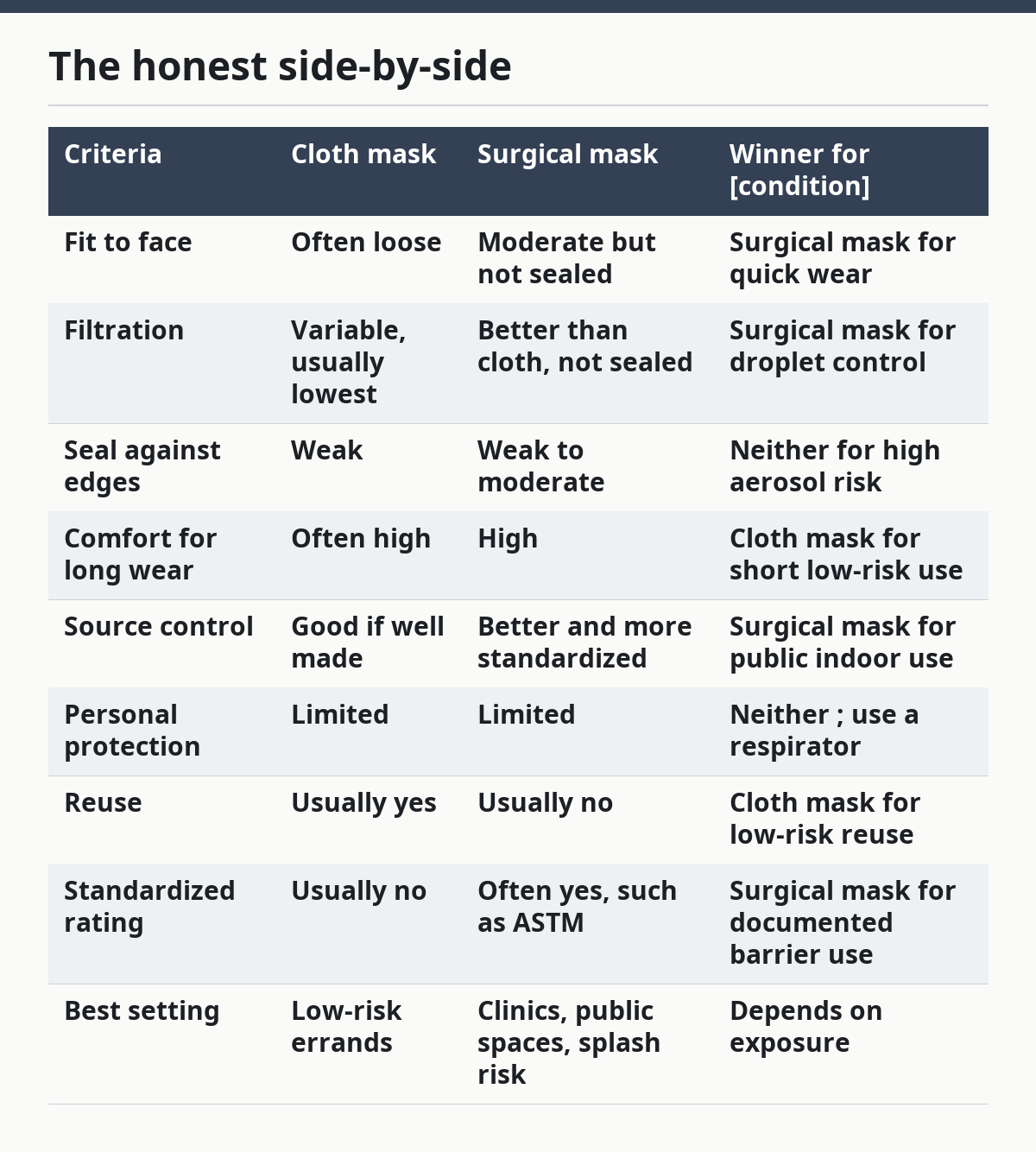
The table sounds simple because the decision really is simple once you stop asking every mask to do the same job. A surgical mask is not a respirator. A cloth mask is not a surgical mask. A respirator is not a comfort accessory.
N95, KN95, and FFP2: who should actually use them?
N95, KN95, and FFP2 are the right formats for people who need higher filtration and a tighter seal. If you care about what you inhale, these are the masks that should be on the short list.
For crowded indoor settings, this respirator family is usually the better choice when the goal is to reduce inhalation risk. A good fit matters as much as the label, because the same mask can perform very differently on different faces. One poor seal can undercut the whole rating.
The strongest reason to pick this category is not brand loyalty. It is the combination of face seal plus filter rating. A well-fitting N95 or FFP2 can outperform a loose mask by a wide margin because it controls the path the air takes.
Who should use them:
- people in crowded indoor settings
- workers around dust, smoke, or fine particles
- anyone with a reason to want higher filtration
- people who can tolerate a tighter fit and longer wear
Who should skip them:
- anyone who cannot get a tolerable seal
- people who need a quick, easy-on mask for short low-risk tasks
- users who need repeated removal and re-donning with minimal fuss
- children or others for whom the fit is not appropriate
The drawbacks are practical:
- fit testing or fit checking may be needed for the best result
- breathing resistance can feel higher than with a surgical mask
- glasses can fog if the nose bridge is not seated well
- beard growth can weaken the seal
If you want one sentence that settles it: choose a respirator when the air itself is the problem. That is the moment when ear loops and loose edges stop being acceptable.
Which mask format is best for work, travel, and daily errands?
The best daily format changes with the setting: respirators for dense indoor exposure, surgical masks for routine barrier use, and cloth masks only for low-risk convenience. That is the practical rule.
When you are packing for a commute, a flight, a grocery run, and a workday all in the same week, you do not need one universal mask. You need the right format for the specific room you are entering.
A simple way to think about it:
- Travel in crowded indoor spaces: respirator
- Quick clinic visit or low-risk public indoor use: surgical mask
- Short, low-risk community settings: cloth mask
- Dusty work or aerosol risk: respirator, and sometimes a specialized industrial model
For errands, comfort matters because you wear the mask longer than you planned. For work, consistency matters because a mask that slips down becomes useless. For travel, fit and ease of replacement matter because you may need a spare. A spare matters more than style.
You also need to think about humidity, heat, and talking. A mask that feels fine for ten minutes may become a nuisance after an hour. That is why the “best” format is often the one you can keep on correctly.
Practical choices by setting:
- Office hallway, low risk: surgical or cloth if policy allows.
- Busy subway car or airport line: respirator.
- Outdoor walk with no crowd: usually no mask unless there is a specific reason.
- Warehouse, workshop, or sanding task: respirator with the right particle rating.
The mistake to avoid is overbuying the highest-grade mask for every task. The best fit for a short low-risk errand may be the one you forget is there. The best fit for a crowded train is the one with the tighter seal, even if it feels less pleasant.
What about valved masks, reusable masks, and face shields?
Valved masks, reusable masks, and face shields each solve a narrow problem, and none replaces the others. That is the part people miss.
If the question is comfort versus protection, the answer depends on what the room demands. A valved respirator may feel easier to breathe through, but the valve can matter in shared spaces because it changes what leaves the mask.
Valved masks
A valved respirator can reduce heat and exhalation resistance for the wearer, but it may release unfiltered exhaled air. That makes it a poor choice where source control matters.
Use it only when:
- the rule set allows it
- the environment is not about protecting other people from your breath
- wearer comfort is a real issue in a hazardous particulate setting
Skip it if:
- you are in a shared indoor space where your breath matters to others
- source control is the main reason for wearing a mask
Reusable masks
Reusable masks make sense when you can wash them correctly and keep a spare in rotation. Their main risk is degradation: a stretched nose wire, worn fabric, or bad cleaning can quietly reduce performance.
Use them when:
- you need repeat use
- you can clean and dry them properly
- the setting does not require a certified disposable format
Skip them if:
- you need predictable, standardized filtration every time
- the mask gets contaminated with heavy dust, oils, or body fluids
Face shields
A face shield is not a mask replacement. It can help with splash protection and can work as a companion piece, but it leaves gaps around the sides and bottom.
Use them when:
- splash protection is part of the job
- eye protection matters
- you are adding a barrier over another approved respirator or mask
Skip them if:
- you want a stand-alone barrier against airborne particles
The truth is, these formats solve different problems. Mixing them up leads to false confidence, which is worse than wearing nothing because it feels safe.
When to reconsider your choice entirely
You should reconsider the whole mask decision if the setting changes from source control to true exposure control. That shift changes the answer fast.
If the room changes, the mask choice should change with it. Yesterday you may have needed a simple face covering for a shop visit; today you may be in a room with sustained exposure, dust, smoke, or people who are sick. The old answer may no longer fit the new room.
Three situations flip the verdict:
- You move indoors with poor ventilation. A loose mask stops being the right tool, and a respirator moves to the top.
- You need long wear with repeated talking. Comfort and seal pull in opposite directions, so fit and tolerability matter more than style.
- You are protecting both yourself and others. Source control and personal protection are not the same thing, and the format has to match the harder job.
Another reason to stop and rethink: if the mask leaks at the nose, rides up your cheeks, or gets removed often, the rating on the package means very little. A good standard on a bad fit is still a bad mask in practice.
For professional environments, follow the site policy or the hazard assessment first. In healthcare, labs, construction, and cleanroom-adjacent work, the right format is the one tied to the task, not the one that feels easiest.
The verdict: which one to choose and why
Choose a respirator format such as N95, KN95, or FFP2 if you need real filtration in a crowded indoor space, around dust or smoke, or for any setting where air exposure is the main concern. Choose a surgical mask if you need a disposable barrier for routine public or clinical use and fit is decent but not perfect. Neither if you are trying to use cloth as a stand-in for a certified respirator in a high-risk room.
That call is blunt on purpose. The wrong mask format is not a minor downgrade; it is a different tool.
FAQ
Are cloth face masks still useful?
Yes, but mainly for low-risk source control and short, routine use. A dense cloth mask can reduce the spread of larger droplets, but it does not match a certified respirator for filtration or seal. If the room is crowded, poorly ventilated, or dusty, cloth is the weaker choice.
Is a surgical mask better than a cloth mask?
Yes, for most barrier uses and public settings, a surgical mask is usually the better disposable option. It is more standardized and easier to use as a quick barrier, though it still does not seal like a respirator. If you need higher personal protection, move up to a respirator.
What is the difference between N95 and KN95?
Both are respirator categories, but they come from different standards systems. N95 is tied to U.S. NIOSH approval, while KN95 is a Chinese standard designation. The name alone does not guarantee fit, so the face seal still matters more than the label.
Can I reuse a disposable mask?
Sometimes, but reuse depends on condition, contamination, and the maker’s guidance. If the mask is damaged, wet, dirty, or hard to breathe through, replace it. A disposable mask that no longer seals well is no longer doing its job.
Do face shields replace masks?
No. A face shield can help with splash protection and can pair with another mask, but it is not a stand-alone substitute for filtration or source control. If the goal is to block airborne particles, a shield is the wrong format on its own.
Which mask format is best for travel?
A respirator is usually the strongest choice for crowded indoor travel because it gives better filtration and a tighter seal. For short, low-risk travel where policy allows, a surgical mask can be acceptable. Cloth is the weakest option once the cabin or station gets crowded.
Drafted with AI; not yet reviewed by a person.

Leave a Reply