



Last updated: November 19, 2026
Quick answer: face mask pH is a formula’s acid-or-alkaline level, and in many masks it matters most when the product uses acids.
This page breaks down what the pH scale means in what pH means in a face mask, why acidic and alkaline formulas behave differently, and where ingredients like lactic acid and glycolic acid fit. For a basic definition, see the NIH overview of the pH scale: https://www.ncbi.nlm.nih.gov/books/NBK470389/.
Key Takeaways
- pH shows how acidic or alkaline a mask formula is.
- A face mask combines acids, water, thickeners, and actives that have to work together.
- Acidic formulas often suit exfoliating actives better.
- The barrier usually does best when the product matches skin surface chemistry.
What pH means in a face mask
Face mask pH tells you how acidic or alkaline the formula is. A mask can sit anywhere on the pH scale, and that number changes how the formula behaves on skin, especially when it contains alpha hydroxy acids or enzyme-style ingredients. According to the American Academy of Dermatology, acidic products can help some exfoliating routines, but product choice should be guided by skin sensitivity and, if needed, a dermatologist’s advice: https://www.aad.org/public/everyday-care/skin-care-basics/dry/exfoliation.
Picture this: you’re reading an ingredient list and see lactic acid near the top, then a clay or enzyme claim lower down. The pH helps explain why that same mask may feel active, gentle, or irritating. It’s a formulation number, not a promise of performance.
A lower pH means the formula is more acidic. A higher pH means it is more alkaline, though most modern skin products stay closer to mildly acidic ranges than to strong alkaline ones.
- Acidic formulas are often used for chemical exfoliation.
- More alkaline formulas can shift how certain ingredients behave.
- The skin’s outer surface, the skin barrier, usually does better with products that stay near the skin’s natural acid range.
Here’s the catch: pH is not the whole formula. A mask with the same pH can still feel very different if one uses kaolin, another uses enzymes, and a third uses glycolic acid. The number matters, but so do the ingredients around it.
Why does pH matter in a face mask?
pH matters because it changes ingredient activity, skin feel, and formula compatibility. A face mask is not just a mix of powders and water; it is a system where acids, water, thickeners, and active ingredients have to work at the same time.
Picture this: you’re using a mask with an exfoliating acid and expecting it to act the same way no matter the formula. It won’t. Lactic acid and glycolic acid work differently depending on the pH, and enzymes can lose activity if the formula drifts too far from the range they need. If you have sensitive skin or a skin condition, check with a dermatologist before choosing an acid mask. The FDA also notes that overuse or misuse of exfoliating acids can increase irritation: https://www.fda.gov/cosmetics/cosmetic-products/alpha-hydroxy-acids.
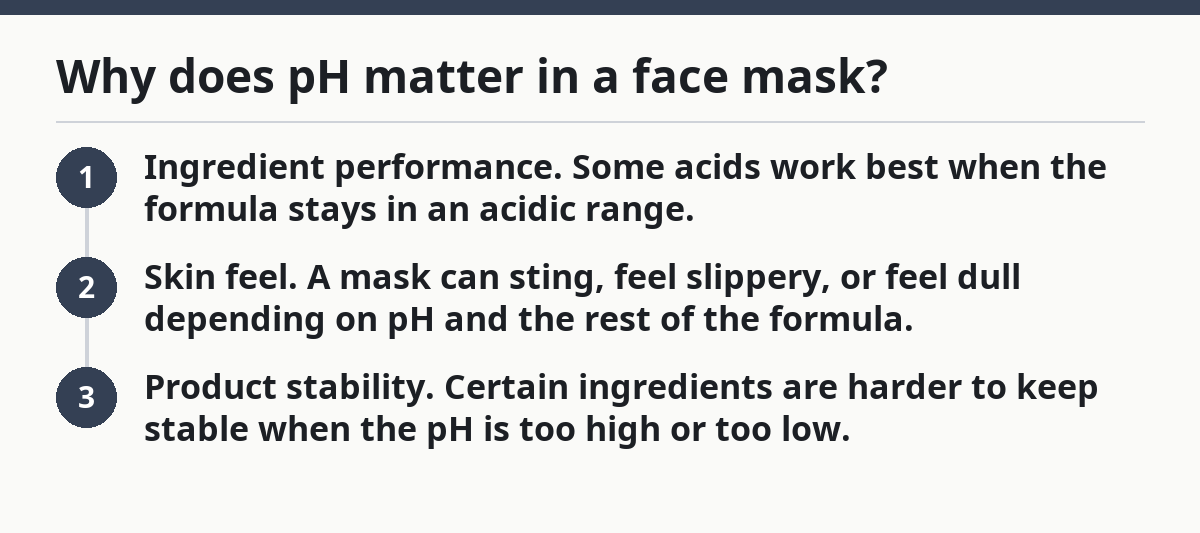
That matters in three common ways:
- Ingredient performance. Some acids work best when the formula stays in an acidic range.
- Skin feel. A mask can sting, feel slippery, or feel dull depending on pH and the rest of the formula.
- Product stability. Certain ingredients are harder to keep stable when the pH is too high or too low.
A good example is an acid mask built around alpha hydroxy acids. If the formula is too alkaline, the acid may be less effective. If it is too acidic, the mask may feel harsher than the rest of the recipe intends. That balance is part science, part formulation judgment.
- Too high can dull some acid activity.
- Too low can raise the sting factor.
- The right range depends on the mask’s job, not on a single universal number.
Acidic vs alkaline formulas: what changes?

Acidic formulas usually support exfoliating actives better, while alkaline formulas can work against them. In facial care, “acidic” does not mean “bad,” and “alkaline” does not mean “good.” It means the product may behave differently on skin and around certain ingredients.
Picture this: you’re comparing a mask with fruit acids to a clay mask with no acid actives. The first often needs a more acidic setup to keep the alpha hydroxy acids doing their job. The second may not need that same range at all.
A simple rule helps:
- Acidic masks are often used when the goal is exfoliation or brightening claims tied to acids.
- Less acidic or neutral-leaning masks are more common when the formula is built around clays, hydrators, or plain conditioning ingredients.
- Alkaline formulas are less common in modern face masks because they can be rougher on the skin barrier.
That does not mean every acidic product is harsh. A well-built mask can be acidic and still be comfortable. The opposite is also true: a mask can feel mild for one person and still be a poor fit for another, especially if the formula combines acids with scrubbing particles or strong fragrance.
- Acidic helps some actives.
- Alkaline can weaken them.
- Comfort depends on the full formula, not just pH.
If you want the formulation side of this topic, the hub on face mask ingredients and formulation science goes deeper into how ingredients are built into a mask, not just how they are marketed.
How pH affects the skin barrier
pH affects the skin barrier by changing how much stress the outer skin layer has to handle. The barrier works best when the product is not fighting the skin’s own surface chemistry.
Picture this: you’re rinsing off a mask and your face feels tight, warm, or unusually squeaky. That feeling can come from the formula being too aggressive for the barrier, and pH is one piece of that. It is not the only piece, but it is a real one.
The skin barrier has a job: keep useful water in and unwanted stress out. When a mask sits far from the skin’s usual acid range, it can make the surface feel stripped or reactive. That is one reason a face mask pH matters even when the ingredient list looks harmless.
Common signs that pH may be part of the issue include:
- A tight feel after rinsing
- A stinging sensation on clean skin
- A dry, papery finish from a mask that should have felt conditioning
- Less comfort when the mask contains acids plus other active ingredients
Here’s the catch: pH alone does not tell you whether a mask is gentle. A low-pH formula can still be well made, and a higher-pH formula can still irritate if it uses rough particles, strong scent, or a lot of actives. But if the barrier is already sensitive, pH becomes even more important.
- The barrier likes balance.
- Strong shifts can cost comfort.
- Mask type changes the risk.
Where lactic acid and glycolic acid fit
Lactic acid and glycolic acid are alpha hydroxy acids that usually need an acidic formula to act as intended. They are common examples because they show why pH is not just chemistry trivia.
Picture this: you’re scanning a mask that lists lactic acid for smoothing and glycolic acid for exfoliation. Those ingredients are not just there for marketing copy. Their behavior depends on how much of the acid is in its active form, which is linked to pH.
A few practical points matter:
- Glycolic acid is smaller and often used when a stronger exfoliating effect is wanted in a formula.
- Lactic acid is also an alpha hydroxy acid, and it is often used in formulas that aim for exfoliation with some conditioning feel.
- Both can lose part of their intended effect if the pH is pushed too far from the acidic range.
This is why formula compatibility matters. If a mask contains acids, the rest of the formula has to be built so the acids stay effective and the texture still works. Thickening agents, oils, water phase, and preservatives all have to fit the pH target. That is formulation work, not guesswork.
- Acid choice changes the target.
- Texture ingredients can shift stability.
- Compatibility decides whether the mask holds together.
The truth is, a formula can be labeled with a hero ingredient and still fail if the pH fights that ingredient. That is why ingredient lists alone do not tell the full story.
How formulators use pH for formula compatibility
Formulators use pH to keep active ingredients stable and useful inside the mask. This is where the number stops being abstract and starts being a production decision.
Picture this: you’re building or evaluating a mask and trying to make three things work at once—texture, shelf stability, and ingredient activity. pH sits in the middle of all three. Change it too far, and one part of the formula may stop behaving the way you wanted.
A practical formulation sequence looks like this:
- Set the mask’s job first, such as exfoliation, clay cleansing, or hydration, so the target pH makes sense.
- Choose the active ingredient system, such as **alpha hydroxy acids**, and check the pH range those ingredients need to work well.
- Build the water phase and texture system around that target so the formula does not separate or thin out.
- Check whether the mask still feels acceptable on skin after the pH is set, because comfort can change quickly at the edges.
- Confirm that the full formula remains compatible over time, not just on day one, since pH drift can change the product later.
This is the part most generic articles skip. pH is not just about “is it acidic?” It is about whether the formula can still hold its ingredients, its feel, and its use case at the same time. A mask can be technically correct and still be wrong for its purpose if the pH is off by enough to affect performance.
- Start with the job.
- Match the acid system.
- Then check stability.
What people get wrong about face mask pH
The biggest mistake is treating pH like a skin-type shortcut instead of a formula property. A face mask pH tells you about the product, not a full personal skin plan. If you are unsure how an acid mask may affect your skin, a dermatologist can help you judge whether the formula is a good fit.
Picture this: you’re trying to judge a mask from a single number on the label, but the formula also includes clays, acids, emulsifiers, and sometimes enzymes. That one number gives useful information, yet it cannot tell you the whole story.
Three mistakes show up often:
- Thinking lower pH always means better. In many formulas, it does not. Very acidic products can be less comfortable and may not fit every mask purpose.
- Thinking neutral pH means gentle by default. It does not. A mask can still irritate if the rest of the formula is too active.
- Ignoring the ingredient system. A mask with glycolic acid has different formulation needs than a clay mask with no exfoliating acids.
The better question is: what is this mask trying to do, and does its pH support that job? If the answer is unclear, the product may be poorly matched, even if the ingredient list looks impressive.
- Lower is not always better.
- Neutral is not always safer.
- The full formula wins.
What pH means in a face mask for formula readers
For formula readers, pH is the compatibility number that helps explain why one mask works and another falls flat. It affects active ingredients, the skin barrier, and the way a mask feels after 10 to 15 minutes on skin.
Picture this: you’re comparing two masks side by side. One uses lactic acid in an acidic base; the other leans on clays and no exfoliating acids. The pH tells you why the first may act more like an active treatment and the second may act more like a cleansing or conditioning step. If you are comparing products for sensitive skin, review the full ingredient list and ask a professional if the acid load is unclear.
If you only remember one thing, make it this: pH is not decoration. It is one of the main reasons a face mask can be effective, unstable, gentle, or irritating. That is why formulation science starts with the number, then builds the rest of the product around it.
- It helps acids work.
- It protects the barrier as much as possible.
- It keeps the formula honest.
FAQ
What is a good ph for a face mask?
A good pH for a face mask is the one that fits the formula’s job, not a single magic number. Acid masks with alpha hydroxy acids usually need a more acidic range than a clay or conditioning mask. The right target depends on whether the product is meant to exfoliate, cleanse, or simply sit on the skin for 10 to 15 minutes.
Does ph affect how a face mask feels?
Yes, pH can affect how a face mask feels on skin. A more acidic formula may sting, tingle, or feel more active, while a less acidic formula may feel calmer but still be ineffective for acid-driven results. Texture, fragrance, and the rest of the formula also change the feel.
Can ph make a face mask irritating?
Yes, pH can make a face mask irritating, especially if the formula is far from the skin’s comfortable range. A low-pH mask with glycolic acid or lactic acid may be too strong for some formulas, and an alkaline formula can also bother the skin barrier. The rest of the ingredients matter too.
Drafted with AI; not yet reviewed by a person.



Leave a Reply