



Last updated: November 20, 2026
Quick answer: in about 10 seconds, you can identify exfoliating ingredients in a face mask formula by checking the first 5 to 10 ingredients for glycolic acid, lactic acid, salicylic acid, papain, or bromelain. In this guide to how to identify exfoliating ingredients in a face mask formula, the clearest clues are names like those on the ingredient list. If the mask says “peel,” “resurfacing,” or “brightening” and the formula has one of those names near the top 5 to 10 ingredients, it is probably built to exfoliate rather than just cleanse.
Key takeaways
- Look for acid names first: glycolic acid, lactic acid, salicylic acid, and other AHAs or BHAs are the main signal.
- Enzyme masks often list papain, bromelain, or “fruit enzymes,” which means gentler, non-acid exfoliation.
- A rinse-off mask can still exfoliate if the formula is strong enough; “wash off” does not mean “non-active.”
- Ingredient order matters more than marketing words. A scrub with sugar may exfoliate by friction, but that is a different kind of exfoliation.
- The same mask can contain soothing ingredients too. Aloe or glycerin does not cancel the exfoliant.
What counts as an exfoliating ingredient in a face mask?
Exfoliating ingredients in a face mask are ingredients that remove dead surface skin cells by acid action, enzyme action, or physical abrasion. In a formula, the main chemical clues are alpha hydroxy acids (AHAs), beta hydroxy acids (BHAs), and enzymes.
AHAs include glycolic acid and lactic acid. Glycolic acid is the smaller of the two and is often used when a formula aims for a stronger surface exfoliating feel. Lactic acid is also an AHA, and it often shows up in masks that want exfoliation plus a less sharp feel. Salicylic acid is a BHA often used in rinse-off products for oilier skin and clogged-looking pores; the American Academy of Dermatology and the U.S. Food and Drug Administration both describe salicylic acid as an exfoliating ingredient in cosmetic and over-the-counter use. AAD FDA
Enzymes are a different lane. Papain, bromelain, and similar fruit enzymes can break down the “glue” that holds dead skin cells together. That can make a mask feel milder than an acid mask, but mild does not mean inactive. A mask with enzymes can still be an exfoliating mask even when it never uses the word acid.
Physical exfoliants are the third group. Sugar crystals, salts, jojoba beads, ground seeds, and clay-like particles can add rubbing or lift-off effects. A scrub mask may exfoliate by movement rather than chemistry. That matters because a formula can contain both a chemical exfoliant and a physical one, which makes it feel more aggressive than the front label suggests.
The easiest habit is to read the ingredient list, not the front panel. A mask can say “glow” or “brighten” and still contain no exfoliant at all. Another mask can say nothing dramatic and still list glycolic acid high enough to matter.
What should I look for first in a face mask formula?
The first names to scan for are glycolic acid, lactic acid, salicylic acid, and enzyme names such as papain and bromelain. Those 5 names cover the most common exfoliating signals in a face mask formula.
Which ingredient names should I look for first?
Here is a fast way to read the list:
- Find the first 5 to 10 ingredients. That is where the formula does most of its work. If glycolic acid, lactic acid, or salicylic acid appears there, the mask is likely built around exfoliation.
- Look for acid families, not just exact names. AHAs can include glycolic acid and lactic acid. BHAs usually point to salicylic acid. If you only know the family name, search the list for any acid that fits it.
- Check for enzyme words. Papain, bromelain, pumpkin enzyme, or “fruit enzymes” often signal enzyme exfoliation.
- Notice physical grit. Sugar, salt, walnut shell powder, or seed powders can mean the formula exfoliates by rubbing. That is still exfoliation, even if there is no acid.
- Read the marketing text last. Words like “renewing,” “smoothing,” or “resurfacing” are clues, but they are not proof. The ingredient list is the proof.
A useful shortcut is to separate “active exfoliation” from “supporting texture.” Glycerin, aloe, clay, and oils can soften the feel of a mask, but they do not make an exfoliant disappear. A formula can be both soothing and exfoliating at the same time.
The biggest miss is assuming all “brightening” masks exfoliate. Some do. Some simply contain niacinamide, vitamin C derivatives, or clay. Those can improve the look of skin without actually exfoliating.
How do AHAs and BHAs show up on a label?
AHAs and BHAs show up by their ingredient names, not by the letters alone. If you see glycolic acid or lactic acid, you are looking at AHAs; if you see salicylic acid, you are looking at a BHA.
The practical difference on a label is simple. AHAs are the acid names most people see in smoothing or surface-renewing masks. Glycolic acid is the most recognizable example, and lactic acid is another common one. BHAs are rarer in masks than in leave-on spot products, but salicylic acid still appears in rinse-off formulas aimed at oilier skin or clogged-looking pores.
A formula can contain one acid or a blend of 2 or 3 acids. That blend matters because it often changes the feel. A mask with glycolic acid plus lactic acid may focus on surface smoothing. A mask with salicylic acid may feel more pore-focused and less about visible flaking.
The table below gives a quick read on the main acid clues.
| Ingredient clue | What it usually means | What it may feel like |
|---|---|---|
| Glycolic acid | AHA exfoliation | More direct surface action |
| Lactic acid | AHA exfoliation | Often a little gentler in feel |
| Salicylic acid | BHA exfoliation | More pore-focused |
| “AHA” on the front | Acid blend, not a single ingredient | Depends on the exact acids used |
| “BHA” on the front | Usually salicylic acid | Depends on the rest of the formula |
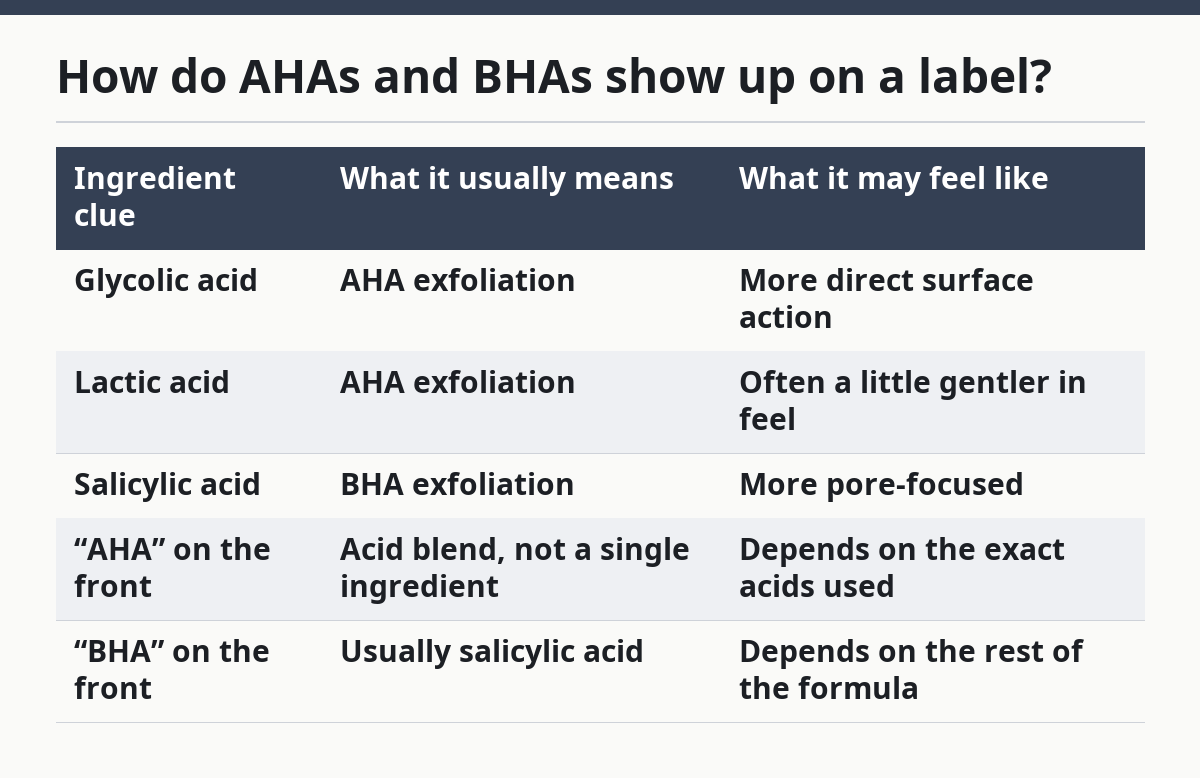
The trade-off is that front-label “AHA” or “BHA” tells you the category, not the full story. A mask can advertise an acid family and still include a lot of oil, clay, or thickening agents that change how it behaves on skin. That is why the ingredient list matters more than the marketing shorthand.
Are enzyme masks really exfoliating?
Yes, enzyme masks really are exfoliating, but they exfoliate in a different way than acid masks. Instead of using an AHA or BHA, they use enzymes such as papain or bromelain to loosen the dead surface layer.
This is the section most readers miss because enzyme masks can look harmless on the label. The front may say “enzymatic,” “fruit enzyme,” or “gentle polish.” That does not mean it is only a soothing mask. It still performs exfoliation, just without the classic acid names.
Enzyme masks often attract people who want a softer feel than a glycolic acid mask. That can be a good fit for a 10-minute rinse-off mask when the goal is mild smoothing. It can also be a bad fit for someone who expects a strong acid effect and gets almost none.
Some enzyme formulas combine enzymes with acid. That combination can make the mask feel more active than either ingredient alone. If both types appear in the same formula, the mask is not just “gentle.” It is a mixed-exfoliation product.
One common mistake is thinking “fruit enzyme” means fruit extract. Those are not the same thing. Fruit extract can be mostly flavor, fragrance, or antioxidant support. A true enzyme exfoliant names the enzyme itself, such as papain or bromelain, or uses a phrase that clearly signals enzymatic action.
Does rinse-off mean the mask is mild?
Rinse-off does not mean mild, and leave-on does not automatically mean stronger. A 10-minute rinse-off mask can still contain exfoliating ingredients that act quickly, while a leave-on mask can be built for slower, lower-dose use.
That is why you should not stop at the product format. A clay mask with salicylic acid can still be exfoliating. A cream mask with lactic acid can still be exfoliating. Even a peel-off mask can rely on acids or enzymes, though the peel-off part is the film, not the exfoliation itself.
The phrase “leave-on versus rinse-off” helps because it tells you how long the formula stays on skin. It does not tell you whether the formula has acids, enzymes, or scrubbing particles. The ingredient list does.
If you want a quick read, check 3 things:
- How long the mask stays on: 5 to 15 minutes is common for rinse-off masks.
- Whether acids are present: glycolic acid, lactic acid, or salicylic acid are direct signs.
- Whether enzymes appear: papain, bromelain, or “fruit enzymes” point to enzymatic exfoliation.
The hard part is that a rinse-off mask can still feel strong if the acid load is high or if the formula includes physical grit. That is why the front label can be misleading. “Wash off” sounds gentle, but the ingredient list may tell a different story.
The same goes for “overnight mask” wording. If the formula contains exfoliating acids, it belongs on the exfoliation shelf even if the brand dresses it up as a sleep mask.
What formula clues help you spot exfoliation fast?
Formula clues help you spot exfoliation fast when the ingredient list is long or crowded with plant extracts. The strongest clues are the acid names, the enzyme names, and the texture agents that often travel with exfoliating masks.
A useful shortcut is to scan for these 4 patterns:
- Acid words: acid, AHA, BHA
- Enzyme words: papain, bromelain, enzyme
- Scrub words: powder, seed, shell, granule
- Result words on the front: peel, resurfac*, smooth, renew, polish
Marketing words are not proof, but they can point you to the right place in the list. If a mask says “peel” and the ingredient list includes glycolic acid near the top, that is a strong exfoliating signal. If it says “gentle glow” and the only actives are glycerin and chamomile, it may not exfoliate at all.
One thing to watch is fragrance-heavy formulas. A mask can smell like fruit and still contain no exfoliating enzyme. A banana-scented mask, for example, is not an enzyme mask just because it sounds natural. The exact ingredient names matter.
Another clue is whether the formula contains both a smoothing base and an active exfoliant. A thick cream with oils and humectants can still be an acid mask. The base changes comfort, not the fact of exfoliation.
If this kind of ingredient reading is useful, the wider hub on face mask ingredients and formulation science gives the broader map. This page stays focused on one job: spotting exfoliation signals in the formula itself.
What do readers usually get wrong?
Readers usually get wrong the idea that “acid mask” is the only kind of exfoliating mask. That mistake hides enzyme masks and physical scrub masks, and it also makes people miss exfoliating ingredients buried in a long formula.
The second mistake is trusting the front of the box. Words like “brightening,” “glowing,” or “peel” are loose marketing terms. They can point to exfoliation, but they do not guarantee it. The ingredient list is the place where glycolic acid, lactic acid, salicylic acid, or enzymes are named plainly.
The third mistake is reading one ingredient in isolation. A mask with salicylic acid and a lot of oil is not the same as a mask with salicylic acid and lightweight humectants. A mask with lactic acid plus enzymes is not the same as an enzyme-only mask. The support ingredients change the feel and can change how obvious the exfoliation seems.
The cost of these mistakes is simple: you may buy the wrong texture for your goal. If you want surface smoothing, a scrub-heavy formula may feel too rough. If you want a pore-focused mask, an enzyme-only formula may feel too soft. If you want a mild option, a strong acid blend may be more than you wanted.
A better approach is to classify the mask before you buy it. Ask three questions: does it have acids, does it have enzymes, and does it have physical grit? That 3-part read is enough to place most masks into the right bucket without guessing from the front label.
What should I remember when reading a mask formula?
You should remember that the ingredient list tells you more than the name on the front. If glycolic acid, lactic acid, salicylic acid, papain, or bromelain appears, the mask is likely exfoliating in some way.
Keep the categories straight. AHAs and BHAs are acid exfoliants. Enzymes are non-acid exfoliants. Scrubs are physical exfoliants. A single mask can use 2 of those 3 at once, which is why the front label alone is not enough.
The best habit is quick and repeatable: read the first 5 to 10 ingredients, look for acid or enzyme names, and check whether the formula also includes grit. That gives you a reliable read in less than a minute. It is not perfect, but it is far better than guessing from words like “radiance” or “glow.”
What ingredients exfoliate in a face mask?
The main exfoliating ingredients in a face mask are AHAs, BHAs, enzymes, and physical scrubs. Glycolic acid and lactic acid are common AHAs, salicylic acid is a well-known BHA, and papain or bromelain are enzyme clues. Sugar, salt, and seed powders can also exfoliate by friction.
How can I tell if a mask is exfoliating?
The clearest sign is a named exfoliant in the ingredient list. Look for glycolic acid, lactic acid, salicylic acid, papain, bromelain, or abrasive particles such as sugar or seed powders. If the front says “peel,” “resurface,” or “polish,” that can help, but the ingredient list is the proof.
Are enzyme masks the same as acid masks?
No, enzyme masks are not the same as acid masks, even though both exfoliate. Acid masks use AHAs or BHAs such as glycolic acid, lactic acid, or salicylic acid. Enzyme masks use proteins such as papain or bromelain to loosen dead surface skin cells in a different way.
Drafted with AI; not yet reviewed by a person.



Leave a Reply