



Last updated: November 19, 2026
Key Takeaways
- Emollients make masks feel smoother, spread faster, and leave less roughness.
- Cream masks usually rely on more emollients for body, glide, and a cushioned finish.
- Look for squalane, caprylic/capric triglyceride, shea butter, fatty alcohols, and ceramides.
- Emollients shape how a mask moves on skin and how it looks after 10 minutes.
Emollients in face masks soften skin, improve slip, and change the finish far more than they change hydration.
Quick answer: the emollients in face masks are the ingredients that make a formula feel smoother and spread more easily, and face mask ingredients and formulation science usually show their effect within 10 to 20 minutes. This page explains the topic Emollients in face masks: what they do and which textures use them in cream, balm, gel-cream, and clay formulas.
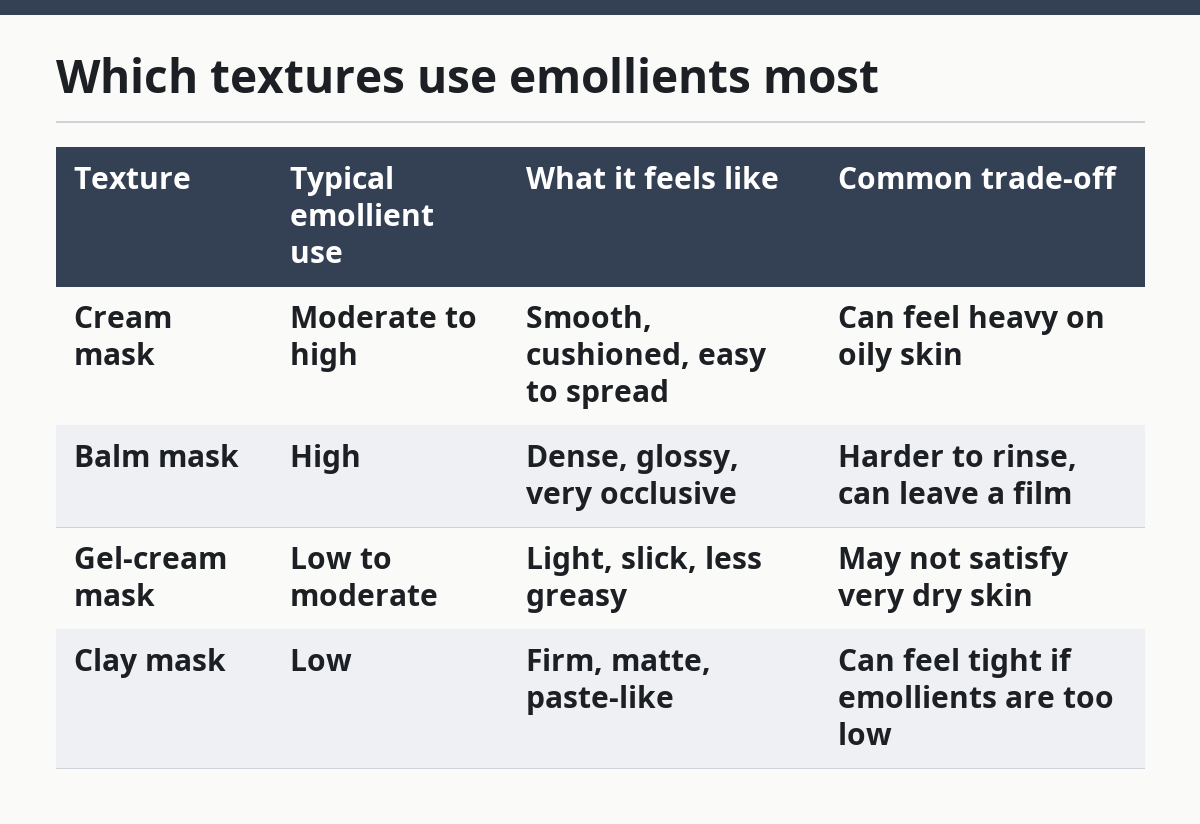
The table below sorts the common types, then the sections after it show how they behave in a jar, tube, or sheet mask.
What emollients do in a face mask
Emollients make a face mask feel smoother, spread faster, and leave less roughness behind. They fill the tiny gaps between dry surface cells, so the skin feels less scratchy after rinse-off or after a leave-on mask sits for 10 to 20 minutes.
For a mask, that usually signals a formula built for feel, not just treatment claims; if you are unsure how rich a product will be, consult a dermatologist or cosmetic formulator. According to the American Academy of Dermatology, products that soften and smooth the skin can also make dry skin feel more comfortable. https://www.aad.org/public/everyday-care/skin-care-basics/dry/skin-care-for-dry-skin
A few names show up again and again in mask formulas:
- Squalane for a light, dry slip
- Caprylic/capric triglyceride for a smooth, cushiony spread
- Shea butter for a richer, denser feel
- Fatty alcohols like cetyl alcohol or cetearyl alcohol for body and a creamy drag-free finish
- Ceramides when the formula wants a skin-barrier cue as well as softness
The truth is, emollients are about feel first. They can support a better finish, but they are not the same thing as a water-binding ingredient. That distinction matters when you read a label.
- Slip: the mask spreads without tugging.
- Softness: skin feels less rough after removal.
- Finish: the skin can look dewy, satin, or film-coated.
- Body: the mask holds shape instead of running like lotion.
Which textures use emollients most
Cream masks use the most emollients because they need body, glide, and a cushioned finish. Gel masks usually use fewer, and clay masks use only enough to keep the paste from feeling dry and chalky.
By contrast, a cream mask and a balm mask on the same shelf usually lean hard on emollients because they need a rich hand feel over 10 to 15 minutes. Clay masks need less of that softness, or they lose the clean, matte clay texture that people expect.
Here’s the catch: texture tells you a lot about the formula’s job.
- Cream masks: often use squalane, shea butter, fatty alcohols, and caprylic/capric triglyceride for a dense, spreadable texture.
- Balm masks: usually contain more oils and butters, so they feel thicker and more occlusive.
- Gel-cream masks: use lighter emollients to keep the formula airy and less greasy.
- Clay masks: may include small amounts of emollients to reduce drag, but too much turns the mask slippery.
A formula with more emollient load usually feels richer and leaves more residue. A formula with less feels cleaner but may tug more on dry patches.
| Texture | Typical emollient use | What it feels like | Common trade-off |
|---|---|---|---|
| Cream mask | Moderate to high | Smooth, cushioned, easy to spread | Can feel heavy on oily skin |
| Balm mask | High | Dense, glossy, very occlusive | Harder to rinse, can leave a film |
| Gel-cream mask | Low to moderate | Light, slick, less greasy | May not satisfy very dry skin |
| Clay mask | Low | Firm, matte, paste-like | Can feel tight if emollients are too low |
If you want the hub page on face mask ingredients and formulation science, this section is the one that tells you where emollients fit in the formula map.
The main emollients you’ll see on a label
Squalane, caprylic/capric triglyceride, shea butter, fatty alcohols, and ceramides are the names to watch. Each one changes the texture in a different way, even when the marketing copy sounds the same.
As you scan an ingredient list and see three or four softening agents packed together near the middle of the list, that usually points to a formula built for feel, not just treatment claims. A 50 mL or 1.7 oz cream mask with those ingredients will usually feel more substantial than a watery gel in the same size jar.
- Squalane: lightweight, dry slip, good for reducing the greasy after-feel.
- Caprylic/capric triglyceride: a common emollient that gives a silky spread and a soft after-touch.
- Shea butter: richer and more protective-feeling; can make a formula thicker and more occlusive.
- Fatty alcohols: not the drying kind of alcohol; these thicken the formula and make it feel creamy.
- Ceramides: often used to support a barrier-style feel, though they do not make a mask automatically rich or oily.
Some formulas pair these with occlusives like petrolatum or dimethicone. That pairing matters because the emollient smooths and the occlusive slows water loss. Those are different jobs.
A simple texture read can still help:
- Squalane forward: lighter feel.
- Butter forward: richer feel.
- Fatty alcohol forward: thick, whipped cream body.
- Ceramide plus emollient: more skin-like, less flashy, often steadier across the face.
How emollients change slip, spread, and finish
Emollients in face masks control how a mask moves under your fingers and how it looks 10 minutes later. They can turn a formula from sticky to silky, or from thin to cushioned, without changing the basic mask type.
As you dot a mask on the forehead, cheeks, and chin, then start spreading it with a brush or fingertips, a formula with enough emollient slides in one pass. One with too little catches on dry patches and bunches around the nose. That is where slip matters most.
Use this quick decision path:
- Read the texture claim first. “Cream,” “balm,” and “butter” usually mean a higher emollient load than “gel.”
- Check the first half of the ingredient list. If squalane, caprylic/capric triglyceride, shea butter, or fatty alcohols appear early, expect a richer feel.
- Match the finish to your goal. A dewy or satin finish often means more emollients; a clean matte finish means fewer.
- Look for occlusives if the skin feels tight. Emollients soften, but occlusives help hold the result in place.
- Choose the removal style. Rinse-off masks can handle heavier emollients than leave-on styles if you hate residue.
A common mistake is assuming every “moisturizing” mask will feel the same. That’s wrong. Two 75 mL / 2.5 oz masks can both say moisturizing, yet one may feel silky from squalane and one thick from shea butter and fatty alcohols.
Emollients versus occlusives versus humectants
Emollients smooth, occlusives seal, and humectants pull in water. That is the cleanest way to read a face mask formula without getting lost in marketing language.
For example, if you open a jar that lists glycerin, squalane, dimethicone, and shea butter, three different jobs are happening at once. Glycerin is the water-holding piece, squalane is the smoothing piece, dimethicone is the sealing piece, and shea butter adds body plus more occlusion. One ingredient class never tells the whole story.
A practical way to sort the three:
- Humectants like glycerin or hyaluronic acid bring in water.
- Emollients like squalane or caprylic/capric triglyceride smooth the skin surface.
- Occlusives like petrolatum, dimethicone, or heavy butters slow water loss.
That mix changes the mask’s payoff. A formula heavy on humectants can feel wet or tacky if it lacks enough emollients. A formula heavy on emollients can feel soft but not especially plump. A formula heavy on occlusives can feel protected but also more sealed or glossy.
The result on skin is not just comfort. It is also timing.
- A 10-minute cream mask often uses emollients to keep the spread easy and the finish cushioned.
- A rinse-off clay mask may use a smaller emollient dose to limit tightness.
- A leave-on sleeping mask often leans harder on occlusives plus emollients for overnight feel.
Because of that, the difference matters if you hate residue. A rich emollient formula can be the right choice for dry, rough skin, but it can feel like too much on a face that wants a lighter finish.
Common mistakes when choosing a mask by feel
The biggest mistake is choosing by the word “hydrating” instead of by the texture system. Hydration claims do not tell you whether the mask will feel silky, greasy, dense, or airy.
When you buy a mask because it sounds gentle, the first application can leave a shiny film you did not want. That usually means the emollient blend was built for a richer finish than you prefer. On the flip side, a thin formula with too little emollient can leave the face feeling squeaky or rough after a clay step.
Common errors and what they cost:
- Picking too many butters for oily skin: the mask may feel heavy and sit on top instead of disappearing.
- Avoiding all oils because of the word “grease”: you can end up with a mask that drags and feels stingy on dry patches.
- Assuming fatty alcohols are drying alcohols: that mistake can make you skip the ingredients that give a cream mask its body.
- Choosing a clay mask with no softeners at all: the skin can feel tight after 5 to 15 minutes.
What to do instead:
- Read for texture clues, not just marketing words.
- If you want less residue, look for squalane or lighter esters near the emollient section.
- If you want more cushion, look for shea butter or a richer fatty alcohol base.
- If you want a balanced cream, look for caprylic/capric triglyceride paired with a little occlusive support.
Who this is not for: if you hate any film on the skin, a heavy balm mask is the wrong texture, and a gel-cream or light rinse-off formula is a better fit.
How to read a mask label for emollients
You can tell a lot from the first 10 ingredients. That is where the main texture builders usually show up, even when the front label focuses on glow or moisture.
As you scroll a product page or stand in a store, you still have more than enough clues if you know where to look. A 50 mL / 1.7 oz jar with squalane, fatty alcohols, and shea butter near the front is usually built for richness, while a thin gel formula with only a light emollient in the middle will feel more weightless.
Use this simple read:
- Look for the emollients first. Squalane, caprylic/capric triglyceride, shea butter, and fatty alcohols are the main texture cues.
- Then look for occlusives. They tell you whether the mask will leave a seal-like finish.
- Then look for humectants. They tell you whether the formula is also trying to add water-binding support.
- Then check the texture language. “Whipped,” “balm,” and “cream” usually imply more body than “gel.”
A label can also hint at how the mask will wash off.
- More emollients plus occlusives: likely more residue.
- More light emollients: likely easier spread and cleaner finish.
- More fatty alcohols: likely a thicker cream structure.
If you already know a face mask ingredient can support softness, this is the page that tells you whether it will feel plush, oily, or balanced. That is the practical part people miss. For ingredient definitions and safety context, see the U.S. FDA’s cosmetics overview and the Cosmetic Ingredient Review panel’s ingredient reports. https://www.fda.gov/cosmetics/cosmetics-products-ingredients and https://www.cir-safety.org/ingredients
FAQ
What is an emollient in skincare?
An emollient is an ingredient that softens and smooths the skin surface. In face masks, it mainly changes slip, spread, and finish. Common examples include squalane, caprylic/capric triglyceride, shea butter, and fatty alcohols. It is about texture first, not just moisture.
Are emollients good for dry skin?
Yes, emollients often suit dry skin because they reduce roughness and make a mask feel less harsh. They are especially useful in cream masks and balm masks that need a richer hand feel. If you dislike residue, a lighter emollient like squalane usually feels easier than shea butter.
How are emollients different from humectants?
Emollients smooth, while humectants bind water. Glycerin and hyaluronic acid are humectant examples; squalane and shea butter are emollients. A mask can use both, and many better-balanced formulas do. The feel on skin changes depending on which one leads the formula.
Drafted with AI; not yet reviewed by a person.



Leave a Reply