



Last updated: November 19, 2026
Quick answer: the best face mask choice usually comes down to three options—sheet, clay, or exfoliating—based on occasion, outcome, and skin type. If you match the mask to the job, you waste less time and get fewer red, tight, or greasy mistakes. This face mask shopping by occasion and outcome — The Complete Guide helps you choose with fewer guesses.
Key Takeaways
- Match the mask to the setting first, then the skin goal.
- Let the outcome drive the purchase, not the packaging.
- Skin type narrows the choice faster than occasion does.
- Ingredients matter more than the front-label claim.
This guide breaks the choice down by occasion, skin goal, and texture so you can buy the mask that fits the moment instead of guessing at the shelf.
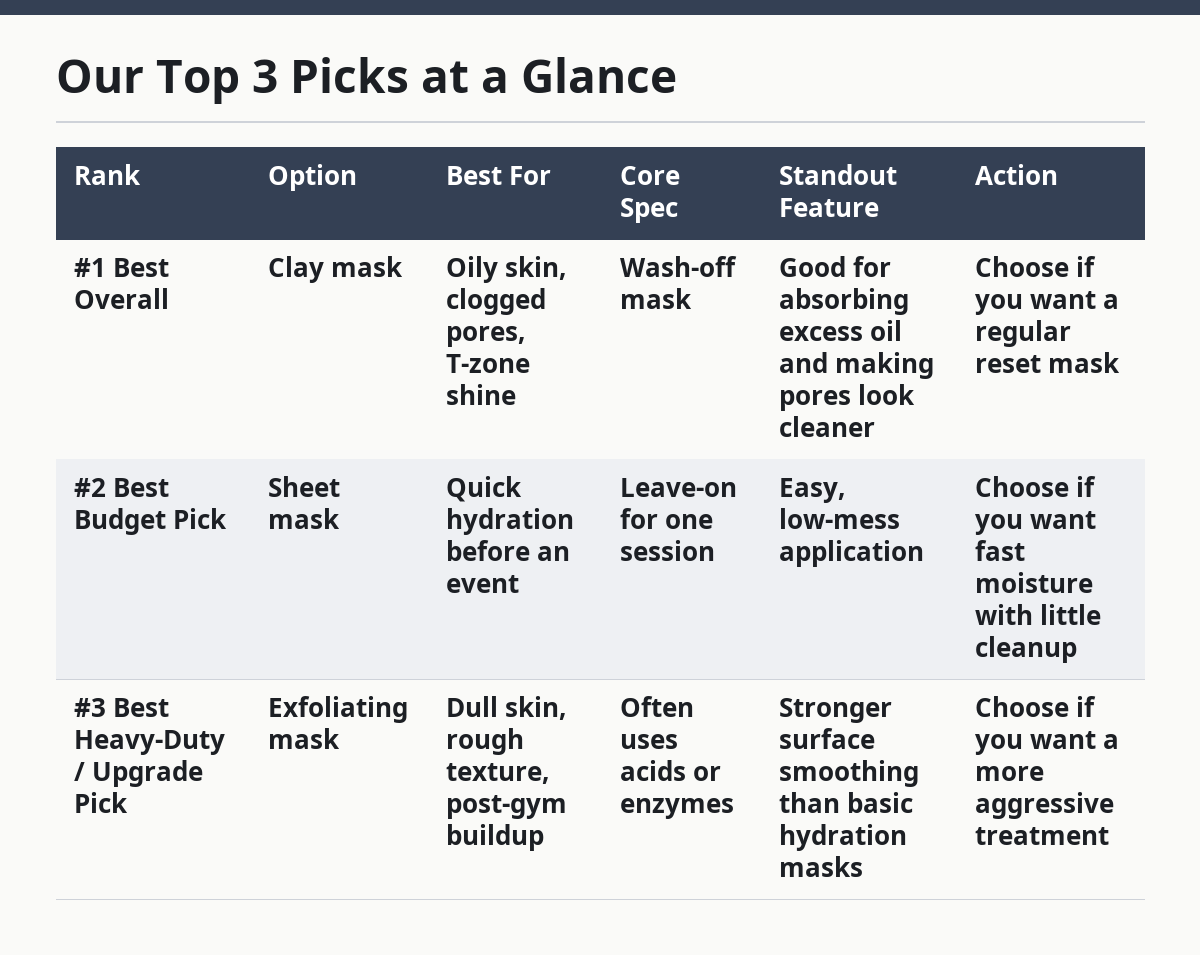
Our Top 3 Picks at a Glance
Use these three options as a starting point, and consult a dermatologist or licensed skincare professional if your skin is reactive or you are unsure which mask fits your needs. The shortlist below is a practical guide, not a medical diagnosis, and ingredient advice can vary by person and product (American Academy of Dermatology; NHS).
| Rank | Option | Best For | Core Spec | Standout Feature | Action |
|---|---|---|---|---|---|
| #1 Best Overall | Clay mask | Oily skin, clogged pores, T-zone shine | Wash-off mask | Good for absorbing excess oil and making pores look cleaner | Choose if you want a regular reset mask |
| #2 Best Budget Pick | Sheet mask | Quick hydration before an event | Leave-on for one session | Easy, low-mess application | Choose if you want fast moisture with little cleanup |
| #3 Best Heavy-Duty / Upgrade Pick | Exfoliating mask | Dull skin, rough texture, post-gym buildup | Often uses acids or enzymes | Stronger surface smoothing than basic hydration masks | Choose if you want a more aggressive treatment |
| Product / Option | Best For | Core Spec | Standout Feature | Action |
|---|---|---|---|---|
| Clay mask | Oily skin and visible shine | Wash-off treatment | Helps remove excess oil and debris | Pick for weekly pore care |
| Sheet mask | Dry skin and pre-event prep | Single-use mask | Fast hydration with no rinsing | Pick for short, simple routines |
| Exfoliating mask | Dull or rough skin | Acid or enzyme treatment | Gives a stronger smoothing effect | Pick for texture-focused care |
Which face mask should I buy for the occasion?
Buy the mask that matches the setting first, then the skin goal second. A wedding needs a different mask than a post-workout reset, and a bedtime routine needs a different one than a lunch-break touch-up.
Picture this: you’re standing in front of a shelf with a dry face, a full calendar, and no time to guess. A sheet mask is usually the easiest pick for a fast glow, while a clay mask is the better choice when the real problem is oil and clogged pores.
Rather than chasing trends, start with the situation in front of you.
- Before an event: choose a hydrating sheet mask, gel mask, or cream mask.
- After a sweaty workout: choose a clay mask or charcoal mask if oil is the issue.
- On a self-care night: choose an exfoliating mask if your skin feels rough.
- For a flight or dry season: choose a rich cream mask or overnight mask.
- For acne-prone skin: choose a targeted clay or sulfur mask, not a heavy occlusive one.
Occasion-to-mask match
| Occasion | Better Mask Type | What It Should Do |
|---|---|---|
| Pre-event | Sheet, gel, cream | Add water back to skin fast |
| Post-workout | Clay, charcoal | Reduce shine and clear buildup |
| Weeknight reset | Exfoliating, clay | Smooth texture and clean pores |
| Dry weather | Cream, overnight | Reduce tightness |
| Travel day | Sheet, stick, gel | Keep the routine simple |
The truth is, a lot of people buy the wrong mask because they shop by trend. That usually means a peel-off mask for dry skin, or a heavy cream mask for skin that already feels greasy.
What outcome do you want from a face mask?
The outcome should drive the purchase, not the packaging. If you want hydration, redness relief, oil control, or smoother texture, each one points to a different mask family.
Picture this: your skin looks tired, but you don’t know if it needs moisture, exfoliation, or oil control. That question matters, because a mask built for shine reduction can leave dry skin tighter, while a rich mask can make oily skin feel coated.
On the flip side, one mask can sometimes do two jobs, but it rarely does them equally well.
- Hydration: sheet masks, gel masks, cream masks, overnight masks.
- Oil control: clay masks, charcoal masks, sulfur masks.
- Smoother texture: exfoliating masks with acids or enzymes.
- Calming: soothing gel or cream masks with simple formulas.
- Brighter look: exfoliating masks or hydrating masks with a good slip.
Outcome-to-mask match
| Outcome | Better Mask Type | What to Look For |
|---|---|---|
| More hydration | Sheet, gel, cream | Water-binding ingredients and a soft finish |
| Less shine | Clay, charcoal | Oil-absorbing base |
| Smoother skin | Acid or enzyme mask | Gentle exfoliation |
| Less irritation | Simple cream or gel | Short ingredient list |
| Fresher-looking skin | Hydrating or exfoliating | Depends on whether dryness or dullness is the issue |
Now, you might be wondering which masks are the most flexible. Gel masks are often the middle ground: lighter than cream, less drying than clay, and easier to live with if your skin changes by season.
Which mask fits your skin type?
Skin type narrows the choice faster than occasion does. Oily skin usually wants less richness, dry skin usually wants more comfort, and sensitive skin usually needs the shortest, plainest formula. If you have persistent irritation or acne concerns, consult a dermatologist or licensed skincare professional before trying stronger formulas (American Academy of Dermatology).
Picture this: you’ve got a face mask in your cart and you’re trying to guess if it will help or wreck your skin. The wrong texture can make a good ingredient feel wrong, especially when your skin is already reactive.
Here’s the catch: the same mask can be perfect for one person and miserable for another.
- Oily skin: clay, charcoal, or lightweight gel.
- Dry skin: cream, balm, or overnight mask.
- Combination skin: clay on the T-zone, hydrating mask elsewhere.
- Sensitive skin: fragrance-light or fragrance-free gel or cream.
- Acne-prone skin: clay or sulfur, used carefully and not too often.
Skin type guide
If you are unsure which mask type is safest for your skin, consult a dermatologist or licensed skincare professional, especially if you react easily to fragrance or exfoliating acids. The American Academy of Dermatology recommends choosing gentler products when skin is sensitive, and the NHS also advises caution with harsh skincare if acne or irritation is active (American Academy of Dermatology; NHS).
| Skin Type | Better Mask Type | Common Mistake |
|---|---|---|
| Oily | Clay, charcoal | Choosing a rich cream mask |
| Dry | Cream, overnight | Choosing a tight-drying clay mask |
| Combination | Multi-zone approach | Treating the whole face the same way |
| Sensitive | Simple gel or cream | Using a strong exfoliating mask too often |
| Acne-prone | Targeted clay or sulfur | Overusing harsh peel-offs |
A generic article often forgets that combination skin exists. It does, and it causes the most wasted purchases because the forehead and cheeks usually want different things.
What ingredients matter most?
Ingredients matter more than the word on the front of the box. A mask labeled “brightening” can still be drying, and a mask labeled “hydrating” can still feel heavy. For ingredient basics, the American Academy of Dermatology and the National Health Service both recommend checking formulas rather than trusting label language alone (American Academy of Dermatology; NHS).
Picture this: you’re scanning an ingredient list with five other people waiting behind you. The front label says one thing; the formula tells the truth.
The simplest filter is to look for ingredients that match the job, and skip the ones that fight your skin.
- Clay: good for oil absorption and pore cleanup.
- Hyaluronic acid: helps a mask feel more hydrating.
- Glycerin: supports moisture retention.
- Aloe: often used for a calming feel.
- Salicylic acid: useful when pores and oil are the issue.
- Glycolic or lactic acid: helps with dullness and roughness.
- Enzymes: a gentler exfoliating route for some users.
- Fragrance: can be a problem for sensitive skin.
Ingredient cheat sheet
| Ingredient | Usually Helps With | Watch Out For |
|---|---|---|
| Clay | Oil and visible shine | Can feel drying |
| Glycerin | Hydration | Usually low risk |
| Hyaluronic acid | Moisture feel | Works best on damp skin and with follow-up moisturizer |
| Salicylic acid | Clogged pores | Can be too much for very dry skin |
| Glycolic acid | Dullness | Can sting sensitive skin |
| Aloe | Comfort | Not always enough on its own |
A short ingredient list is not automatically better, but it can be easier to match to a skin goal.
What should I avoid if I want better results?
Avoid masks that solve the wrong problem. A stripping clay mask on a dry face can leave you tighter than before, and a rich cream mask on oily skin can feel greasy instead of helpful.
Picture this: you want a quick fix, so you grab the first trending mask you see. That shortcut usually backfires when the mask’s texture fights your skin’s actual condition.
Here are the common mistakes that cost people time and money:
- Using peel-off masks too often: they can be harsh and leave skin irritated.
- Choosing strong acids without a need: stronger exfoliation is not always better.
- Buying by scent: a nice smell does not mean a better result.
- Ignoring skin type: this is how people buy masks that feel wrong on day one.
- Expecting one mask to do everything: most masks do one job well and the rest only okay.
Don’t-buy-until-you-check list
| Checkpoint | Why It Matters | Better Pick If Not Sure |
|---|---|---|
| Skin type | Controls comfort | Gel or sheet mask |
| Main goal | Stops random buying | Match the outcome first |
| Sensitivity | Reduces irritation risk | Simple cream mask |
| Time available | Prevents rushed use | Sheet mask for short windows |
| Cleanup tolerance | Keeps routine realistic | Leave-on or easy-rinse mask |
On the flip side, the cleanest-looking choice on a shelf is not always the best one. The box can be polished; your skin still has to live with the formula.
How do I shop by occasion without overbuying?
Shop by a repeatable use case, not by mood. One hydrating mask for events, one oil-control mask for breakouts, and one gentle mask for recovery covers most needs without filling a drawer.
Picture this: your bathroom shelf already has half-used tubes and one mask you forgot you bought. That usually happens when each purchase was tied to a feeling instead of a clear use.
The simplest way to shop is to build a small set around real life.
- Pick one event mask. Choose a sheet or gel mask for quick hydration before dinners, photos, or meetings.
- Pick one reset mask. Choose clay or charcoal for oily days or after heavy makeup.
- Pick one comfort mask. Choose cream or overnight for dry weather or recovery days.
- Add one treatment mask only if needed. Choose exfoliating acid or enzyme masks if texture is the main concern.
- Stop there. More masks usually mean more overlap, not better skin.
Small routine, big payoff
| Slot | Best Mask Type | Why It Earns Its Place |
|---|---|---|
| Event prep | Sheet or gel | Fast and low fuss |
| Oil reset | Clay | Useful after shine or buildup |
| Dry-skin rescue | Cream or overnight | Keeps skin comfortable |
| Texture treatment | Exfoliating | Handles roughness and dullness |
The truth is, most people need fewer masks than they think. A tight edit saves money and keeps your routine easy enough to repeat.
What should a first-time buyer choose?
A first-time buyer should start with a sheet mask or a gentle clay mask. Those two cover the broadest set of real-world needs without asking you to know your skin like a chemist.
Picture this: you want one mask that won’t make the whole routine feel hard. A sheet mask gives you the easiest hydration path, while a gentle clay mask handles oil without forcing you into a complicated ingredient puzzle.
Here’s the catch: a first purchase should be boring in the best way.
- Choose sheet if your main problem is dryness before an event.
- Choose clay if your main problem is shine or clogged pores.
- Choose gel if your skin gets easily annoyed.
- Choose cream if your face often feels tight after cleansing.
- Avoid peel-off if you want the lowest-risk beginner option.
Best first-buy scenarios
| If you are… | Start with… | Why |
|---|---|---|
| New to masks | Sheet mask | Easy to use, low commitment |
| Oily at the T-zone | Clay mask | Better match for shine |
| Dry in cold weather | Cream mask | More comfort |
| Easily irritated | Gentle gel | Fewer harsh effects |
| Shopping for one event | Hydrating sheet | Fastest payoff |
A beginner does not need the strongest mask on the shelf. They need the one least likely to be a bad surprise.
Face mask shopping by occasion and outcome: quick decision guide
The fastest decision is simple: choose occasion first, then outcome, then skin type. That order keeps you from buying a mask that looks right but feels wrong.
Picture this: you have three minutes and a cart full of options. The most direct route is to ask three questions in order.
Quick picker
| Question | If yes, choose |
|---|---|
| Do you need fast hydration before going out? | Sheet or gel mask |
| Do you need oil control or pore cleanup? | Clay or charcoal mask |
| Do you want smoother texture? | Exfoliating mask |
| Does your skin feel dry or tight? | Cream or overnight mask |
| Is your skin reactive? | Simple gel or cream mask |
The best answer is often a close fit, not a perfect one. You do not need a perfect match to get a good result. You need a close match that fits the day you are actually having.
FAQ
What face mask is best before an event?
A hydrating sheet mask or gel mask is usually the best pick before an event. It gives the skin a fresher look without the risk of heavy residue or a long rinse. If your skin is oily, choose a lighter formula and avoid anything that feels stripping.
Is a clay mask good for dry skin?
A clay mask is usually not the first choice for dry skin. Clay is better for oil control and pore cleanup, and it can leave dry skin feeling tighter. A cream mask or overnight mask is usually a better fit.
Can I use a face mask every day?
Most face masks are not meant for daily use, especially exfoliating or clay masks. Hydrating sheet masks can fit more often for some people, but skin type matters. If your skin gets dry or irritated, a less frequent schedule is usually smarter.
What is the easiest face mask for a beginner?
A sheet mask is the easiest face mask for a beginner. It is simple to apply, low-mess, and usually aimed at hydration. If the skin is oily rather than dry, a gentle clay mask can also be a practical first pick.
Which mask helps with dull skin?
An exfoliating mask usually helps most with dull skin. Acid or enzyme formulas can smooth the surface and make skin look brighter. If dullness is really dryness, though, a hydrating mask may be the better choice.
Final take
The right face mask is the one that matches the occasion, the outcome, and your skin type in that order. If you buy that way, you stop collecting random jars and start getting repeatable results.
Picture this: next time you shop, you already know what shelf to head toward. That’s the whole point of buying by occasion and outcome—you get a mask that earns its spot because it solves a real problem, not because it looked promising in the moment.
Drafted with AI; not yet reviewed by a person.



Leave a Reply