



Last updated: November 18, 2026
Quick answer: for most routines, the face mask goes in step 3 of 6—after cleanser and toner, before serum, moisturizer, and sunscreen. How to layer a face mask with cleanser, serum, moisturizer, and sunscreen depends on the mask type, so a rinse-off clay mask and a leave-on sheet mask do not slot into the routine the same way.
Key takeaways
- Clean skin comes first, so the mask can reach the surface instead of sitting on oil and leftover makeup.
- A rinse-off mask usually goes after toner and before serum; a leave-on mask can replace serum or sit right before moisturizer.
- Sunscreen is usually the last morning step, after moisturizer has had a moment to settle, though product directions can vary.
- If your skin stings or gets tight, shorten the mask time or skip extra actives that day.
- The right order matters more than adding more products.
What is the right order?

The right order is cleanser, toner, face mask, serum, moisturizer, then sunscreen in the morning. That sequence keeps heavier or rinse-off products from blocking lighter ones, and it lets sunscreen finish the routine as the top layer.
A simple rule helps: go from thinnest to thickest, with sunscreen last during the day. If the mask is a wash-off clay mask, it belongs after toner and before serum. If it is a leave-on or sheet mask, it often acts like a serum step, so the next layer is usually moisturizer.
Here is the short version in one line: cleanse, tone, mask, treat, seal, protect. If you are unsure how a specific product is meant to be used, check the label or consult a skin professional; the general layering guidance from the American Academy of Dermatology and NHS sunscreen guidance supports keeping the routine simple and sunscreen last.
| Product | Morning order | Night order | Why it goes there |
|---|---|---|---|
| Cleanser | 1 | 1 | Removes oil, sweat, and residue |
| Toner | 2 | 2 | Prepares skin if you use one |
| Face mask | 3 | 3 | Sits on clean skin, before leave-on treatment layers |
| Serum | 4 | 4 | Delivers a light treatment layer |
| Moisturizer | 5 | 5 | Seals in the steps underneath |
| Sunscreen | 6 | 0 | Final daytime shield |
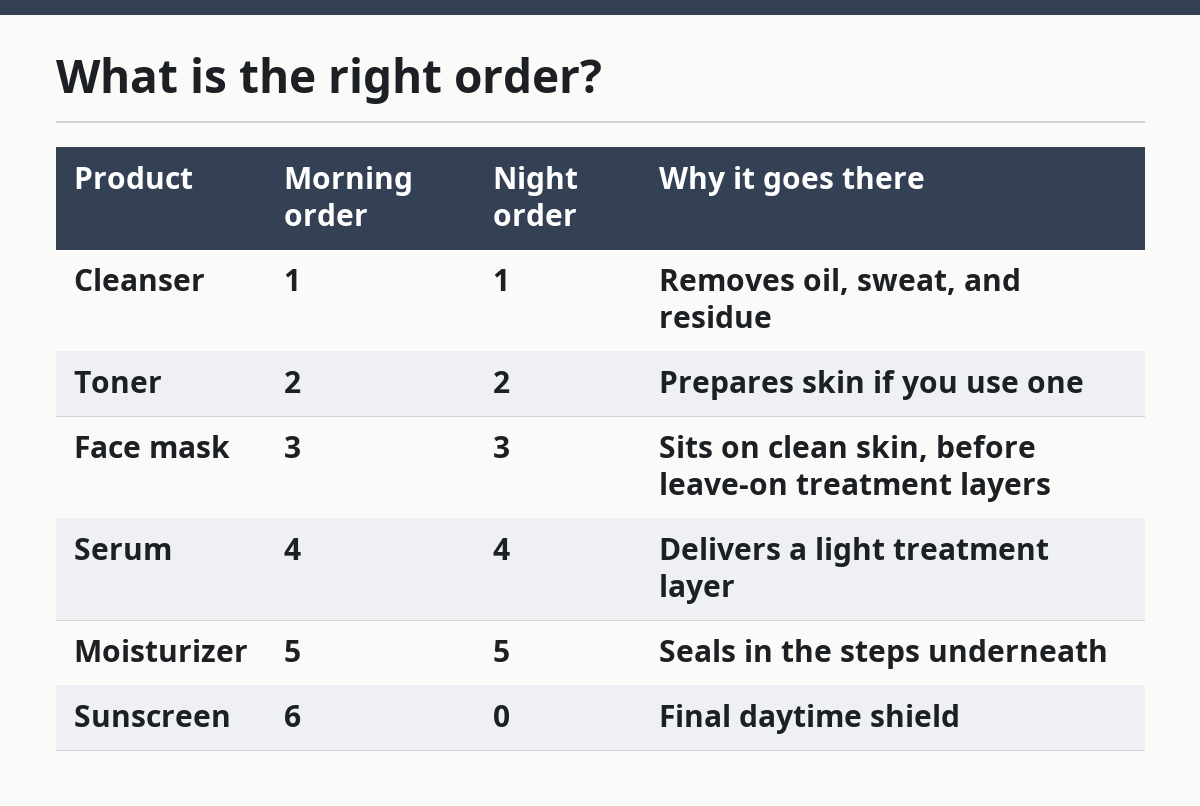
This is the core order you can trust for most routines. The part that changes is the kind of mask, not the logic of the sequence.
How do I fit a face mask into my routine?
I fit a face mask into the routine by placing it after cleansing and before any leave-on treatment that needs bare skin. Start with cleanser, then use toner if it is part of your routine, then apply the mask, then continue with serum and moisturizer.
Use the mask on skin that is fully clean but not stripped. If you wash twice, stop there; do not pile on three or four cleansing steps before masking, because that can leave skin dry and red. A 10 to 15 minute wash-off mask is common for many formulas, but the label matters more than the clock.
After a rinse-off mask, pat the face dry and move to serum while the skin still feels slightly damp. That helps the next layer spread evenly without rubbing. If the mask is a sheet mask or another leave-on style, follow its directions and then decide whether your serum step is still needed.
The big mistake is treating every mask like a separate routine. It is not. The mask is one step inside the routine, not a second cleanser and not a substitute for sunscreen. For mask basics and timing, the AAD’s face mask advice is a useful starting point, but if your skin is reactive, consult a dermatologist or other qualified skin professional.
Should the mask go before or after toner and serum?
The mask usually goes after toner and before serum, but sheet masks and leave-on masks can act like the serum step itself. That is the cleanest way to think about it when you are trying to keep the routine simple.
Toner comes first because it is light and sits close to bare skin. A rinse-off mask then gets direct contact with the skin without having to push through a thick layer of serum or cream. After you remove the mask, serum goes on next because it is lighter than moisturizer and can still do its job.
A sheet mask is the main exception. It already adds a wet treatment layer, so many routines treat it as the serum step and go straight to moisturizer after it. If your serum is a strong active, such as one that tingles or stings easily, do not stack it under a mask unless the product directions say that is okay; if there is any doubt, consult a professional or follow the brand directions. The Cleveland Clinic also recommends checking product instructions rather than forcing one universal order.
The simplest split is this: rinse-off mask after toner, serum after rinse-off mask, moisturizer after serum. For sheet masks, toner first, sheet mask next, then moisturizer if the skin needs it. That keeps the routine from getting crowded.
What changes in the morning routine?
The morning routine adds sunscreen at the end, and that changes the whole stack. After cleanser, toner, face mask, serum, and moisturizer, sunscreen goes on last so it can form the outer daytime layer.
If you use a mask in the morning, keep the rest of the routine light. A heavy cream under sunscreen can make the face feel slick, and that can tempt you to rub off product before it has settled. Give each layer a short pause, just long enough for the skin to stop feeling wet before the next step.
A morning mask makes the most sense when the skin feels dry, dull, or tight and you still need to leave the house. It is not the moment to overload the face with several strong actives. If the mask already feels rich, you may not need a separate serum that day.
For sunscreen, think final and fixed. It never goes under moisturizer, and it never goes before a mask. On a morning when you mask, the sunscreen still stays last, even if the rest of the order changes a little. The NHS and AAD both place sunscreen at the end of a daytime routine.
What changes at night?
At night, the routine ends with moisturizer, so the order gets simpler. Cleanser, toner, face mask, serum, and moisturizer is the usual line-up when there is no sunscreen to finish the routine.
Night is the better place for a more involved mask because there is no daylight step after it. That gives you room to use a rinse-off mask, wait for the skin to calm down, and then finish with serum and moisturizer. A 10-minute mask can fit easily before bed without turning the routine into a project.
If you are using a mask on a night when your skin feels irritated, keep the rest of the routine plain. Skip extra layers that do not add much. A basic cleanser, a short mask, and a bland moisturizer may be enough.
The night routine is also where people overdo it most. Two serums plus a mask plus a strong moisturizer can leave skin looking greasy and feeling tender. The fix is simple: choose one treatment path for the night, not three.
Which mask type changes the order?
The mask type changes the order because not every mask works like a wash-off treatment. A rinse-off clay mask, a cream mask, and a sheet mask each behave differently, so the steps around them shift too.
| Mask type | Where it fits | Best next step | Main trade-off |
|---|---|---|---|
| Rinse-off clay mask | After toner, before serum | Serum | Can feel drying if left on too long |
| Cream mask | After toner, before serum or moisturizer | Serum or moisturizer | May be too rich for oily skin |
| Sheet mask | After toner, before moisturizer | Moisturizer | Can make the routine feel wet and layered |
| Leave-on mask | Usually after toner, then check the label | Often moisturizer | Can crowd out serum if it already feels heavy |
This is why a generic “mask after serum” rule causes trouble. A clay mask needs bare skin contact, while a sheet mask is already loaded with fluid and can take the place of a serum step. The label matters more than the trend.
If the product has clear instructions, follow those first. Product directions beat routine charts every time, especially with masks that are designed to stay on the skin or be rinsed off after a set number of minutes. If the label is unclear, consult a skin professional rather than guessing.
What mistakes make the routine backfire?
The routine backfires when the skin gets overloaded, stripped, or blocked by the wrong layer order. The most common problem is putting serum or moisturizer on before a rinse-off mask, which can keep the mask from touching the skin evenly.
Another mistake is leaving a clay mask on until it feels tight and flaky. That does not mean it worked better. It usually means the skin lost too much water, and the next serum or moisturizer may sting more than usual. A mask that stays on too long can make the rest of the routine feel off for the next few hours.
Using too many active products in one pass is another issue. A strong serum under a mask can irritate skin faster than either product alone. If redness, stinging, or tightness shows up, cut the routine back to cleanser, one mask, moisturizer, and sunscreen in the morning.
The fastest fix is to separate treatment steps. Keep the mask in its own slot, use one serum, and let moisturizer do the sealing. A routine with fewer steps often works better than a crowded one.
For a broader view of mask types and when people use them, the hub on face mask formats and use-cases can sit beside this guide.
Can I layer this for redness after shaving?
Yes, but the safest version is the simplest one. After shaving, use a gentle cleanser, then a calm mask only if the product is meant for sensitive skin, then a plain moisturizer, and sunscreen in the morning.
Shaved skin can react fast to strong acids, hot water, fragrance, and long mask times. That means the usual full routine may be too much right after a shave, even if it works on a normal day. A short, mild routine is better than trying to treat redness with more layers.
If a serum burns on shaved skin, leave it out for that day. A stinging serum under a mask can turn a small flush into a longer flare-up. When the face feels tender, less product is usually the smarter move.
If redness keeps showing up after shaving, that can be a sign to ask a dermatologist or other qualified skin professional about the products in the routine.
Do you put moisturizer on after a face mask?
Yes, moisturizer usually goes on after a face mask unless the mask already leaves the skin coated and your label says to stop there. A rinse-off mask almost always needs moisturizer next because the skin can feel dry after the product comes off.
If the mask is a sheet mask or a rich leave-on mask, moisturizer may still help, but you may need less of it. The goal is to seal the skin, not bury it under three heavy layers. A small amount is enough for most routines.
Should face mask go before or after serum?
The face mask usually goes before serum if it is a rinse-off mask. That lets the mask touch clean skin first, then the serum can go on after the mask has done its job.
A sheet mask is the main exception because it often functions like a serum step. In that case, the next product is usually moisturizer, not another serum. If you are using an active serum, check the product instructions or consult a professional before layering it with a mask.
Where does sunscreen fit after a morning mask?
Sunscreen goes last, after moisturizer, even on a morning when you use a face mask. That position lets it sit on top of the rest of the routine and do its daytime job.
If the skin feels wet or slippery after the mask, wait a moment before sunscreen so the layer goes on evenly. A rushed application can pill or feel patchy, which makes the final step harder to keep on the face.
Drafted with AI; not yet reviewed by a person.



Leave a Reply