


Last updated: November 18, 2026
Quick Answer: In 3 checks, choose a leave-on face mask for a no-rinse routine by confirming it is meant to stay on, judging whether the finish is light or rich enough for your skin, and making sure it layers cleanly with moisturizer. For how to choose a face mask for no-rinse routines, the safest choice is often a light gel or sleeping mask, while cream masks can suit drier skin; if a formula pills under moisturizer or feels too heavy, it is probably the wrong pick.
In short: if you want a face mask you do not wash off, start with a leave-on face mask, then judge it by texture, finish, and how it sits over your night cream or moisturizer.
Key takeaways
- Leave-on face masks are chosen for comfort and residue, not only for ingredients.
- Gel masks usually feel lighter; cream masks usually feel richer.
- Sleeping masks and overnight masks are meant to stay on, so their finish matters more than a rinse-off mask’s foam or scent.
- If a mask pills with moisturizer, it is a bad match for a no-rinse routine.
- The right mask should disappear enough to let you sleep, not cling like a thick film.
What does a leave-on face mask need to do?
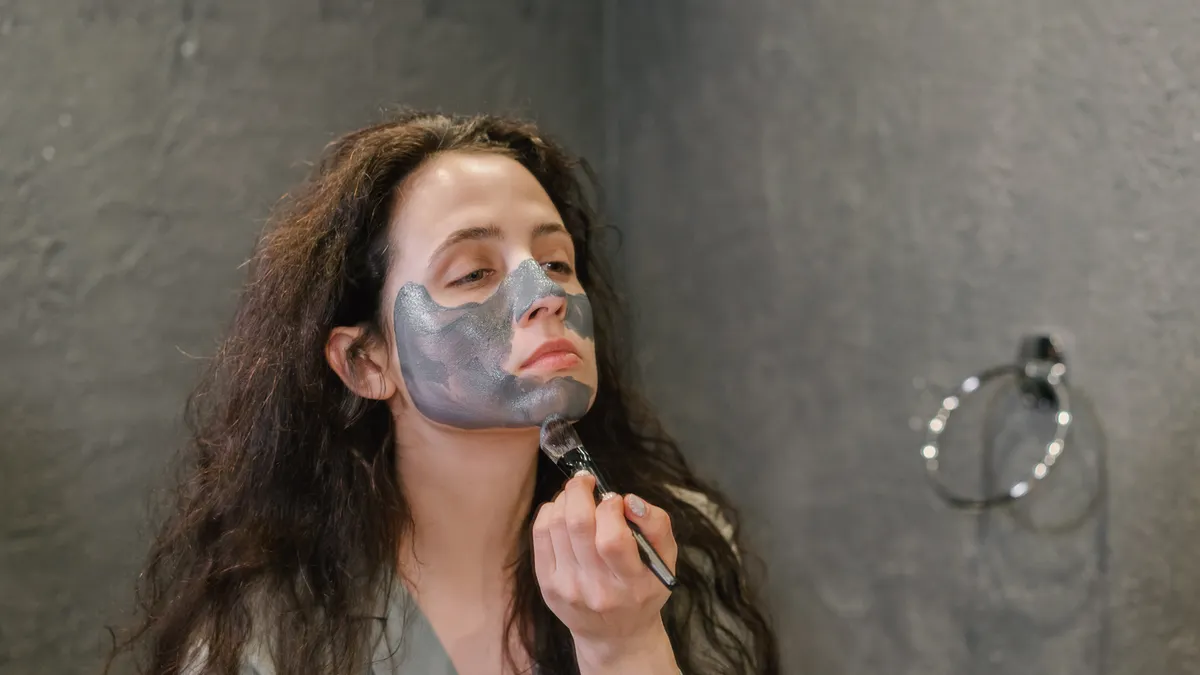
Because a leave-on face mask stays on skin for several hours, it needs to remain comfortable without turning greasy, tacky, or flaky. That matters more in a no-rinse routine than in a wash-off routine, because there is no sink step to fix a bad finish.
A good no-rinse mask leaves a thin layer, not a waxy coat. It should either sink in partly on its own or sit neatly under a light moisturizer without creating rolling or pilling. If you can feel it on the pillow after 10 minutes, the texture is probably too heavy for your routine.
This is where the label matters. Overnight masks and sleeping masks are designed to remain on skin while you sleep, while gel masks and cream masks describe texture. A product can be both a sleeping mask and a gel mask, or an overnight mask and a cream mask. That combination tells you more than a single marketing word.
For a shopper, the question is simple: do you want a mask that vanishes into a soft finish, or one that leaves a richer coating by morning? The first is easier for mixed or oily skin. The second is often better for skin that feels dry after shaving, but it may be too much under a heavy moisturizer.
Which texture fits your routine?
Therefore, the texture that fits your routine is the one that matches your moisturizer, your pillow time, and the finish you can live with. For how to choose a face mask for no-rinse routines, texture is the main filter because it controls residue more than the brand name does.
| Type | Best for | What it feels like | What to skip |
|---|---|---|---|
| Gel mask | Light finish, low residue, warm nights | Cool, slippery, quick to spread | Thick layers that stay wet for too long |
| Cream mask | Dry or tight skin, richer feel | Dense, cushioned, more occlusive | Very oily skin or a routine that already uses a heavy night cream |
| Sleeping mask | Overnight wear, simple routine | Designed to sit on skin for hours | Any formula that pills under your moisturizer |
| Overnight mask | Leave-on use with less fuss | Similar to sleeping masks, often richer | Routines that hate shine or transfer |
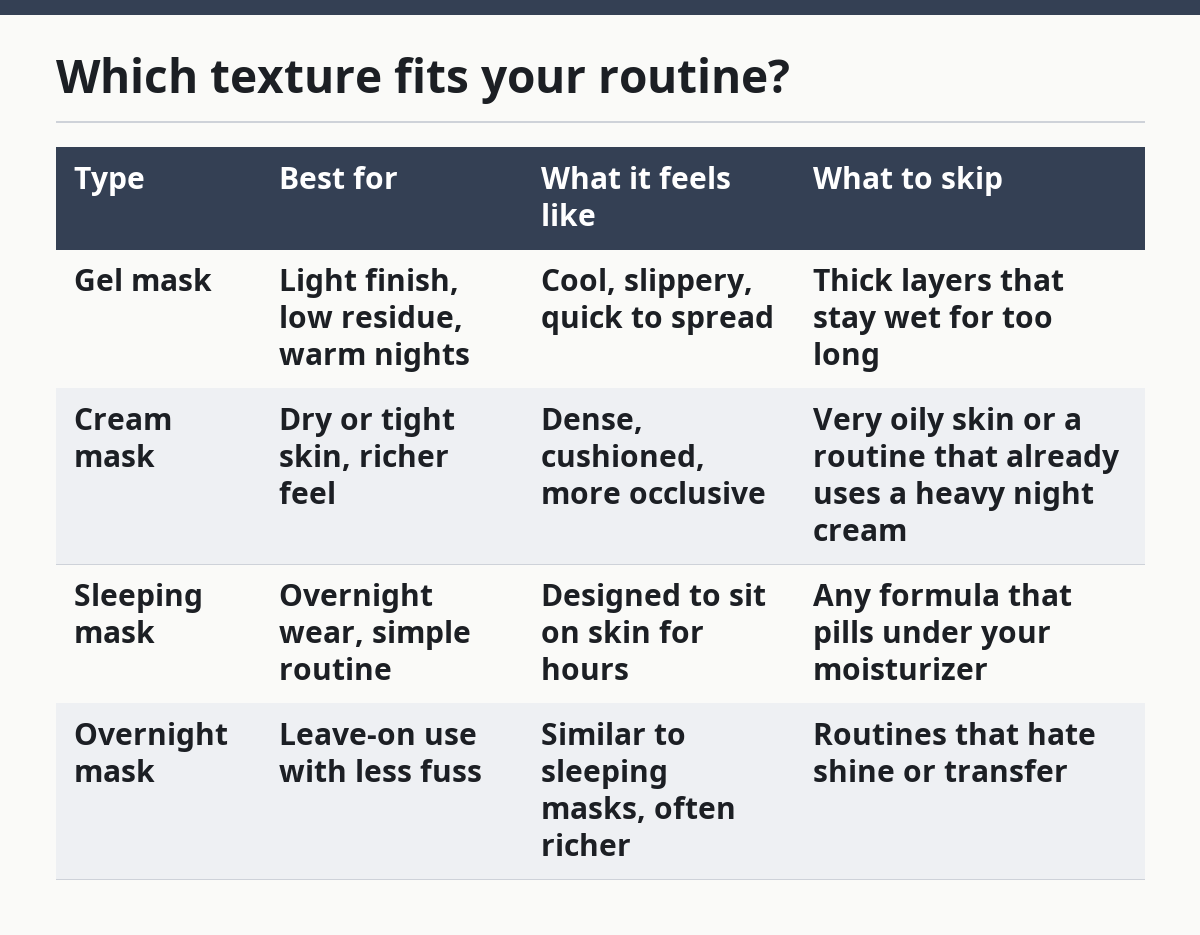
Gel masks usually suit a no-rinse routine best because they tend to feel lighter and leave less visible residue. Cream masks bring more slip and cushion, which can be useful if your skin feels rough or tight, but they are more likely to sit on top of the skin. Sleeping masks are a strong choice if the package clearly says they are meant for overnight wear, since that finish is built into the product.
The wrong choice is often obvious by the second use. If a gel dries sticky or a cream leaves a greasy sheen on the nose and chin, the mask is fighting your routine. If you already use a rich moisturizer, a heavy cream mask can double the residue and make your face feel coated by bedtime.
How do you read the label before buying?
Because you are buying for a no-rinse routine, you read the label by checking whether the product is truly leave-on, how it says to layer, and what finish it promises. A few words on the front can save you from buying a mask that belongs in the rinse-off category.
Start with the product type. If the package says sleeping mask, overnight mask, leave-on face mask, or no-rinse use, that is the signal you want. If it only says “mask” and the directions say to rinse after 10 to 15 minutes, it does not belong in this routine.
Then look for the texture claim. “Gel” usually points to a lighter feel; “cream” usually points to a richer one. A clay mask or peel-off mask is a poor match here because those are built to be removed, not worn to bed. A simple ingredient list is often less helpful than the use instructions, because the finish is what affects daily comfort.
One more label clue matters: layering language. If the box warns against using a moisturizer over it, or says it should be the last step, that tells you the formula is already doing a lot. That may be fine for a minimalist routine, but it is a warning sign if you like to add a night cream after masking.
In store, you can check the basics in about 30 seconds: leave-on or rinse-off, gel or cream, and whether it plays well with moisturizer.
How should you layer it with moisturizer?
You should layer a leave-on face mask after a light moisturizer only if the product instructions allow it and the finish stays comfortable. The goal is a smooth layer, not a thick stack of products.
A simple order works best for most no-rinse routines: cleanse, apply the mask in a thin layer, wait a few minutes, then decide whether you need moisturizer on top. If the mask already leaves a soft, cushioned finish, stop there. If your skin still feels dry after 5 to 10 minutes, a light moisturizer can go over it, but only in a small amount.
This is where gel masks and cream masks behave differently. A gel mask often accepts a light moisturizer without much drama. A cream mask can turn too heavy if you add another rich product on top. That is why a thick night cream and a thick sleeping mask are usually a bad pair; the finish can shift from nourishing to greasy fast.
The best layering test is not shine alone, but whether the surface feels stable after a few minutes. If the mask slides, pills, or leaves little rolls when you touch it, the stack is too much. Cut back to one product or switch to a lighter texture next time.
For more on layering rules, see the moisturizer layering guide and the overnight skincare routine basics.
A no-rinse routine works best when the final layer feels like skin, not frosting.
What finish should you expect by morning?
Ultimately, you should expect a finish that feels rested, not slick, and that does not transfer badly to your pillow. In a no-rinse routine, finish is the real proof that the mask belongs in your life.
Some masks dry down to a soft satin feel. Others stay dewy. A few stay glossy enough to bother anyone who sleeps on their side. None of those finishes is automatically wrong, but the wrong one for your routine becomes obvious when you wake up. If your face feels coated, your hairline looks shiny, or your pillowcase picks up residue, the mask is too rich or too sticky.
A good leave-on face mask should also respect the rest of your routine. If you shave and the skin already feels warm or sensitive, a heavy, heavily fragranced mask can make the finish feel worse, not better. A lighter gel or simple sleeping mask is often the cleaner fit because it reduces the chance of lingering tackiness.
Think of finish in three categories: invisible, dewy, and heavy. Invisible and light dewy finishes suit most no-rinse routines. Heavy finishes are only worth it if your skin truly wants that much occlusion and you do not mind residue.
If you want a mask you can forget about, do not chase the richest one on the shelf. Chasing richness is how a bedtime routine becomes a sticky one.
What should you skip?
Because residue is the whole issue in a no-rinse routine, you should skip any face mask that treats residue as an afterthought. If you are unsure whether a product is safe for your skin or causes irritation, consult a dermatologist or other qualified professional, and check guidance from the American Academy of Dermatology on choosing products for your skin type: https://www.aad.org/public/everyday-care/skin-care-basics/dry/how-to-select-skin-care-products
Skip rinse-off masks sold as “hydrating” if the directions still tell you to wash them away after 10 to 20 minutes. Skip clay masks, peel-off masks, and any product that hardens, because those are built for removal, not sleep. Skip formulas that are so fragranced or so thick that they sit like a film for hours. Those are the ones most likely to feel wrong on a pillow.
A second thing to skip is over-layering. A sleeping mask plus a heavy moisturizer plus an occlusive balm is usually too much for one face, even if each product looks gentle on paper. That combination can leave skin shiny at bedtime and grimy in the morning. If the mask is rich, let it be the final step.
The biggest trade-off is simple: richer masks can feel more comforting, but they also create more residue. Lighter masks are easier to live with, but they may not give the same cushioned feel. That is why no-rinse shoppers do better when they choose based on finish first and ingredient hype second.
If the package does not clearly say leave-on, sleeping, or overnight wear, leave it on the shelf.
Which no-rinse mask type fits your skin and habits?
The best no-rinse mask is the one that matches both your skin type and the way you sleep. A formula that seems ideal in the store can fail once it meets a humid room, a pillow, or a second layer of moisturizer.
Use this rule of thumb:
- Pick a gel mask if you want the least visible residue and a lighter bedtime feel.
- Pick a cream mask if your skin feels dry, tight, or easily uncomfortable without a richer layer.
- Pick a sleeping mask if you want a product that is clearly meant to stay on overnight.
- Pick an overnight mask if you want the simplest version of a leave-on routine and do not mind more occlusion.
For a no-rinse routine, I would rule out any mask that feels heavy within the first minute on skin. That is a bad sign for comfort later in the night. I would also rule out any formula that forces you to choose between comfort and a clean pillowcase. The best product should get close to giving you both.
The smartest shopping move is to start with the lightest version of the texture you think you need. If that fails to feel nourishing enough, move one step richer. Going straight to the thickest cream mask often creates the exact residue problem the no-rinse routine was meant to avoid.
For broader shopping help, the face mask shopping and selection hub can point you to the next decision after texture: how to compare formulas without guessing. See also the face mask types guide and the sleeping mask guide.
No-rinse routines reward restraint. The right leave-on face mask is the one that feels calm on skin, layers cleanly, and still looks decent when the lights go out.
Drafted with AI; not yet reviewed by a person.

Leave a Reply